The Book of the Dead, Plate 5 - 6
THE BOOK OF THE DEAD
The Papyrus of Ani
by
E. A. WALLIS BUDGE
Late keeper of Assyrian and Egyptian Antiquities
in the British Museum
[1895]
PLATES V AND VI.
Vignettes: The funereal procession to the tomb; running the length of the two plates. In the centre of Plate V. the mummy of the dead man is seen lying in a chest or shrine mounted on a boat with runners, which is drawn by oxen. In the boat, at the head and foot of the mummy, are two small models of Nephthys and Isis. By the side kneels Ani's wife Thuthu, lamenting. In front of the boat is the Sem priest burning incense in a censer, and pouring out a libation from a vase; he wears his characteristic dress, a panther's skin. Eight mourners follow. one of whom has his hair whitened. In the rear a sepulchral ark or chest surmounted. by a figure of Anubis and ornamented with emblems of "protection" and "stability," is drawn on a sledge by four attendants, and is followed by two others. By their side walk other attendants carrying Ani's palette, boxes, chair, couch, staff, etc.
In Plate VI. the procession is continued up to the tomb. In the centre is a group of wailing women, followed by attendants carrying on yokes boxes of flowers, vases of unguents, etc. In the right centre are a cow with her calf, chairs of painted wood with flowers upon them, and an attendant with shaven head, carrying a haunch, newly cut, for the funereal feast. The group on the right is performing the last rites. Before the door of the tomb stands the mummy of Ani to receive the final honours; behind him, embracing him, stands Anubis, the god of the tomb; and at his feet, in front, kneels Thuthu to take a last farewell of her husband's body. Before a table of offerings stand two priests: the Sem priest, who wears a panther's skin, holding in his right hand a libation vase, and in his left a censer; and a priest holding in his right hand an instrument with which he is about to touch the mouth and eyes of the mummy, and in his left the instrument for "opening the mouth." Behind or beside them on the ground, in a row, lie the instruments employed in the ceremony of "opening the mouth," etc., the mesxet instrument, the sepulchral box, the boxes of purification, the bandlet, the libation vases, the ostrich feather and the instruments called Seb-ur, Temanu or Tun-tet, and the Pesh-en-kef. The Kher-heb priest stands behind reading the service of the dead from a papyrus.
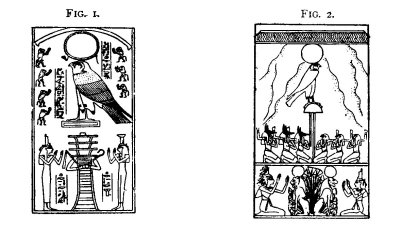
Appendix: In the papyrus of Hunefer a slab or stele with rounded top is placed by the door of the tomb (Fig. 1, p. 265). In the upper part of it the deceased is shown adoring Osiris, and below is the legend, "Hail, Osiris, the chief of Amenta, the lord of eternity, spreading out in everlastingness, lord of adorations, chief of the company of his gods; and hail, Anubis [dweller] in the tomb, great god, chief of the holy dwelling. May they grant that I may go into and come out from the underworld, that I may follow Osiris in all his festivals at the beginning of the year, that I may receive cakes, and that I may go forth into the presence of [Osiris]; I, the double (ka) of Osiris, the greatly favoured of his god, Hu-nefer." In the upper register of this section of the papyrus is the text of the "Chapter of opening the mouth of the statue of Osiris." The complete scene, including this stele and vignette, appears in the tomb of Pe-ta-Amen-Apt. In the vignette of the first chapter of the Book of the Dead in the papyrus of Neb-qet[1] the soul of the deceased is represented descending the steps of the tomb to carry food to its mummy in the underground chamber (Fig. 2).


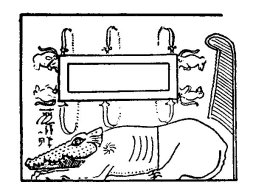
The ceremonies which took place at the door of the tomb in an Egyptian funeral are of considerable interest. The priest called Kher-heb, holding the Sem priest by the arm, gives directions for the slaughter of "a bull of the South." The slaughterer, standing on the bull, cuts off a fore-leg (Fig. 3) and takes out the heart. A woman, called the Tcherauur, who personifies Isis, then whispers in the deceased's ear, "Behold, thy lips are set in order for thee, so that thy mouth may be opened." Next, an antelope and a duck are brought by order of the Kher-heb, and their heads are cut off. The Kher-heb then addresses the Sem priest: "I have seized them for thee, I have brought unto thee thine enemies. His hands bring his head [as] his gift. I have slain them for thee, O Tmu; let not his enemies rise up against this god." The slaughterer then presents the thigh to the Kher-heb, and the heart to an official whose title was Smer, and all three then "place the thigh and the heart upon the ground before this god" (i.e., Osiris). The Kher-heb then says to the deceased, represented by his mummy or statue: I have brought unto thee the thigh (Fig. 4) as the Eye of Horus. I have brought unto thee the heart; let there be no rising up against this god. I have brought unto thee the antelope, his head is cut off; I have brought unto thee the duck, his head is cut off." Here the sacrifice ends.


The next part of the ceremony, i.e., "the opening of the mouth and eyes," is performed by the Sem priest, who addresses the deceased: "I have come to embrace thee, I am thy son Horus, I have pressed thy mouth; I am thy son, I love thee. His mother beats her breast and weeps for him, and those who are in chains with him (i.e., Isis and Nephthys) beat their breasts. Thy mouth was closed, but I have set in order for "thee thy mouth and thy teeth." The Kher-heb next calls on the Sem priest four times: "O Sem, take the Seb-ur (Fig. 5) and open the mouth and the eyes"; and while the Sem priest is performing the ceremony the Kher-heb continues: "Thy mouth was closed, but I have set in order for thee thy mouth and thy teeth. I open for thee thy mouth, I open for thee thy two eyes. I have opened for thee thy mouth with the instrument of Anubis. I have opened thy mouth with the instrument of Anubis, with the iron tool with which the mouths of the gods were opened. Horus, open the mouth, Horus, open the mouth. Horus hath opened the mouth of the dead, as he whilom opened the mouth of Osiris, with the iron which came forth from Set, with the iron tool (Fig. 6) with which he opened the mouths of the gods. He hath opened thy mouth with it. The dead shall walk and shall speak, and his body shall [be] with the great company of the gods in the Great House of the Aged one in Annu, and he shall receive there the ureret crown from Horus, the lord of mankind." The Kher-heb next says: "Let the Ami-Khent priest (Fig. 7) stand behind him (i.e., the deceased), and say, 'My father, my father,' four times." The eldest son of the deceased then stands behind the deceased, and in his name the Kher-heb says: "His mother beateth her breast and weepeth for him, and those who are in chains with him also beat their breasts." Another priest, called Am-Khent-Heru, takes up the same position and says: "Isis goeth unto Horus, who embraceth his father." A priestly official belonging to the mesenti class then goes behind the deceased, and the Sem, Smer and Kher-heb priests stand in front, and the Sem priest and the Kher-heb, personifying Horus and Sut, respectively cry: "I am Horus, I am Sut; I will not let thee illumine the head of my father." The Sem priest then leaves the Ka-chapel and returns, leading in the Se-mer-f, i.e., "the son who loveth him"; whereupon the Kher-heb says: "O Sem, let the Se-mer-f come into the tomb in order that he may see the god." The Sem priest holding him by the arm then leads forward the Se-mer-f, who addresses the deceased: "I have come, I have brought unto thee thy son who loveth thee; he shall open for thee thy mouth and thine eyes." (Fig. 8). A tomb-official, Am-as, then takes up his position behind the deceased, and the Se-mer-f and the Kher-heb stand in front; the Kher-heb repeating four times: "The Se-mer-f openeth the mouth and the two eyes of the deceased, first with a needle of iron, then with a rod of smu metal"; the Am-as addressing the deceased: "Behold the Se-mer-f"; and the Kher-heb saying, in the name of the Se-mer-f: "I have pressed for thee thy mouth, even as thy father pressed it in the name of Seker. Hail, Horus hath pressed thy mouth for thee, he hath opened thine eyes for thee; Horus hath opened thy mouth for thee, he hath opened for thee thine eyes; they are firmly stablished. Thy mouth was closed; I have ordered thy mouth and thy teeth for thee in their true order. Thou hast [again] opened thy mouth; Horus hath opened thy mouth. I have stablished thy mouth firmly. Horus hath opened for thee thy mouth, Horus hath opened for thee thy two eyes." The Kher-heb then speaks on behalf of the Sem priest: "Thy mouth was closed up. I have ordered aright for thee thy mouth and thy teeth. Thy mouth is firmly stablished. Thy mouth was tightly closed. His mouth is firmly stablished, and [his] two eyes are firmly stablished." The Sem priest next presents to the deceased (Fig. 9) a cone-shaped offering, and at the same time the Kher-heb says: "Open the mouth and the two eyes, open the mouth and the two eyes. Thou hadst tightly closed thy mouth, thou hast [again] opened thy two eyes." Then the Kher-heb says, on behalf of the Smer (Fig. 10) priest who stands behind the deceased:


"One cometh unto thee for thy purification." Next the Se-mer-f comes forward with four boxes (Fig. 11) in his hands, and the Kher-heb says: "O se-mer-f, take the four boxes of purification, press the mouth and the two eyes, and open the mouth and the two eyes with each of them four times, and say, 'Thy mouth and thy two eyes are firmly stablished, and they are restored aright,' and say also, 'I have firmly pressed thy mouth, I have opened thy mouth, I have opened thy two eyes by means of the four boxes of purification."' The Sem priest then approaches the deceased (Fig. 12) with the instrument ###, and the Kher-heb at the same time says: "O Sem priest, lay the pesh-en-kef upon his mouth, and say, 'I have stablished for thee thy two jaw-bones in thy face which was divided into two parts.'" The Sem priest next makes an offering of grapes (Fig. 13), the Kher-heb saying: "O Sem priest, place the grapes upon his mouth and say, 'He bringeth to thee the eye of Horus, he graspeth it; do thou also grasp it.'" After an ostrich feather has been offered (Fig. 14) by the Sem priest, and a number of the ceremonies described above have been repeated, and other animals slaughtered, the Kher-heb addresses the Sem priest, and says: "Take the instrument Tun-tet (thrice) and open the mouth and the eyes" (four times). He then continues: "O Sem priest, take the iron instrument of Anubis, Tun-tet (thrice). Open the mouth and the two eyes (four times), and say, 'I open for thee thy mouth with the iron instrument of Anubis with which he opened the mouths of the gods. Horus openeth the mouth, Horus openeth the mouth, Horus openeth the mouth with the iron which cometh forth from Set, wherewith he hath opened the mouth of Osiris. With the iron tool (meskhet) wherewith he opened the mouths of the gods doth he open the mouth. He [the deceased] shall go in and he shall speak [again], and his body shall dwell with the company of the great gods in Annu, wherein he hath received the ureret crown from Horus, lord of men. Hail, Horus openeth thy mouth and thy two eyes with the instrument Seb-ur or Teman, with the instrument Tun-tet of the Opener of the Roads (i.e., Anubis) wherewith he opened the mouth of all the gods of the North. Horus the Great cometh to embrace thee. I, thy son who loveth thee, have opened thy mouth and thy two eyes. His mother beateth her breast in grief while she embraceth him, and the two sisters (i.e., Isis and Nephthys), who are one, strike themselves in grief. All the gods open thy mouth according to the book of the service."' The Kher-heb next instructs the Sem priest to clothe the mummy or statue of the deceased with the nemes band or fillet (Fig. 15), and to say: "Lo! the nemes fillet, the nemes fillet, which cometh as the light, which cometh as the light; it cometh as the eye of Horus, the brilliant; it cometh forth from Nekheb. The gods were bound therewith; bound round is thy face with it in its name of Hetch (i.e., light, or brilliance), coming forth from Nekheb. "All that could do harm to thee upon earth is destroyed." The Sem priest, holding a vase of ointment in his left hand, and smearing the mouth with his fore-finger (Fig. 16), says: "I have anointed thy face with ointment, I have anointed thine eyes. I have painted thine eye with uatch and with mestchem. May no ill-luck happen through the dethronement of his two eyes in his body, even as no evil fortune came to Horus through the overthrow of his eye in his body. Thy two eyes are decked therewith in its name of Uatch, which maketh thee to give forth fragrance, in its name of "Sweet-smelling." A number of scented unguents and perfumes are brought forward, and at the presentation of each a short sentence is recited by the Kher-heb having reference to the final triumph of the deceased in the underworld and to the help which the great gods will render to him.


Text: [Chapter I. HERE BEGIN THE CHAPTERS OF COMING FORTH BY DAY, AND OF THE SONGS OF PRAISE AND GLORIFYING, AND OF COMING FORTH FROM AND GOING INTO THE GLORIOUS NETER-KHERT IN THE BEAUTIFUL
AMENTA; TO BE SAID ON THE DAY OF THE BURIAL: GOING IN AFTER COMING FORTH. Osiris Ani, Osiris, the scribe Ani, saith: "Homage to thee, O bull of Amenta, Thoth the king of eternity is with me. I am the great god in the boat of the Sun; I have fought for thee. I am one of the gods, those holy princes who make Osiris to be victorious over his enemies on the day of weighing of words. I am thy mediator, O Osiris. I am [one] of the gods born of Nut, those who slay the foes of Osiris and hold for him in bondage the fiend Sebau. I am thy mediator, O Horus. I have fought for thee, I have put to flight the enemy for thy name's sake. I am Thoth, who have made Osiris victorious over his enemies on the day of weighing of words in the great House of the mighty Ancient One in Annu. I am Tetteti, the son of Tetteti; I was conceived in Tattu, I was born in Tattu. I am with those who weep and with the women who bewail Osiris in the double land (?) of Rechtet; and I make Osiris to be victorious over his enemies. Ra commanded Thoth to make Osiris victorious over his enemies; and that which was bidden for me Thoth did. I am with Horus on the day of the clothing of Teshtesh and of the opening of the storehouses of water for the purification of the god whose heart moveth not, and of the unbolting of the door of concealed things in Re-stau. I am with Horus who guardeth the left shoulder of Osiris in Sekhem, and I go into and come out from the divine flames on the day of the destruction of the fiends in Sekhem. I am with Horus on the day of the festivals of Osiris, making the offerings on the sixth day of the festival, [and on] the Tenat festival in Annu. I am a priest in Tattu, I Rere (?) in "the temple of Osiris, [on the day of] casting Up the earth. I see the things which are concealed in Re-stau. I read from the book of the festival of the Soul [which is] in Tattu. I am the Sem priest, and I perform his course. I am the great chief of the work on the day of the placing of the hennu boat of Seker upon its sledge. I have grasped the spade on the day of digging the ground in Suten-henen. O ye who make perfected souls to enter into the Hall of Osiris, may ye cause the perfected soul of Osiris, the scribe Ani, victorious [in the Hall of Double Truth], to enter with you into the house of Osiris. May he hear as ye hear; may he see as ye see; may he stand as ye stand; may he sit as ye sit!
"O ye who give bread and ale to perfected souls in the Hall of Osiris, give ye bread and ale at the two seasons to the soul of Osiris Ani, who is victorious before all the gods of Abtu, and who is victorious with you.
"O ye who open the way and lay open the paths to perfected souls in the Hall of Osiris, open ye the way and lay open the paths to the soul of Osiris, the scribe and steward of all the divine offerings, Ani [who is triumphant] with you. May he enter in with a bold heart and may he come forth in peace from the house of Osiris. May he not be rejected, may he not be turned back, may he enter in [as he] pleaseth, may he come forth [as he] desireth, and may he be victorious. May his bidding be done in the house of Osiris; may he walk, and may he speak with you, and may he be a glorified soul along with you. He hath not been found wanting there, and the Balance is rid of [his] trial."
Appendix: After the First Chapter M. Naville has printed in his Todtenbuch the text of a composition which also refers to the funeral, and which he has designated Chapter 1B. It is entitled "Chapter of making the mummy to go into the underworld on the day of the funeral." The text is, however, mutilated in places; and the following version has been made by the help of the two copies of the text published by Pleyte, Chapitres Supplentaires au Livre des Morts, p. 182 ff.; and by Birch, Proc. Soc. Bibl. Arch., 1885, p. 84 f.
[Chapter IB.] " Homage to thee, O thou who livest in Set-Sert of Amenta. Osiris the scribe Nekht-Amen, triumphant, knoweth thy name. Deliver thou him from the worms which are in Re-stau, and which feed upon the bodies of men and drink their blood. Osiris, the favoured one of his divine city, the royal scribe Nekht-Amen, triumphant, is known unto you [ye worms] and he knoweth your names. This is the first bidding of Osiris, the Lord of All, who hath completed all his hidden works: 'Give thou breath [unto them] who fear those who are in the Bight of the Stream of Amenta.' He hath ordered the plans of . . . . . . . . . . . His throne is placed within the darkness, and there is given unto him glory in Re-stau. O god of light, come thou down unto me and swallow up the worms which are in Amenta, The great god who dwelleth within Tattu, whom he seeth not, heareth his prayers. They who are in affliction fear him [the god] who cometh forth with the sentence at the sacred block. Osiris, the royal scribe Nekht-Amen, cometh with the decree of the Lord of All, and Horus hath taken possession of his throne for him. He cometh with tidings; [may he enter in] according to his word and may he see Annu. The nobles have stood up on the ground before him, and the scribes magnify him. The princes bind his swathings, and make festivals for him in Annu. For him hath heaven been led captive; he hath seized the inheritance of the earth in his grasp. Neither heaven nor earth can be taken away from him, for, behold, he is Ra, the first-born of the gods. His mother suckleth him, she giveth her breast from the sky."
[Rubric.] The words of this chapter are to be said after [the deceased] is laid to rest in Amenta, etc.
Text: [Chapter XXII.] CHAPTER OF GIVING A MOUTH TO OSIRIS ANI, THE SCRIBE AND TELLER OF THE HOLY OFFERINGS OF ALL THE GODS. MAY HE BE VICTORIOUS IN NETER-KHERT! "I rise out of the egg in the hidden land. May my mouth be given unto me that I may speak with it before the great god, the lord of the underworld. May my hand and my arm not be forced back by the holy ministers of any god. I am Osiris, the lord of the mouth of the tomb; and Osiris, the victorious scribe Ani, hath a portion 3 with him who is upon the top of the steps. According to the desire of my heart, I have come from the Pool of Fire, and I have quenched it. Homage to thee, O thou lord of brightness, thou who art at the head of the Great House, and who dwellest in night and in thick darkness; I have come unto thee. I am glorious, I am pure; my arms support thee. Thy portion shall be with those who have gone before. O grant unto me my mouth that I may speak therewith; and that I may follow my heart when it passeth through the fire and darkness."
[Rubric of Chapter LXXII.] If this writing be known [by the deceased] upon earth, and this chapter be done into writing upon [his] coffin, he shall come forth by day in all the forms of existence which he desireth, and he shall enter into [his] place and shall not be rejected. Bread and ale and meat shall be given unto Osiris, the scribe Ani, upon the altar of Osiris. He shall enter into the Fields of Aaru in peace, to learn the bidding of him who dwelleth in Tattu; there shall wheat and barley be given unto him; there shall he flourish as he did upon earth; and he shall do whatsoever pleaseth him, even as [do] the gods who are in the underworld, for everlasting millions of ages, world without end.
Appendix: The text of Chapter LXXII. does not occur in the Papyrus of Ani. It is given by M. Naville (see Todtenbuch, I., Bl. 84) from, a papyrus in the Louvre. In the vignettes which accompany it, the deceased is represented as adoring three gods, who are either standing in a shrine or are seated upon it. In other instances, the deceased stands by a sepulchral chest or outside a pylon with hands raised in adoration. The following is a translation of the Louvre text:--
CHAPTER OF COMING FORTH BY DAY AND OF PASSING THROUGH THE AMMAHET. "Homage to you, O ye lords of kas, ye lords of right and truth, infallible, who shall endure for ever and shall exist through countless ages, grant that 1 may enter into your [presence]. I, even I, am pure and holy, and I have gotten power over the spells which are mine. judgment hath been passed upon me in my glorified form. Deliver ye me from the crocodile which is in the place of the lords of right and truth. Grant ye unto me my mouth that I may speak therewith. May offerings be made unto me in your presence, for I know you and I know your names, and I know the name of the great god. Grant ye abundance of food for his nostrils. The god Rekem passeth through the western horizon of heaven. He travelleth on, and I travel on he goeth forth, and I go forth. Let me not be destroyed in the place Mesqet let not the Fiend get the mastery over me; let me not be driven back from your gates; let not your doors be shut against me; for I have [eaten] bread in Pe and I have drunken ale in Tepu. If my arms be fettered in the holy habitation, may my father Tmu stablish for me my mansion in the place above [this] earth where there are wheat and barley in abundance which cannot be told. May feasts be made for me there, for my soul and for my body. Grant me even offerings of the dead, bread, and ale, and wine, oxen, and ducks, linen bandages and incense, wax, and all the good and fair and pure things whereby the gods do live. May I rise again in all the forms which I desire without fail and for ever. May I sail up and down through the fields of Aaru; may I come thither in peace; for I am the double Lion-god."
- Published in The Book of Dead
- 0