log in
The Popol Vuh

The Popol Vuh (252)

The Popol Vuh

The Sacred Book of The Mayas

The Book of The Community

English Version by

Delia Goetz and Sylvanus G. Morley

( 1950 by the University of Oklahoma Press)

Translation by Adri Recinos


Children categories

The Alexiad

The Alexiad (18)

The Alexiad

by

Anna Comnena (Komnene)

Edited and translated by Elizabeth A. Dawes.

London: Routledge, Kegan, Paul, 1928.


View items...
Famous Men of the Middle Ages

Famous Men of the Middle Ages (35)

Entry of the Crusaders into Jerusalem, by Eugene Delacroix [1840] (Public Domain Image)

Famous Men of

the Middle Ages

BY JOHN HENRY HAAREN, LL.D.

District Superintendent of Schools

The City of New York

and A. B. POLAND, Ph.D.

Superintendent of Schools
Newark, N.J.

AMERICAN BOOK COMPANY
NEW YORK * CINCINNATI * CHICAGO

1904


Scanned and proofed by Eliza Yetter, March 2007. HTML Formatting by John Bruno Hare at sacred-texts.com. This text is in the public domain in the United States because it was published prior to January 1st, 1923. These files may be used for any purpose without restriction.


View items...
From Goddess to King

From Goddess to King (30)

FROM GODDESS TO KING

A History of Ancient Europe from the

OERA LINDA BOOK

By Anthony Radford

1997 Ojai, California

With thanks to Anthony Radford for his permission to publish his book

©1997 Anthony Radford, all rights reserved.


View items...
The Origin and deeds of the Goths

The Origin and deeds of the Goths (10)

THE ORIGIN AND DEEDS OF THE GOTHS

551 AD

JORDANES

translated by Charles C. Mierow

Princeton University Press, 1915


View items...
The Mysteries of Mithra

The Mysteries of Mithra (9)

THE MYSTERIES OF MITHRA

by Franz Cumont

translated from the second revised French edition by Thomas J. McCormack

Chicago, Open Court

[1903]

Scanned at sacred-texts.com, February, 2003. J.B. Hare, redactor. This text is in the public domain. This file may be used for any non-commercial purpose provided this attribution is left intact.

 
View items...
The Oera Linda Book

The Oera Linda Book (11)

The Oera Linda Book

Written in 1256 AD, from a diary
which was put together 560-558 BC.

from the Original Frisian text

verified by Dr. Ottema

by :

William R. Sandbach

Londen, Trubner & Co, 1876

oera-linda-front

Frontpage of the Dutch translation of the Oera Linda Book (1876)

oera-linda-front

Page 45 from the Oera Linda Manuscript


View items...
Pagan Regeneration

Pagan Regeneration (11)

PAGAN REGENERATION

A STUDY OF MYSTERY INITIATIONS IN THE GRAECO-ROMAN WORLD

BY HAROLD R. WILLOUGHBY

[b. 1890 d. 1962]

Chicago., Ill., The University of Chicago Press

[1929, copyright not renewed]

Scanned and proofed by Eliza Fegley, sacredspiral.com, June 2003. Additional formatting and proofing by J. B. Hare, sacred-texts.com. This text is in the public domain in the United States because it was not renewed in a timely fashion at the US copyright office. These files may be used for any non-commercial purpose, provided this notice of attribution is left intact.

 
View items...
The Secret Hystory

The Secret Hystory (34)

The Secret History

by

Procopius of Caesarea

translated by Richard Atwater

(Chicago: P. Covici, 1927 New York Covici Friede 1927)

Reprinted, Ann Arbor, MI: University of Michigan Press, 1961, with indication that copyright had expired on the text of the translation.

 
View items...
Teutonic Myth and Legend

Teutonic Myth and Legend (47)

Freyja [Public domain image]

TEUTONIC MYTH

AND LEGEND

by Donald A. Mackenzie

An Introduction to the Eddas & Sagas, Beowulf, The Nibelungenlied, etc.

[1912?]

This is Donald Mackenzie's able retelling of the Northern mythological cycle. He weaves a coherent narrative from the Eddas, the Niebelunglied, the Volsung Saga, Beowulf, the primordial Hamlet myths, and Medieval German tales of chivalry. MacKenzie also wrote Egyptian Myth and Legend and Myths of Crete and Pre-Hellenic Europe.


View items...
Caesar's Commentaries on the Gallic and Civil Wars

Caesar's Commentaries on the Gallic and Civil Wars (16)

Julius Caesar

Caesar's Commentaries on the Gallic and Civil Wars

With the Supplementary Books attributed to Hirtius

Including the Alexandrian, African and Spanish Wars

Translator W. A. Mc.Devitte Translator W. S. Bohn

1st Edition.

Harper & Brothers New York 1869

Harper's New Classical Library

Authorship information:

Suetonius (Suet.12 Caes. Julius.56), in his biography of Julius Caesar states that the Gallic and Civil Wars were written by Caesar, and that the 8th book of the Gallic Wars was written by (Aulus) Hirtius. Suetonius also indicates that either Caesar's friend Oppius, or Hirtius likely wrote about the Alexandrian, African and Spanish wars, but that their authorship was not certain.


View items...

From Goddess to King, Biblography

FROM GODDESS TO KING

A History of Ancient Europe from the

OERA LINDA BOOK

By Anthony Radford

BIBLIOGRAPHY

  • A. G. Gallanopoulos & Edward Bacon Atlantis, The Truth Behind the Legend, Indianapolis: Bobbs-Merrill.
  • Barbara Hand Clow Signet of Atlantis, Bear & Co. Santa Fe, New Mexico.
  • Carolyn McVickar Edwards The Storyteller's Goddess, Harper Collins, San Francisco.
  • Chester S. Chard Man in Prehistory Mcgraw-hill Book Co. New York.
  • Cyril Aldred Egypt to the End of the Old Kingdom. Thames and Hudson Ltd, London.
  • Dorothy B. Vitaliano Legends of the Earth The Citadel Press, Secaucus, New Jersey.
  • Ernestene L. Green In Search of Man Little, Brown & Co., Boston.
  • Frances E. Sabin Classical Myths that Live Today Silver Burdett Co. New York.
  • Herbert Wendt In Search of Adam Houghton Mifflin Co. Boston.
  • Homer, T. A. Buckley translation Charles E. Merrill Co.
  • Immanuel Velikovsky Ages in Chaos Doubleday & Company, Inc. New York.
  • James G. Frazer The New Golden Bough Criterion Books, New York.
  • John E. Pfeiffer The Emergence of Man Harper & Row, New York.
  • Jurgen Spanuth Atlantis - The Mystery Unravelled Arco Publishers Limited, London.
  • L. Sprague de Camp Lost Continents Dover Publications, Inc. New York.
  • Larousse Encyclopaedia of Mythology Auge, Gillon,
  • Hollier-Larouse, Moreau et Cie.
  • M.S. Miller, J. L. Miller Harper's Bible Dictionary Harper & Brothers, New York.
  • Norbert Guterman Russian Fairy Tales Pantheon Books Inc, New York.
  • Philippe Diole 4,000 Years Under the Sea, Sidwick & Jackson Ltd. London.
  • Robert Graves The Greek Myths, The White Goddess
  • George Braziller, Inc. New York.
  • Robert Scrutton The Other Atlantis Sphere Books, London.
  • The New Encyclopaedia Britannica Benton, Publisher, Chicago.
  • Thor Heyerdahl The Tigris Expedition Doubleday & Company, Inc. New York.
  • William R. Sandbach Oera Linda Book 1876
  • Thet Oera Linda Bok, Dr. J. G. Ottema, Friesland, 1872. English translation.
  • Zecharia Sitchin The Stairway to Heaven Avon Books, New York.

From Goddess to King, Appendix B, ADDRESS TO THE FRIESLAND SOCIETY, 1871

FROM GODDESS TO KING

A History of Ancient Europe from the

OERA LINDA BOOK

By Anthony Radford

APPENDIX B

ADDRESS TO THE FRIESLAND SOCIETY, 1871

The preface of Dr. Ottemas original modern publication of the Oera Linda Book that was read at a meeting of the Friesland Society, February, 1871.

Over de Linden, Chief Superintendent of the Royal Dockyard at the Helder, possesses a very ancient manuscript which has been inherited and preserved in his family from time immemorial, without anyone knowing whence it came or what it contained, owing to both the language and the writing being unknown.

All that was known was that a tradition contained in it had from generation to generation been recommended to careful preservation. It appeared that the tradition rests upon the contents of two letters, with which the manuscript begins, from Hiddo oera Linda, anno 1256, and from Liko Oera Linda, anno 803. It came to C. over de Linden by the directions of his grandfather, Den Heer Andries over de Linden, who lived at Enkhuizen, and died there on the 15thof April 1820, aged sixty-one. As the grandson was at that time barely ten years old, the manuscript was taken care of for him by his aunt, Aafjie Meylhoff, born Over de Linden, living at Enkhuizen, who in August 1848 delivered it to the present possessor.

Dr. E. Verwijs having heard of this, requested permission to examine the manuscript, and immediately recognized it as very ancient Fries. He obtained at the same time permission to make a copy of it for the benefit of the Friesland Society, and was of the opinion that it might be of great importance, provided it was not suppositious, and invented for some deceptive object, which he feared. The manuscript being placed in my hands, I also felt very doubtful, though I could not understand what object any one could have in inventing a false composition only to keep it a secret. This doubt remained until I had examined carefully executed facsimiles of two fragments, and afterwards of the whole manuscript - the first sight of which convinced me of the great age of the document.

Immediately occurred to me Caesars remark upon the writings of the Gauls and the Helvetians in his `Bello Gallico (i. 29, and vi. 14), `Graecis utuntur literis, though it appears in v. 48 that they were not entirely Greek letters. Caesar thus points out not only a resemblance - and a very true one - as the writing, which does not altogether correspond with any known form of letters, resembles the most, on a cursory view, the Greek writing, such as is found on monuments and the oldest lapidary. Besides, I formed the opinion afterwards that the writer of the latter part of the book had been a contemporary of Caesar.

The form and the origin of the writing is so minutely and fully described in the first part of the book, as it could not be in any other language. It is very complete, and consists of thirty-four letters, among which are three separate forms of a and u, and two of e, i, y, and o, besides four pairs of double constants - ng, th, ks, and gs. The ng, which as a nasal sound has no particular mark in any western language, is an indivisible conjunction; the th is soft, as in English, and is sometimes replaced by d; the gs is seldom met with - I believe only in the word segse, to say, in modern Fries sidse, pronounced sisze.

The paper, of large quarto size, is made of cotton, not very thick, without watermark or makers mark, made upon a frame or wire-web, with not very broad perpendicular lines.

An introductory letter gives the year 1256 as that in which this manuscript was written by Hiddo overa Linda on foreign paper. Consequently it must have come from Spain, where Arabs brought into the market paper manufactured from cotton.

On this subject, W. Wattenbach writes in his `Das Schriftwesen im Mittelalter (Leipzig, 1871), s. 93:

`The manufacture of paper from cotton must have been in use among the Chinese from very remote times, and must have become known to the Arabs by the conquest of Samarkand about the year 704. In Damascus this manufacture was an important branch of industry, for which reason it was called Charta Damascena. By the Arabians this art was brought to the Greeks. It is asserted that Greek manuscripts of the tenth century written upon cotton paper exist, and that in the thirteenth century it was much more used than parchment. To distinguish it from Egyptian paper it was called Charta bombicina, gossypina, cuttunea, xylina. A distinction from linen paper was not necessary. In the manufacture of cotton paper raw cotton was originally used. We first find paper from rags mentioned by Petrus Clusiacensis (1122-50).

`The Spaniards and the Italians learned the manufacture of this paper from the Arabians. The most celebrated factories were at Jativa, Valencia, Toledo, besides Fabriano in the March of Ancona.

In Germany the use of this material did not become very extended, whether it came from Italy or Spain. Therefore the further this preparation spread from the East and the adjoining countries, the more the necessity there was that linen should take the place of cotton. A document of Kaubeuren on linen paper of the year 1318 is of very doubtful genuineness. Bodman considers the oldest pure linen paper to be of the year 1324, but up to 1350 much mixed paper was used. All carefully written manuscripts of great antiquity show by the regularity of their lines that they must have been ruled, even though no traces of the ruled lines can be distinguished. To make the lines they used a thin piece of lead, a ruler, and a pair of compasses to mark the distances.

In old writings the ink is very black or brown; but while there has been more writing since the thirteenth century, the color of the ink is often gray or yellowish, and sometimes quite pale, showing that it contains iron. All this affords convincing proof that the manuscript before us belongs to the middle of the thirteenth century, written with clear black letters between fine lines carefully traced with lead. The color of the ink shows decidedly that it does not contain iron. By these evidences the date given, 1256, is satisfactorily proved, and it is impossible to assign any later date. Therefore all suspicion of modern deception vanishes.

The language is very old Fries, still older and purer than the Fries Rjuchtboek or old Fries laws, differing from that both in form and spelling, so that it appears to be an entirely distinct dialect, and shows that the locality of the language must have been (as it was spoken) between the Vlie and the Scheldt.

The style is extremely simple, concise, and unembarrassed, resembling that of ordinary conversation, and free in the choice of words. The spelling is also simple and easy, so that the reading of it does not involve the least difficulty, and yet with all its regularity, so unrestricted, that each of the separate writers who have worked at the book has his own peculiarities, arising from the changes in pronunciation in a long course of years, which naturally must have happened, as the last part of the work is written five centuries after the first.

As a specimen of antiquity in language and writing, I believe I may venture to say that this book is unique of its kind.

The writing suggests an observation, which may be of great importance.

The Greeks know and acknowledge that their writing was not their own invention. They attribute the introduction of it to Kadmus, a Phoenician. The names of their oldest letters, from Alpha to Tau, agree so exactly with the names of the letters in the Hebrew alphabet, with which the Phoenician will have been nearly connected, that we cannot doubt that the Hebrew was the origin of the Phoenician. But the form of their letters differs so entirely from that of the Phoenician and Hebrew writing, that in that particular no connection can be thought of between them. Whence, then, have the Greeks derived the form of their letters?

From `thet bok tha Adela folstar (`The Book of Adelas Followers we learn that in the time when Kadmus is said to have lived, about sixteen centuries before Christ, a brisk trade existed between the Frisians and the Phoenicians, whom they named Kadhemer, or dwellers on the coast.

The name Kadmus comes too near the word Kadhemer for us not to believe that Kadmus simple meant a Phoenician.

Further on we learn that about the same time a priestess of the castle in the island of Walcheren, Min-erva, also called Nyhellenia, had settled in Attica at the head of a Frisian colony, and had founded a castle at Athens. Also, from the accounts written on the walls of Waraburgt, that the Finns likewise had a writing of their own - a very troublesome and difficult one to read - and that, therefore, the Tyrians and the Greeks had learned the writing of Frya. By this representation the whole thing explains itself, and it becomes clear whence comes the exterior resemblance between the Greek and the old Fries writing, which Caesar also remarked among the Gauls; as likewise in what manner the Greeks acquired and retained the names of the Finn and the forms of the Fries writing.

Equally remarkable are the forms of their figures. We usually call our figures Arabian, although they have not the least resemblance to those used by the Arabs. The Arabians did not bring their ciphers from the East, because the Semitic nations used the whole alphabet in writing numbers. The manner of expressing all numbers by ten signs the Arabs learned in the West, though the form was in some measure corresponding with their writing, and was written from left to right, after the Western fashion. Our ciphers seem here to have sprung from the Fries ciphers (siffar), which form had the same origin as the handwriting and is derived from the lines of the Juul?

The book as it lies before us consists of two parts, differing widely from each other, and of dates very far apart. The writer of the first part calls herself Adela, wife of Apol, chief man of the Linda country. This is continued by her son Adelbrost, and her daughter Apollonia. The first book, running from page 1 to 88, is written by Adela. The following part, from 88 to 94, is begun by Adelbrost and continued by Apollonia. The second book, running from page 94 to 114, is written by Apollonia. Much later, perhaps two hundred and fifty years, a third book is written, from page 114 to 134, by Frethorik; then follows from page 134 to 143, written by his widow, Wiljo; after that from page 144 to 169, by their son, Konered; and then from page 169 to 192 by their grandson, Beeden (a doubtful assumption). Pages 193 and 194, with which the last part must have begun, are wanting, therefore the writer is unknown. He must have been a son of Beeden.

On page 134, Wiljo makes mention of another writing of Adela. These she names `thet bok tha sanga (theta boek) tha tellinga, and `thet Hellia bok; and afterwards `tha skrifta fon Adela jeftha Hellia.

To fix a date we must start from the year 1256 of our era, when Hiddo overa Linda made a copy, in which he says that it was 3449 years after Atland was sunk. This disappearance of the old land (aldland, atland) was known by the Greeks, for Plato mentions in his `Timaeus, 24, the disappearance of Atlantis, the position of which was only known as somewhere far beyond the Pillars of Hercules. From this writing it appears that the land stretching far out to the west of Jutland, of which Helgoland and the islands of North Friesland are the last barren remnants. This event, which occasioned a great dispersion of the Frisian race, became the commencement of a chronological reckoning corresponding with 2193 before Christ, and is known by geologists as the Cimbrian flood.

On page 80 begins an account in the year 1602, after the disappearance of Atland, and thus in the year 591 before Christ; and on page 82 is the account of the murder of Frana, `Eeremoeder, of Texland, two years later - that is, in 589. When, therefore, Adela commences her writing with her own coming forward in an assembly of the people thirty years after the murder of the Eeremoeder, that must have been the year 559 before Christ. In the part written by her daughter Apollonia, we find that fifteen months after the assembly Adela was killed by the Finns in an attack by surprise of Texland. This must accordingly have happened 557 years before Christ. Hence it follows that the first book, written by Adela, was of the year 558 before Christ. The second book, by Apollonia, we may assign to the year 530 before Christ. The later part contains the history of the known kings of Friesland, Friso, Adel (Ubbo), and Asega Askar, called Black Adel. Of the third king, Ubbo, nothing is said, or rather that part is lost, as the pages 169 to 188 are missing. Frethorik, the first writer, who appears now, was a contemporary of the occurrences, which he relates, namely, the arrival of Friso. He was a friend of Liudgert den Geertman, who, as rear admiral of the fleet of Wichhirte, the sea-king, had come with Friso in the year 303 before Christ, 1,890 years after the disappearance of Atland. He has borrowed most of his information from the logbook of Liudgert.

The last writer gives himself out most clearly as a contemporary of Black Adel or Askar, about the middle of his reign, which Furmerius states to have been from 70 before Christ to 11 after the Birth of Christ, the same period as Julius Caesar and Augustus. He therefore wrote in the middle of the last century before Christ, and knew of the conquest of Gaul by the Romans. It is thus evident that there elapsed fully two centuries between the two parts of the work.

Of the Gauls we read on page 84 that they were called the `Missionaries of Sidon. And on page 124 `that the Gauls are Druids. The Gauls, then, were Druids and the name Galli, used for the whole nation, was really only the name of an order of priesthood brought from the East, just as among the Romans the Galli were priests of Cybele.

The whole contents of the book are in all respects new. That is to say, there is nothing in it that we were acquainted with before. What we here read of Friso, Adel, and Askar, differs entirely from what is related by our own chroniclers, or rather presents it in quite another light. For instance, they all relate that Friso came from India, and that thus the Frisians were of Indian descent; and yet they add that Friso was a German, and belonged to a Persian race which Herodotus called Germans. Accordingly to the statement in this book, Friso did come from India and with the fleet of Nearchus; but he is not therefore Indian. He is of Frisian origin, of Fryas people. He belongs, in fact to a Frisian colony, which after the death of Nyhellenia, fifteen and a half centuries before Christ, under the guidance of a priestess Geert, settled in the Punjab, and took the name of Geertmen. The Geertmen were known by only one of the Greek writers, Strabo, who mentions them as being entirely different from Phoenicians (slightly edited) in manners, language and religion.

The historians of Alexanders expeditions do not speak of Frisians or Geertmen, though they mention Indo-scythians, thereby describing a people who lived in India, but whose origin is in the distant, unknown North.

In the accounts of Liudgert no names are given of places where the Frieslanders lived in India. We only know that they first established themselves to the east of the Punjab, and afterwards moved to the west of those rivers. It is mentioned, moreover, as a striking fact, that in summer the sun at midday was straight above their heads. They therefore lived within the tropics. We find in Ptolemy, exactly 24N. on the west side of the Indus, the name Minnagara; and about six degrees east of that, in 22N., another Minnagara. This name is pure Fries, the same as Walhallagara, Foolsgara, and comes from Minna, the name of an Eeremoeder, in whose time the voyages of Teunis and his nephew Inca took place.

The coincidence is too remarkable to be accidental, and not to prove that Minnagara was the headquarters of the Frisian Colony. The establishment of the colonists in the Punjab in 1551 before Christ, and their journey thither, we find fully described in Adels book; and with the mention of one most remarkable circumstance, namely, that the Frisian mariners sailed through the strait in whose times still ran into the Red Sea.

In Strabo, book i. pages 38 and 50, it appears that Eratosthenes was acquainted with the existence of the strait, of which the later geographers make no mention. It existed still in the time of Moses (Exodus xiv. 2) for he encamped at Piha-chiroht, `the mouth of the strait. Moreover, Strabo mentions that Sesostris made an attempt to cut through the isthmus, but that he was not able to accomplish it. That in very remote times the sea did flow through is proved by the result of the geological investigations on the isthmus made by the Suez Canal Commission, of which Mr. Renaud presented a report to the Academy of Sciences on the 19thJune 1856. In that report, among other things, appears the following: `Une question fort controvers est celle de savoir, si Loque oles Hebreux fuyaient de lEgypte sous la conduite de Moe, les lacs amers faisaient encore partie de la merrouge. Cette dernie hypothes accorderait mieux qu lhypothe contraire avec le texte des livres sacres, mais alors il faudrait admettre que depuis loque de Moe le seuil de Suez serait sorti des eaux.

With regard to this question, it is certainly of importance to fall in with an account in this Frisian manuscript, from which it seems that in the sixteenth century before Christ the connection between the Bitter Lakes and the Red Sea still existed, and that the strait was still navigable. The manuscript further states that soon after the passage of the Geertmen there was an earthquake; that the land rose so high that all the water ran out, and all the shallows and alluvial lands rose up like a wall. This must have happened after the time of Moses, so that at the date of the Exodus (1564 BC) the track between Suez and Bitter Lakes was still navigable, but could be forded dry-foot at low water.

This point, then, is the commencement of the isthmus, after the forming of which, the northern inlet was certainly soon filled up as far as the Gulf of Pelusium.

The map by Louis Figuier, in the `Ann scientifique et industrielle (premie ann), Paris, Hachette, 1857, gives a distinct illustration of the formation of this land.

Another statement that occurs only in Strabo, finds also here a conformation. Strabo alone of all the Greek writers relates that Nearchus, after he had landed his troops in the Persian Gulf, at the mouth of the Pasitigris, sailed out of the Persian Gulf, by Alexanders command, and steered round Arabia through the Arabian Gulf. As the account stands, it is not clear what Nearchus had to do there, and what the object of the further voyage was. If, as Strabo seems to think, it was only for geographical discovery, he need not have taken the whole fleet. One or two ships would have sufficed. We do not read that he returned. Where, then, did he remain with the fleet?

The answer to this question is to found in the Frisian version of the story. Alexander had bought the ships on the Indus, or had had them built by descendants of the Frisians who had settled there - the Geertmen - and had taken into his service sailors from among them, and at the head of them was Friso. Alexander having accomplished his voyage and the transport of his troops, had no further use for the ships in the Persian Gulf, but wished to employ them in the Mediterranean. He had taken that idea into his head, and it must be carried into effect. He wished to do what no one had done before him. For this purpose Nearchus was to sail up the Red Sea, and on his arrival at Suez was to find 200 elephants, 1,000 camels, workmen and materials, timber and ropes in order to haul the ships by hand over the isthmus. This work was carried on and accomplished with so much zeal and energy that after three months labor the fleet was launched in the Mediterranean. That the fleet really came to the Mediterranean appears in Plutarchs Life of Alexander; but he makes Nearchus bring the fleet round Africa, and sail through the pillars of Hercules.

After the defeat at Actium, Cleopatra, in imitation of this example, tried to take her fleet over the isthmus in order to escape to India, but was prevented by the inhabitants of Arabia Petraea, who burnt her ships. (See Plutarchs Life of Antony). When Alexander shortly afterwards died, Friso remained in the service of Antigonus and Demetrius, until, having been grievously insulted by the latter, he resolved to seek out with his sailors their fatherland, Friesland. To India he could not, indeed, return.

Thus these accounts chime in with and clear up each other, and in that way afford a mutual confirmation of the events.

Such simple narratives and surprising results led me to conclude that we had to do here with more than mere Saga and Legends.

Since the last twenty years attention has been directed to the remains of the dwellings on piles, first observed in the Swiss lakes, and afterwards in other parts of Europe. (See Dr. E. Rkert, Die Pfahlbauten; Wurzburg, 1869. Dr. T. C. Winkler, in the Volksalmanak, t.N.v.A.1867). When they were found, endeavors were made to discover, by the existing fragments of arms, tools and household articles, by whom and when these dwelling had been inhabited. There are no accounts of them in historical writers, beyond what Herodotus writes in book v. chapter 16, of the Paeonen. The only trace that has been found in one of the panels of Trajans Pillar, in which the destruction of a pile village in Dacia is represented.

Doubly important, therefore, is it to learn from the writing of Apollonia that she, as `Burgtmaagd (chief of the virgins), about 540 years before Christ, made a journey up the Rhine to Switzerland, and there became acquainted with the Lake Dwellers (marsaten). She describes their dwellings built upon piles - the people themselves - their manners and customs. She relates that they lived by fishing and hunting, and that they prepared the skins of animals with the bark of the birch-tree in order to sell the furs to the Rhine boatmen, who brought them into commerce. This account of the pile dwellings of the Swiss lakes can only have been written in the time when these dwellings still existed and were still lived in. In the second part of the writing, Konered oera Linda relates that Adel, the son of Friso (approximately 250 years before Christ), visited the pile dwellings in Switzerland with his wife Ifkja.

Later than this account there is no mention by any writer whatever of the pile dwellings, and the subject has remained for twenty centuries utterly unknown until 1853, when an extraordinary low state of the water led to the discovery of these dwellings. Therefore no one could have invented this account in the intervening period. Although a great portion of the first part of the work - the book of Adela - belongs to the mythological period before the Trojan war, there is a striking difference between it and the Greek myths. The Myths have no dates, much less any chronology, nor any internal coherence of successive events. The untrammeled fancy develops itself in every poem separately and independently. The mythological stories contradict each other on every point. `Les Mythes ne se tiennent pas, is the only key to the Greek Mythology.

Here, on the contrary, we meet with a regular succession of dates starting from a fixed period - the destruction of Atland, 2193 before Christ. The accounts are natural and simple, often naive, never contradict each other, and are always consistent with each other in time and place. As, for instance, the arrival and sojourn of Ulysses with the Burgtmaagd Kalip at Walhallagara (Walcheren), which is the most mythical portion of all, is here said to be 1,005 years after the disappearance of Atland, which coincides with 1188 years before Christ, and thus agrees very nearly with the time at which the Greeks say the Trojan war took place. The story of Ulysses was not brought here for the first time by the Romans. Tacitus found it already in Lower Germany (see `Germania, chap. 3), and says that at Asciburgium there was an alter on which the names of Ulysses and his father Laes were inscribed.

Another remarkable difference consists in this, that the Myths knew no origin, do not name either writers or relaters of their stories, and therefore never can bring forward any authority. Whereas in Adelas book, for every statement is given a notice where it was found or whence it was taken. For instance, `This comes from Minnos writings - this is written on the walls of Waraburgt - this in the town of Frya - this at Stavia - this at Walhallagara.

There is also this further. Laws, regular legislative enactments, such as are found in great numbers in Adelas book, are utterly unknown in Mythology, and indeed are irreconcilable with its existence. Even when the Myth attributes to Minos the introduction of lawgiving in Crete, it does not give the least account of what the legislation consisted. Also among the Gods of Mythology there existed no system of laws. The only law was unchangeable Destiny and the will of the supreme Zeus.

With regard to Mythology, this writing, which bears no mythical character, is not less remarkable than with regard to history. Notwithstanding the frequent and various relations with Denmark, Sweden, and Norway, we do not find any traces of acquaintance with the Northern or Scandinavian Mythology. Only Wodin appears in the person of Wodan, a chief of the Frisians, who became the son-in-law of one Magy, King of the Finns, and after his death was deified.

The Frisian religion is extremely simple and pure Monotheism. Wr-Alda or Wr-Aldas spirit is the only eternal, unchangeable, perfect and almighty being. Wr-Alda created everything. Out of him proceeds everything - first the beginning, then time, and afterwards Irtha, the Earth. Irtha bore three daughters - Lyda, Finda and Frya - the mothers of the three distinct races, black, yellow and white - Africa, Asia and Europe. As such, Frya is the mother of Fryas people, the Frieslanders. She is the representative of Wr-Alda, and is reverenced accordingly. Frya has established her `Tex, the first law, and has established the religion of the eternal light. The worship consists of the maintenance of a perpetually burning lamp, foddik, by priestesses, virgins. At the head of the virgins in every town was a Burgtmaagd, and the chief of the Burgtmaagden was the Eeremoeder of the Fryasburgt of Texland. The Eeremoeder governs the whole country. The kings can do nothing, nor can anything happen without her advice and approval. The first Eeremoeder was appointed by Frya herself, and was called Fasta. In fact, we find her the prototype of the Roman Vestal Virgins.

We are reminded here of Velleda (Welda) and `Aurinia in Tacitus (`Germania, 8.Hist., iv. 61, 65; v. 22,24. `Annals i. 54), and of Gauna, the successor of Velleda, in Dio Cassius (Fragments, 49). Tacitus speaks of the town of Velleda as `edita turris, page 146. It was the town of Mannagarda forda (Munster).

In the country of the Marsians he speaks of the temple Tanfane (Tanfanc), so called from the sign of the Juul.

The last of these towns was Fastaburgt in Ameland, temple Fost, destroyed, according to Occa Scarlensis, in 806.

If we find among the Frisians a belief in a Godhead and ideas of religion entirely different from the Mythology of other nations, we are the more surprised to find in some points the closest connections with the Greek and Roman Mythology, and even of the origins of the two deities of the highest rank, Min-erva and Neptune. Min-erva (Athene) was originally a Burgtmaagd, priestess of Frya, at the town of Walhallagara, Middelburg, or Domburg, in Walcheren. And this Min-erva is at the same time the mysterious enigmatical goddess of whose worship scarcely any traces beyond the votive stones of Domburg, in Walcheren, Nyhellenia, of whom no mythology knows anything more than the name, which etymology has used for all sorts of fantastical derivations.

The other, Neptune, called by the Etrurians Nethunus, the God of the Mediterranean Sea, appears here to have been, when living, a Friesland Viking, or sea-king, whose home was Alderga (Ouddorp, not far from Alkmaar). His name was Teunis, or Cousin Teunis, who had chosen the Mediterranean as the destination of his expeditions, and must have been deified by the Tyrians at the time when the Phoenician navigators began to extend their voyages so remarkably, sailing to Friesland in order to obtain British tin, northern iron, and amber from the Baltic, about 2,000 years before Christ.

Besides these two we meet with a third mythological person - Minos, the lawgiver of Crete, who likewise appears to have been a Friesland sea-king, Minno, born at Lindaoord, between Wieringen and Kreyl, who imparted to the Cretans an `Asegaboek. He is that Minos who, with his brother Rhadamanthus and Aeacus, presided as judges over the fates of the ghosts in Hades, and must not be confounded with the late Minos, the contemporary of Aegeus and Theseus, who appears in the Athenian Fables.

The reader may perhaps be inclined to laugh at these statements, and apply to me the words that I myself lately used, fantastic and improbable. Indeed at first I could not believe my own eyes, and yet after further considerations I arrived at the discovery of extraordinary conformities which render the case much less improbable than the birth of Minerva from the head of Jupiter by a blow from the axe of Hephaestus, for instance.

In the Greek Mythology all the gods and goddesses have a youthful period. Pallas alone has no youth. She is no otherwise than adult. Min-erva appears in Attica as high priestess from a foreign country, a country unknown to the Greeks. Pallas is a virgin goddess, Min-erva is a Burgtmaagd. The fair, blue-eyed Pallas, differing thus in type from the rest of the gods and goddesses, evidently belonged to Fryas people. The character for wisdom and emblematical attributes, especially the owl, are the same for both. Pallas gives to the new town her own name, Athenai, which has no meaning in Greek. Min-erva gives to the town built by her the name Athene, which has an important meaning in Fries, namely that they came there as friends - `Athen.

Min-erva came to Athens about 1600 years before Christ, the period at which the Grecian Mythology was beginning to be formed. Min-erva landed with the fleet of Jon at the head of a colony in Attica. In later times we find her on the Roman votive stones in Walcheren, under the name of Nyhellenia, worshipped as a goddess of navigation; and Pallas is worshipped by the Athenians as the protecting goddess of shipbuilding and navigation.

Time is the carrier who must eternally turn the `Jol (wheel) and carry the sun along his course through the firmament from winter to winter, thus forming the year, every turn of the wheel being a day. In winter the `Jolfeest is celebrated on Frys day. Then cakes are baked in the form of the suns wheel, because with the Jol Frya formed the letters when she wrote her `Tex. The Jolfeest is therefore also in honor of Frya as inventor of writing.

Just as this Jolfeest has been changed by Christianity into Christmas throughout Denmark and Germany, and into St. Nicholas Day in Holland; so, certainly, our St. Nicholas dolls - the lover and his sweetheart - are a memorial of Frya, and the St. Nicholas letters a memorial of Fryas invention of letters formed from the wheel.

I cannot analyze the whole contents of this writing, and must content myself with the remarks that I have made. They will give an idea of the richness and importance of the contents. If some of it is fabulous, it must have an interest for us, since so little of the traditions of our forefathers remains to us.

An internal evidence of the antiquity of these writings may be found in the fact that the name Batavians had not yet been used. The inhabitants of the whole country as far as the Scheldt are Fryas people - Frieslanders. The Batavians are not a separate people. The name Batavi is of Roman origin. The Romans gave it to the inhabitants of the banks of the Waal, which river bears the name Patabus in the `Tabula Pentingeriana. The name Batavi does not appear earlier than Tacitus and Pliny, and is interpolated in Caesars `Bello Gallico, iv. 10. (See my treatise on the course of the rivers through the countries of the Frisians and Batavians, p. 49, in `DeVrije Fries. 4thvol. 1stpart, 1845).

I will conclude with one more remark regarding the language. Those who have been able to take only a superficial view of the manuscripts have been struck by the polish of the language, and its conformity with the present Friesland language and Dutch. In this they seem to find grounds for doubting the antiquity of the manuscript.

But, I ask, is, then, the language of Homer much less polished than that of Plato or Demosthenes? And does not the greatest portion of Homers vocabulary exist in the Greek of our day?

It is true that language alters with time, and is continually subject to slight variations, owing to which language is found to be different at different epochs. This change in the language in this manuscript accordingly gives ground for important observations to philologists. It is not only that of the eight writers who have successively worked at the book, each is recognizable by slight peculiarities in style, language and spelling; but more particularly between the two parts of the book, between which an interval of more than two centuries occurs, a striking difference of the language is visible, which shows what a slowly progressive regulation it has undergone in that period of time. As a result of these considerations, I arrive at the conclusion that I cannot find any reason to doubt the authenticity of these writings. They cannot be forgeries. In the first place, the copy of 1256 cannot be. Who could have at that time forged anything of that kind? Certainly no one. Still less any one at an earlier date. At a later date a forgery is equally impossible, for the simple reason that no one was acquainted with the language. Except Grimm, Richthofen and Hettema, no one can be named sufficiently versed in that branch of philology, or who had studied the language so as to be able to write in it. And if one could have done so, there would have been no more extensive vocabulary at his service than that which the East Frisian laws afford. Therefore, in the centuries lately elapsed, the preparation of this writing was impossible. Whoever doubts this let him begin by showing where, when, by whom, and with what object such a forgery could be committed, and let him show in modern times the fellow of this paper, this writing, and this language.

Moreover, that the manuscript of 1256 is not original, but is a copy, is proved by the numerous faults in the writing, as well as by some explanations of words which already in the time of the copyist had become obsolete and little known, as, for instance, in pages 82 (114), `to thera flete jefta bedrum; page 151 (204), `bargum jefta tonnum fon tha besta bjar.

A still stronger proof is that between pages 157 and 158 one or more pages are missing, which cannot have been lost out of the manuscript because the pages 157 and 158 are on the front and the back of the same leaf.

Page 157 finishes thus: `Three months afterwards Adel sent messengers to all the friends that he had gained, and requested them to send him intelligent people in the month of May. When we turn over the leaf, the other side begins, `his wife, he said, who had been Maid of Texland, had got a copy of it.

There is no connection between these two. There is wanting, at least, the arrival of the invited, and an account of what passed at their meeting. It is clear, therefore, that the copyist must have turned over two pages of the original instead of one.

There certainly existed then an earlier manuscript, and that was doubtless written by Liko oera Linda in the year 803.

We may thus accept that we possess in this manuscript, of which the first part was composed in the sixth century before our era, the oldest production, after Homer and Hesiod, of European literature. And here we find in our fatherland a very ancient people in possession of development, civilization, industry, commerce, literature, and pure elevated ideas of religion, whose existence we had never conjectured. Hitherto we have believed that the historical records of our people reach no farther back than the arrival of Friso the presumptive founder of the Frisians, whereas here we become aware that these records mount up to more than 2,000 years before Christ, surpassing the antiquity of Hellas and equaling that of Israel.

This appendix was taken from the Introduction to the Oera Linda Book by W. R. Sandbach, published in London by Trubner & Co., in 1876. It is an English translation of Dr. J. G. Ottemas Dutch Translation of the original Frisian text, published in Friesland, in 1872 under the title Thet Oera Linda Bok. The London edition contains the Frisian text on the left and English on the right and was verified by Dr. Ottema.

From Goddess to King, Appendix A, EXTRACTS FROM THE OERA LINDA BOOK

FROM GODDESS TO KING

A History of Ancient Europe from the

OERA LINDA BOOK

By Anthony Radford

APPENDIX A

EXTRACTS FROM THE BOOK

Frys Tex That was Inscribed on the Walls of all Citadels.

Fryas Tex:

Prosperity awaits the free. At last they shall see me again. Though him only can I recognize as free who is neither a slave to another nor to himself. This is my counsel: When in dire distress, and when mental and physical energy avail nothing, then have recourse to the spirit of Wr-Alda; but do not appeal to him before you have tried all other means, for I tell you beforehand, and time will prove its truth, that those who give way to discouragement sink under their burdens. To Wr-Aldas spirit only shall you bend the knee in gratitude - threefold - for what you have received, for what you do receive, and for the hope of aid in time of need. You have seen how speedily I have come to your assistance. Do likewise to your neighbor, but wait not for his entreaties. The suffering would curse you, my maidens would erase your name from the book, and I would regard you as a stranger. Let not your neighbor express his thanks to you on bent knee, which is only due to Wr-Aldas spirit. Envy would assail you, Wisdom would ridicule you, and my maidens would accuse you of irreverence. Four things are given for your enjoyment - air, water, land, and fire - but Wr-Alda is the sole possessor of them. Therefore, my counsel to you is, choose upright men who will fairly divide the labor and the fruits; so that no man shall be exempt from work or from the duty of defense. If ever it should happen that one of your people should sell his freedom, he is not of you, he is a bastard. I counsel you to expel him and his mother from the land. Repeat this to your children morning, noon, and night, till they think of it in their dreams. If any man should deprive another, even his debtor, of his liberty, let him be to you as a vile slave; and I advise you to burn his body and that of his mother in an open place, and bury them fifty feet below the ground, so that no grass shall grow upon them. It would poison your cattle. Meddle not with the people of Lyda, nor of Finda, because Wr-Alda would help them, and any injury that you inflicted on them would recoil upon your heads. If it should happen that they come to you for advice or assistance, then it behooves you to help them; but if they should rob you, then fall upon them with fire and sword. If any of them should seek a daughter of yours to wife, and she is willing, explain to her her folly; but if she will follow her lover, let her go in peace. If your son wishes for a daughter of theirs, do the same as to your daughter; but let not either one or the other ever return among you, for they would introduce foreign morals and customs, and if these were accepted by you, I could not longer watch over you. Upon my servant Fasta I have placed all my hopes. Therefore you must chose her for Earth Mother. Follow my advice, then she will hereafter remain my servant as well as all the sacred maidens who succeed her. Then shall the lamp which I have lighted for you never be extinguished. Its brightness shall always illuminate your intellect, and you shall always remain as free from foreign domination as your fresh river-water is distinct from the sea.

Fastas Laws Established before 2100 BC.

These Are The Laws Established For The Government of Citadels:

When a citadel is built, the lamp belonging to it must be lighted at the original lamp in Texland, and that can only be done by the Mother. Every Mother shall appoint her own maidens. She may even choose those who are mothers in other towns. The Mother of Texland may appoint her own successor, but should she die without having done so, the election shall take place at a general assembly of the whole nation. The Mother of Texland may have twenty-one maidens and seven assistants, so that there may always be seven to attend the lamp day and night. She may have the same number of maidens who are mothers in other towns. If a maiden wishes to marry, she must announce it to the Mother, and immediately resign her office, before her passion shall have polluted the light. For the service of the Mother and of each of the burgtmaidens there shall be appointed twenty-one townsmen: seven civilians of mature years, seven warriors of mature years, and seven seamen of mature years. Out of the seven three shall retire every year, and shall not be replaced by members of their own family nearer than the fourth degree. Each may have three hundred young townsmen as defenders. For this service they must study Fryas Tex and the laws. From the sages they must learn wisdom, from the warriors the art of war, and from the sea-kings the skill required for distant voyages. Every year one hundred of the defenders shall return to their homes, and those that may have been wounded shall remain in the citadels. At the election of the defenders no burgher or Grevetman, or other person of distinction, shall vote, but only the people. The Mother at Texland shall have three times seven active messengers, and three times twelve speedy horses. In the other citadels each maiden shall have three messengers and seven horses. Every citadel shall have fifty farm workers chosen by the people, but only those may be chosen who are not strong enough to go to war or to go to sea. Every citadel must provide for its own sustenance, and must maintain its own defense, and look after its share of the general contributions. If a man is chosen to fill any office and refuses to serve, he can never become a burgher, nor have any vote. And if he is already a burgher, he shall cease to be so. If any man wishes to consult the Mother of a burgtmaid, he must apply to the secretary, who will take him to the burgtmaster. He will then be examined by a surgeon to see if he is in good health. If he is passed, he shall lay aside his arms, and seven warriors shall present him to the Mother. If the affair concerns only one district, he must bring forward not less than three witnesses; but if it affects the whole of Friesland, he must have twenty-one additional witnesses, in order to guard against any deceptions. Under all circumstances the Mother must take care that her children, that is, Fryas people, shall remain as temperate as possible. This is her most important duty. If she is called upon to decide any judicial question between a Grevetman and the community, she must incline towards the side of the community in order to maintain peace, and because it is better that one man should suffer than many. If any one comes to the Mother for advice, and she is prepared to give it, she must do it immediately. If she does not know what to advise, he must remain waiting seven days; and if she then is unable to advise, he must go away without complaining, for it is better to have no advice at all than bad advice. If a mother shall have given bad advice out of ill-will, she must be killed or driven out of the land, deprived of everything. If her Burgers are accomplices, they are to be treated in a similar manner. If her guilt is doubtful or only suspected, it must be considered and debated, if necessary, for twenty-one weeks. If half the votes are against her, she must be declared innocent. If two-thirds are against her, she must wait a whole year. If the votes are then the same, she must be considered guilty, but may not be put to death. If any one of the one-third who have voted for her wish to go away with her, they may depart with all their live and dead stock, and shall not be the less considered, since the majority may be wrong as well as the minority.

The Universal Laws that were Begun by Fasta.

Universal Law:

All freeborn men are equal, wherefore they must all have equal rights on sea and land, and on all that Wr-Alda has given. Every man may seek the wife of his choice, and every woman may bestow her hand on him whom she loves. When a man takes a wife, a house and yard must be given to him. If there is none, one must be built for him. If he has taken a wife in another village, and wishes to remain, they must give him a house there, and likewise the free use of the common. To every man must be given a piece of land behind his house. No man shall have land in front of his house, still less an enclosure, unless he has performed some public service. In such a case it may be given, and the youngest son may inherit it, but after him it returns to the community. Every village shall possess a common for the general good, and the chief of the village shall take care that it is kept in good order, so that posterity shall find it uninjured. Every village shall have a marketplace. All the rest of the land shall be for tillage and forest. No one shall fell trees without the consent of the community, or without the knowledge of the forester; the forests are general property, and no man can appropriate them. The market charges shall not exceed one-twelfth of the value of the goods either to native or strangers. The portion taken for the charges shall not be sold before the other goods. All the market receipts must be divided yearly into a hundred parts, three days before the Jule-day. The Grevetman and his council shall take twenty parts; the keeper of the market ten, and his assistants five, the Earth Mother one, the midwife four, the village ten, and the poor and infirm shall have fifty parts. There shall be no usurers in the market. If any should come, it will be the duty of the maidens to make it known through the whole land, in order that such people may not be chosen for any office, because they are hardhearted. For the sake of money they would betray everybody - the people, the mother, their nearest relations, and even their own selves. If any man should attempt to sell diseased cattle or damaged goods for sound, the market keeper shall expel him, and the maidens shall proclaim him throughout the country.

The Final Section of the Laws of Minno.

Laws For The Navigators:

All Fryas sons have equal rights, and every stalwart youth may offer himself as a navigator to the Alderman, who may not refuse him as long as there is any vacancy. The navigators may choose their own masters. The traders must be chosen and named by the community to which they belong, and the navigators have no voice in their election. If during a voyage it is found that the king is bad or incompetent, another may be put in his place, and on the return home he may make his complaint to the Alderman. If the fleet returns with profits, the sailors may divide one-third among themselves in the following manner: The king twelve portions, the admiral seven, the boatswains each two portions; the captains three, and the rest of the crew each one part; the youngest boys each one-third of a portion, the second boys half a portion each, and the eldest boys two-thirds of a portion each. If any have been disabled, they must be maintained at the public expense, and honored in the same way as the soldiers. If any have died on the voyage, their nearest relatives inherit their portion. Their widows and orphans must be maintained at the public expense; and if they were killed in a sea-fight, their sons may bear the names of their fathers on their shields. If a topsailsman is lost, his heirs shall receive a whole portion. If he was betrothed, his bride may claim seven portions in order to erect a monument to her bridegroom, but then she must remain a widow all her life. If the community is fitting out a fleet, the purveyors must provide the best provisions for the voyage, and for the women and children. If a sailor is worn out and poor, and has no house or patrimony, one must be given to him. If he does not wish for a house, his friends may take him home; and the community must bear the expense, unless his friends decline to receive it.

Famous Men of the Middle Ages: Warwick The Kingmaker. Lived From 1428-1471

WARWICK THE KINGMAKER

LIVED FROM 1428-1471

I

THE earl of Warwick, known as the "kingmaker," was the most famous man in England for many years after the death of Henry V. He lived in a great castle with two towers higher than most church spires. It is one of the handsomest dwellings in the world and is visited every year by thousands of people. The kingmaker had a guard of six hundred men. At his house in London meals were served to so many people that six fat oxen were eaten at breakfast alone. He had a hundred and ten estates in different parts of England and no less than 30,000 persons were fed daily at his board.  He owned the whole city of Worcester, and besides this and three islands, Jersey, Guernsey and Alderney, so famed in our time for their cattle, belonged to him.

He had a cousin of whom he was as fond as if he were a brother. This was Richard, duke of York, who was also own cousin to King Henry VI, the son of Henry V.

One evening as the sun was setting, and the warders were going to close the gates of the city of York for the night, a loud blast of a horn was heard. It was made by the sentry on the wall near the southern gate. An armed troop was approaching. When they drew near the gate their scarlet coats embroidered with the figure of a boar proved them to be the men of the earl of Warwick. The earl himself was behind them. The gate was opened.

Passing through it and on to the castle, the earl and his company were soon within its strong stone walls.

"Cousin," said the earl of Warwick to the duke of York as they sat talking before a huge log fire in the great room of the castle, "England will not long endure the misrule of a king who is half the time out of his mind."

The earl spoke the truth. Every now and then Henry VI lost his reason, and the duke of York, or some other nobleman, had to govern the kingdom for him.

The earl of Warwick added: "You are the rightful heir to the throne. The claim of Henry VI comes through Lancaster, the fourth son of Edward III--yours through Lionel, the second. His claim comes through his father only--yours through both your father and mother.  It is a better claim and it is a double claim."

"That is true, my cousin of Warwick," replied the duke of York, "but we must not plunge England into war."

"Surely not if we can help it," replied the earl. "Let us first ask for reform. If the king heeds our petition, well and good. If not I am determined, cousin of York, that you shall sit on the throne of England instead of our insane sovereign."

A petition was soon drawn up and signed and presented to Henry. It asked that Henry would do something which would make the people contented.

The king paid no attention to it. Then a war began.  It was the longest and most terrible that ever took place in England. It lasted for thirty years.

Those who fought on the king's side were called Lancastrians, because Henry's ancestor, John of Gaunt, was the duke of Lancaster. The friends of Richard were called Yorkists, because he was duke of York. The Lancastrians took a red rose for their badge; the Yorkists a white one. For this reason the long struggle has always been called the "War of the Roses."

In the first great battle the Red Rose party was defeated and the king himself was taken prisoner.

The victors now thought that the duke of York ought to be made king at once. However, a parliament was called to decide the question, and it was agreed that Henry should be king as long as he lived, but that at his death the crown should pass to the duke of York.

II

MOST people though this was a wise arrangement; but Queen Margaret, Henry's wife, did not like it at all, because it took from her son the right to reign after his father's death. So she went to Scotland and the North of England, where she had many friends, and raised an army.

She was a brave woman and led her men in a battle in which she gained the victory. The duke of York was killed, and the queen ordered some of her men to cut off his head, put upon it a paper crown in mockery, and fix it over one of the gates of the city of York.

Warwick attacked the queen again as soon as he could; but again she was victorious and captured from Warwick her husband, the king, whom the earl had held prisoner for some time past.

This was a great triumph for Margaret, for Henry became king once more.

fmma35

But the people were still discontented. The York party was determined that Edward, the son of the old duke of York, should be made king. So thousands flocked to the White Rose standard and Warwick marched to London at their head.

The queen saw that her only safety was in flight. She left London and the kingmaker entered the city in triumph.

The citizens had been very fond of the old duke of York, and when his party proclaimed his handsome young son King Edward IV, the city resounded with the cry "God save King Edward."

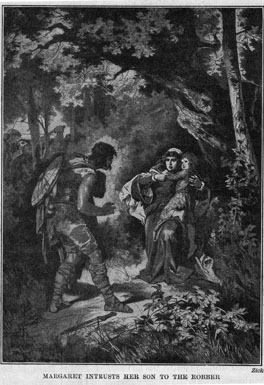
Brave Queen Margaret was completey defeated in another battle. The story is told that after this she fled into a forest with her young son. A robber met them, but Margaret, with wonderful courage, said to him, "I am your queen and this is your prince. I entrust him to your care."

The man was pleased with the confidence that she showed. He took her and the young prince to a safe hiding place, and helped them to escape from England in a sailing vessel.

III

EDWARD IV now seemed to be seated securely upon the throne. But trouble was near. Warwick wished him to follow his advice. Edward thought he could manage without any advice. Then the king and the kingmaker quarreled, and at last became open enemies and fought one another on the field of battle. The end of it was that Warwick was defeated, and driven out of the country. He sailed across the channel and sought refuge in France.

There whom should he meet but his old enemy, Queen Margaret. She had beaten him in battle, and had beheaded his cousin Richard, duke of York; he had beaten her and driven her from her kingdom; and twice he had made her husband prisoner and taken from him his crown. In spite of all this the two now became fast friends, and the kingmaker agreed to make war upon Edward and restore Henry to the throne.

He asked assistance from Louis XI, king of France, who supplied him with men and money. So with an army of Frenchmen the kingmaker landed on the shores of England. Thousands of Englishmen who were tired of Edward flocked to Warwick's standard, and when he reached London he had an army of sixty thousand men.

Edward fled without waiting for a battle and escaped to the Netherlands in a sailing-vessel. The kingmaker had now no one to resist him. The gates of London were opened to him, and the citizens heartily welcomed him. Marching to the Tower, he brought out the old king and placed him once more upon the throne.

But though Edward had fled, he was not discouraged. He followed the example of the kingmaker and asked aid from foreign friends. The duke of Burgundy supplied him with money and soldiers, and he was soon back in England.

His army grew larger and larger every day. People had been very much dissatisfied with Edward and had rejoiced to get rid of him and have Henry for king, because if Henry was not clever he was good. But in a short time they had found out that England needed a king who was not only good but capable.

So when Edward and his French soldiers landed most people in England welcomed them. The kingmaker was now on the wrong side.

Edward met him in battle at a place called Barnet, and completely defeated him. Warwick was killed and Henry once more became prisoner.

In another battle both Margaret and her son were made prisoners. The son was brutally murdered in the presence of King Edward. Margaret was placed in the Tower, and King Henry, who died soon after the battle of Tewksbury, was probably poisoned by order of Edward.

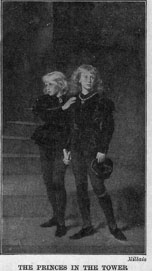
In 1438, after a reign of twenty-two years, Edward died, leaving two sons. Both were boys, so Edward's brother, Richard, duke of Gloucester, was made regent until young Edward V, the older of the two, should come of age.

But Richard was determined to make himself king. So he put both the young princes in the Tower. He than hired ruffians to murder them. One night, when the little princes were asleep, the murderers smothered them with pillows and buried their bodies at the foot of a stairway in the Tower, and there, after many years, their bones were found.

fmma35

After Richard had murdered his two nephews, he was crowned king, as Richard III, much pleased that his plans had succeeded so well. He thought that now nobody could lay claim to the throne. But he was mistaken. One person did claim it. This was Henry Tudor, earl of Richmond.

Henry's father, Edmund Tudor, was only a Welsh gentleman, but was the half-brother of Henry VI through their mother Queen Katherine. Henry's mother was descended from John of Gaunt, fourth son of Edward III, and thus through his mother he was of royal blood and a Lancastrian.

When Richard III by his wickedness and cruelty had made all England hate him, the Red Rose party gathered about Henry Tudor, raised an army, and fought against the king in the battle of Bosworth.

Richard was a bad man, but he was brave, and he fought like a lion. However, it was all in vain. He was defeated and killed. His body was thrown on the back of a horse, carried to a church near the field of battle and buried.

The battered crown which Richard had worn was picked up and placed on Henry's head and the whole Lancastrian army shouted, "Long live King Henry!"

Parliament now voted that Henry Tudor and his heirs should be kings of England. Not long afterwards Henry married the heiress of the house of York, and thus both the Red Roses and the White were satisfied, as the king was a Lancastrian and the queen a Yorkist. So the long and terrible Wars of the Roses came to an end.

THE END

Famous Men of the Middle Ages: Gutenberg, Lived from 1400-1468

GUTENBERG

LIVED FROM 1400-1468

I

WHILE Joan of Arc was busy rescuing France from the English, another wonderful worker was busy in Germany. This was John Gutenberg, who was born in Mainz.

The Germans--and most other people--think that he was the inventor of the art of printing with movable types. And so in the cities of Dresden and Mainz his countrymen have put up statues in his memory.

Gutenberg's father was a man of good family. Very likely the boy was taught to read. But the books from which he learned were not like ours; they were written by hand. A better name for them than books is "manuscripts," which means "hand-writings."

While Gutenberg was growing up a new way of making books came into use, which was a great deal better than copying by hand. It was what is called block-printing. The printer first cut a block of hard wood the size of the page that he was going to print. Then he cut out every word of the written page upon the smooth face of his block. This had to be very carefully done. When it was finished the printer had to cut away the wood from the sides of every letter. This left the letters raised, as the letters are in books now printed for the blind.

The block was now ready to be used. The letters were inked, paper was laid upon them and pressed down.

With blocks the printer could make copies of a book a great deal faster than a man could write them by hand. But the making of the blocks took a long time, and each block would print only one page.

Gutenberg enjoyed reading the manuscripts and block books that his parents and their wealthy friends had; and he often said it was a pity that only rich people could own books. Finally he determined to contrive some easy and quick way of printing.

He did a great deal of his work in secret, for he thought it was much better that his neighbors should know nothing of what he was doing.

So he looked for a workshop where no one would be likely to find him. He was now living in Strasburg, and there was in that city a ruined old building where, long before his time, a number of monks had lived. There was one room of the building which needed only a little repairing to make it fit to be used. So Gutenberg got the right to repair that room and use it as his workshop.

All his neighbors wondered what became of him when he left home in the early morning, and where he had been when they saw him coming back late in the twilight. Some felt sure that he must be a wizard, and that he had meetings somewhere with the devil, and that the devil was helping him to do some strange business.

Gutenberg did not care much what people had to say, and in his quiet room he patiently tried one experiment after another, often feeling very sad and discouraged day after day because his experiments did not succeed.

At last the time came when he had no money left. He went back to his old home, Mainz, and there met a rich goldsmith named Fust (or Faust).

fmma34

Gutenberg told him how hard he had tried in Strasburg to find some way of making books cheaply, and how he had now no more money to carry on his experiments. Fust became greatly interested and gave Gutenberg what money he needed. But as the experiments did not at first succeed Fust lost patience. He quarreled with Gutenberg and said that he was doing nothing but spending money.  At last he brought suit against him in the court, and the judge decided in favor of Fust. So everything in the world that Gutenberg had, even the tools with which he worked, came into Fust's possession.

II

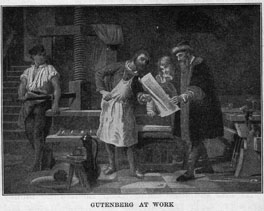
BUT though he had lost his tools, Gutenberg had not lost his courage. And he had not lost all his friends. One of them had money, and he bought Gutenberg a new set of tools and hired a workshop for him. And now at last Gutenberg's hopes were fulfilled.  First of all it is thought that he made types of hard wood. Each type was a little block with a single letter at one end. Such types were a great deal better than block letters. The block letters were fixed. They could not be taken out of the words of which they were parts. The new types were movable so they could be set up to print one page, then taken apart and set up again and again to print any number of pages.

But type made of wood did not always print the letters clearly and distinctly, so Gutenberg gave up wood types and tried metal types. Soon a Latin Bible was printed. It was in two volumes, each of which had three hundred pages, while each of the pages had forty-two lines. The letters were sharp and clear. They had been printed from movable types of metal.

III

THE Dutch claim that Lorenz Coster, a native of Harlem, in the Netherlands, was the first person who printed with movable type. They say that Coster was one day taking a walk in a beech forest not far from Harlem, and that he cut bark from one of the trees and shaped it with his knife into letters.

Not long after this the Dutch say Coster had made movable types and was printing and selling books in Harlem.

The news that books were being printed in Mainz by Gutenberg went all over Europe, and before he died printing-presses like his were at work making books in all the great cities of the continent.

About twenty years after his death, when Venice was the richest of European cities, a man named Aldus Manutius established there the most famous printing house of that time. He was at work printing books two years before Columbus sailed on his first voyage. The descendents of Aldus continued the business after his death for about one hundred years. The books published by them were called "Aldine," from Aldus. They were the most beautiful that had ever come from the press. They are admired and valued to this day.

Famous Men of the Middle Ages: Joan of Arc, Lived from 1412-1431

JOAN OF ARC

LIVED FROM 1412-1431

I

IN the long wars between the French and English not even the Black Prince or King Henry V gained such fame as did a young French peasant girl, Joan of Arc.

She was born in the little village of Domremy. Her father had often told her of the sad condition of France--how the country was largely in the possession of England, and how the French king did not dare to be crowned.

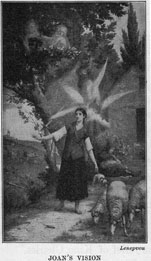
And so the thought came to be ever in her mind, "How I pity my country!" She brooded over the matter so much that by and by she began to have visions of angels and heard strange voices, which said to her, "Joan, you can deliver the land from the English. Go to the relief of King Charles."

At last these strange visions and voices made the young girl believe that she had a mission from God, and she determined to try to save France.

When she told her father and mother of her purpose, they tried to persuade her that the visions of angels and the voices telling her of the divine mission were but dreams. "I tell thee, Joan," said her father, "it is thy fancy. Thou hadst better have a kind husband to take care of thee, and do some work to employ thy mind."

fmma33

"Father, I must do what God has willed, for this is no work of my choosing," she replied. "Mother, I would far rather sit and spin by your side than take part in war. My mission is no dream. I know that I have been chosen by the Lord to fulfill His purpose and nothing can prevent me from going where He purposes to send me."

The village priest, her young companions, even the governor of the town, all tried to stop her, but it was in vain.

To the governor she said, "I must do the work my Lord has laid out for me."

Little by little people began to believe in her mission. At last all stopped trying to discourage her and some who were wealthy helped her to make the journey to the town of Chinon, where the French king, Charles the Seventh, was living.

II

WHEN Joan arrived at Chinon, a force of French soldiers was preparing to go to the south of France to relieve the city of Orleans which the English were besieging.

King Charles received Joan kindly and listened to what she had to say with deep attention. The girl spoke modestly, but with a calm belief that she was right.

"Gracious King," she said, "my name is Joan. God has sent me to deliver France from her enemies. You shall shortly be crowned in the cathedral of Rheims (remz). I am to lead the soldiers you are about to send for the relief of Orleans. So God has directed and under my guidance victory will be theirs."

The king and his nobles talked the matter over and finally it was decided to allow Joan to lead an army of about five thousand men against the English at Orleans.

When she left Chinon at the head of her soldiers, in April, 1429, she was in her eighteenth year. Mounted on a fine war-horse and clad in white armor from head to foot, she rode along past the cheering multitude, "seeming rather," it has been said, "of heaven than earth." In one hand she carried an ancient sword that she had found near the tomb of a saint, and in the other a white banner embroidered with lilies.

The rough soldiers who were near her left off their oaths and coarse manners, and carefully guarded her. She inspired the whole army with courage and faith as she talked about her visions.

When she arrived at the besieged city of Orleans she fearlessly rode round its walls, while the English soldiers looked on in astonishment. She was able to enter Orleans, despite the efforts of the besiegers to prevent her.

She aroused the city by her cheerful, confident words and then led her soldiers forth to give battle to the English. Their success was amazing.  One after another the English forts were taken.

fmma33

When only the strongest remained and Joan was leading the attacking force, she received a slight wound and was carried out of the battle to be attended by a surgeon.  Her soldiers began to retreat. "Wait," she commanded, "eat and drink and rest; for as soon as I recover I will touch the walls with my banner and you shall enter the fort." In a few minutes she mounted her horse again and riding rapidly up to the fort, touched it with her banner. Her soldier almost instantly carried it. The very next day the enemy's troops were forced to withdraw from before the city and the siege was at end.

The French soldiers were jubilant at the victory and called Joan the "Maid of Orleans."  By this name she is known in history. Her fame spread everywhere, and the English as well as the French thought she had more than human power.

She led the French in several other battles, and again and again her troops were victorious.

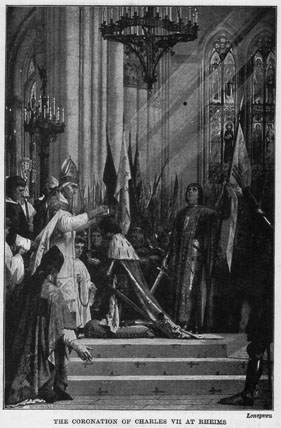
At last the English were driven far to the north of France. Then Charles, urged by Joan, went to Rheims with twelve thousand soldiers, and there, with splendid ceremonies, was crowned king. Joan holding her white banner, stood near Charles during the coronation.

When the ceremony was finished, she knelt at his feet and said, "O King, the will of God is done and my mission is over! Let me now go home to my parents."

But the king urged her to stay a while longer, as France was not entirely freed from the English. Joan consented, but she said, "I hear the heavenly voices no more and I am afraid."

fmma33

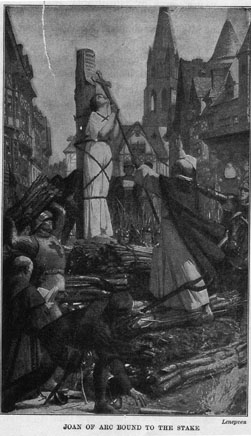
However she took part in an attack upon the army of the Duke of Burgundy, but was taken prisoner by him. For a large sum of money the duke delivered her into the hands of the English, who put her in prison in Rouen. She lay in prison for a year, and finally was charged with sorcery and brought to trial. It was said that she was under the influence of the Evil One. She declared to her judges her innocence of the charge and said, "God has always been my guide in all that I have done. The devil has never had power over me."

Her trial was long and tiresome. At its close she was doomed to be burned at the stake.

So in the market-place at Rouen the English soldiers fastened her to a stake surrounded by a great pile of fagots.

A soldier put into her hands a rough cross, which he had made from a stick that he held.  She thanked him and pressed it to her bosom. Then a good priest, standing near the stake, read to her the prayers for the dying, and another mounted the fagots and held towards her a crucifix, which she clasped with both hands and kissed. When the cruel flames burst out around her, the noble girl uttered the word "Jesus," and expired.

fmma33

A statue of her now stands on the spot where she suffered.

Among all the men of her time none did nobler work than Joan.  And hence it is that we put the story of her life among the stories of the lives of the great men of the Middle Ages, although she was only a simple peasant girl.

Famous Men of the Middle Ages: Henry V, King from 1413-1422

HENRY V

KING FROM 1413-1422

I

OF all the kings that England ever had Henry V was perhaps the greatest favorite among the people. They liked him because he was handsome and brave and, above all, because he conquered France.

In his youth, Prince Hal, as the people called him, had a number of merry companions who sometimes got themselves into trouble by their pranks. Once one of them was arrested and brought before the chief justice of the kingdom.

Prince Hal was not pleased because sentence was given against his companion and he drew his sword, threatening the judge. Upon this the judge bravely ordered the prince to be arrested and put into prison.

Prince Hal submitted to his punishment with good grace and his father is reported to have said, "Happy is the monarch who has so just a judge, and a son so willing to obey the law."

One of Prince Hal's companions was a fat old knight named Sir John Falstaff. Once Falstaff was boasting that he and three men had beaten and almost killed two men in buckram suits who had attacked and tried to rob them. The prince led him on and gave him a chance to brag as much as he wanted to, until finally Falstaff swore that there were at least a hundred robbers and that he himself fought with fifty. Then Prince Hal told their companions that only two men had attacked Falstaff and his friends, and that he and another man who was present were those two. And he said that Falstaff, instead of fighting, had run as fast as his legs could carry him.

There was real goodness as well as merriment in Prince Hal. And so the people found; for when he became king on the death of his father he told his wild companions that the days of his wildness were over; and he advised them to lead better lives in future.

As Henry V, Prince Hal made himself famous in English history by his war with France.

Normandy, you remember, had belonged to Henry's ancestor, William the Conqueror. It had been taken from King John of England by the French king, Philip Augustus, in 1203.

Soon after his coronation Henry sent a demand to the French king that Normandy should be restored, and he made the claim which his great-grandfather, Edward III, had made that he was by right the king of France.

Of course, the king of France would not acknowledge this. Henry therefore raised an army of thirty thousand men and invaded France.

Before he began to attack the French he gave strict orders to his men that they were to harm no one who was not a soldier and to take nothing from the houses or farms of any persons who were not fighting.

Sickness broke out among Henry's troops after they landed, so that their number was reduced to about fifteen thousand. Fifty or sixty thousand Frenchmen were encamped on the field of Agincourt to oppose this little army.

The odds were greatly against Henry. The night before the battle one of his officers said he wished that the many thousand brave soldiers who were quietly sleeping in their beds in England were with the king.

"I would not have a single man more," said Henry. "If god give us victory, it will be plain we owe it to His grace. If not, the fewer we are the less loss for England."

fmma32

The men drew courage from their king. The English archers poured arrows into the ranks of their opponents; and although the French fought bravely, they were completely routed. Eleven thousand Frenchmen fell. Among the slain were more than a hundred of the nobles of the land.

II

AGINCOURT was not the last of Henry's victories. He brought a second army of forty thousand men over to France. Town after town was captured, and at last Henry and his victorious troops laid siege to Rouen, which was then the largest and richest city in France.

The fortifications were so strong that Henry could not storm them, so he determined to take the place by starving the garrison. He said, "War has three handmaidens--fire, blood, and famine. I have chosen the meekest of the three."

He had trenches dug round the town and placed soldiers in them to prevent citizens from going out of the city for supplies, and to prevent the country people from taking provisions in.

A great number of the country people had left their homes when they heard that the English army was marching towards Rouen, and had taken refuge within the city walls. After the siege had gone on for six months there was so little food left in the place that the commander of the garrison ordered these poor people to go back to their homes.

Twelve thousand were put outside the gates, but Henry would not allow them to pass through his lines; so they starved to death between the walls of the French and the trenches of the English.

As winter came on the suffering of the citizens was terrible. At last they determined to set fire to the city, open their gates, and make a last desperate attack on the English.

Henry wished to preserve the city and offered such generous terms of surrender that the people accepted them. Not only Rouen but the whole of Normandy, which the French had held for two hundred years, was now forced to submit to Henry.

The war continued for about two years more, and the English gained possession of such a large part of France that at Christmas Henry entered Paris itself in triumph.

But, strange to say, the king against whom he had been fighting and over whom he was triumphing sat by his side as he rode through the streets. What did this mean? It meant that the French were so terrified by the many victories of Henry that all--king and people--were willing to give him whatever he asked. A treaty was made that as the king was feeble Henry should be regent of the kingdom and that when the king died Henry should succeed him as king of France.

In the treaty the French king also agreed to give to Henry his daughter, the Princess Katherine, in marriage. She became the mother of the English King, Henry VI.

The arrangement that an English sovereign should be king of France was never put into effect; for in less than two years after the treaty was signed the reign of the great conqueror came to an end. Henry died.

In the reign of his son all his work in gaining French territory was undone. By the time that Henry VI was twenty years old England, as you will read in the story of Joan of Arc, had nothing left of all that had been won by so many years of war except the single town of Calais.

Famous Men of the Middle Ages: Tamerlane, Lived from 1333-1405

TAMERLANE

LIVED FROM 1333-1405

I

TAMERLANE was the son of the chief of a Mongolian tribe in Central Asia. His real name was Timour, but as he was lamed in battle when a youth he was generally called Timour the Lame, and this name was gradually changed to Tamerlane.  He was born in 1333, so that he lived in the time of the English king, Edward III, when the Black Prince was winning his victories over the French. He was a descendant of a celebrated Tatar soldier, Genghis Khan, who conquered Persia, China, and other countries of Asia. When twenty-four years old Tamerlane became the head of his tribe, and in a few years he made himself the leader of the whole Mongolian race.

He was a tall, stern-looking man, of great strength, and, although lame in his right leg, could ride a spirited horse at full gallop and do all the work of an active soldier. He was as brave as a lion--and as cruel.

fmma31

He chose the ancient city of Samarcand, in Turkistan, for his capital; and here he built a beautiful marble palace, where he lived in the greatest luxury.

After he had enjoyed for some time the honors which fell to him as chief ruler of the Mongolians, he began to desire further conquests. He determined to make himself master of all the countries of Central Asia.

"As there is but one God in heaven," he said, "there ought to be but one ruler on the earth."

So he gathered an immense army from all parts of his dominion, and for weeks his subjects were busy making preparations for war. At length he started for Persia in command of a splendid army. After gaining some brilliant victories he forced the Persian king to flee from his capital.

All the rich country belonging to Persia, from the Tigris to the Euphrates, submitted to the Mongolian conqueror.

Tamerlane celebrated his Persian conquest by magnificent festivities which continued for a week. Then orders were given to march into the great Tatar empire of the North. Here Tamerlane was victorious over the principal chiefs and made them his vassals. In pursuing the Tatars he entered Russia and sacked and burned some of the Russian cities. He did not, however, continue his invasion of this country, but turned in the direction of India.

At last his army stood before the city of Delhi, and after a fierce assault forced it to surrender. Other cities of India were taken and the authority of Tamerlane was established over a large extent of the country.

II

BAJAZET, sultan of Turkey, now determined to stop Tamerlane's eastward march.

News of this reached the conqueror's ears. Leaving India, he marched to meet the sultan. Bajazet was a famous warrior. He was so rapid in his movements in war that he was called "the lightning."

Tamerlane entered the sultan's dominions and devastated them. He stormed Bagdad, and after capturing the place killed thousands of the inhabitants.

At length the rivals and their armies faced each other. A great battle followed. It raged four or five hours and then the Turks were totally defeated. Bajazet was captured.

Tamerlane then ordered a great iron cage to be made and forced the sultan to enter it. The prisoner was chained to the iron bars of the cage and was thus exhibited to the Mongol soldiers, who taunted him as he was carried along the lines.

As the army marched from place to place the sultan in his cage was shown to the people. How long the fallen monarch had to bear this humiliating punishment is not known.

Tamerlane's dominions now embraced a large part of Asia. He retired to his palace at Samarcand and for several weeks indulged in festivities.

He could not, however, long be content away from the field of battle. So he made up his mind to invade the Empire of China. At the head of a great army of two hundred thousand soldiers he marched from the city of Samarcand towards China. He had gone about three hundred miles on the way when, in February, 1405, he was taken sick and died. His army was disbanded and all thought of invading China was given up.

Thus passed away one of the greatest conquerors of the Middle Ages. He was a soldier of genius but he cannot be called a truly great man. His vast empire speedily fell to pieces after his death. Since his day there has been no leader like him in that part of Asia.

Famous Men of the Middle Ages: William Tell and Arnold Von Winkelried

WILLIAM TELL AND ARNOLD VON WINKELRIED

I

FAR up among the Alps, in the very heart of Switzerland, are three districts, or cantons, as they are called, which are known as the Forest Cantons and are famous in the world's history. About two thousand years ago the Romans found in these cantons a hardy race of mountaineers, who, although poor, were free men and proud of their independence. They became the friends and allies of Rome, and the cantons were for many years a part of the Roman Empire, but the people always had the right to elect their own officers and to govern themselves.

When Goths and the Vandals and the Huns from beyond the Rhine and the Danube overran the Roman Empire, these three cantons were not disturbed. The land was too poor and rocky to attract men who were fighting for possession of the rich plains and valleys of Europe, and so it happened that for century after century, the mountaineers of these cantons lived on in their old, simple way, undisturbed by the rest of the world.

In a canton in the valley of the Rhine lived the Hapsburg family, whose leaders in time grew to be very rich and powerful. They became dukes of Austria and some of them were elected emperors. One of the Hapsburgs, Albert I, claimed that the land of the Forest Cantons belonged to him. He sent a governor and a band of soldiers to those cantons and made the people submit to his authority.

In one of the Forest Cantons at this time lived a famous mountaineer named William Tell. He was tall and strong. In all Switzerland no man had a foot so sure as his on the mountains or a hand so skilled in the use of a bow. He was determined to resist the Austrians.

Secret meetings of the mountaineers were held and all took a solemn oath to stand by each other and fight for their freedom; but they had no arms and were simple shepherds who had never been trained as soldiers. The first thing to be done was to get arms without attracting the attention of the Austrians. It took nearly a year to secure spears, swords, and battle-axes and distribute them among the mountains. Finally this was done, and everything was ready. All were waiting for a signal to rise.

fmma30

The story tells us that just at this time Gessler, the Austrian governor, who was a cruel tyrant, hung a cap on a high pole in the market-place in the village of Altorf, and forced everyone who passed to bow before it. Tell accompanied by his little son, happened to pass through the marketplace. He refused to bow before the cap and was arrested. Gessler offered to release him if he would shoot an apple from the head of his son. The governor hated Tell and made this offer hoping that the mountaineer's hand would tremble and that he would kill his own son. It is said that Tell shot the apple from his son's head but that Gessler still refused to release him. That night as Tell was being carried across the lake to prison a storm came up. In the midst of the storm he sprang from the boat to an over-hanging rock and made his escape. It is said that he killed the tyrant. Some people do not believe this story, but the Swiss do, and if you go to Lake Lucerne some day they will show you the very rock upon which Tell stepped when he sprang from the boat.

That night the signal fires were lighted on every mountain and by the dawn of day the village of Altorf was filled with hardy mountaineers, armed and ready to fight for their liberty. A battle followed and the Austrians were defeated and driven from Altorf. This victory was followed by others.

fmma30

A few years later, the duke himself came with a large army, determined to conquer the mountaineers. He had to march through a narrow pass, with mountains rising abruptly on either side. The Swiss were expecting him and hid along the heights above the pass, as soon as the Austrians appeared in the pass, rocks and trunks of trees were hurled down upon them. Many were killed and wounded. Their army was defeated, and the duke was forced to recognize the independence of the Forest Cantons.

This was the beginning of the Republic of Switzerland. In time five other cantons joined them in a compact for liberty.

II

ABOUT seventy years later the Austrians made another attempt to conquer the patriots. They collected a splendid army and marched into the mountains. The Swiss at once armed themselves and met the Austrians at a place called Sempach. In those times powder had not been invented, and men fought with spears, swords, and battle-axes. The Austrian soldiers stood shoulder to shoulder, each grasping a long spear whose point projected far in front of him. The Swiss were armed with short swords and spears and it was impossible for them to get to the Austrians. For a while their cause looked hopeless, but among the ranks of the Swiss was a brave man from one of the Forest Cantons. His name was Arnold von Winkelried. As he looked upon the bristling points of the Austrian spears, he saw that his comrades had no chance to win unless an opening could be made in that line. He determined to make such an opening even at the cost of his life. Extending his arms as far as he could, he rushed toward the Austrian line and gathered within his arms as many spears as he could grasp.
"Make way for liberty!" he cried--
Then ran, with arms extended wide,
As if his dearest friend to clasp;
Ten spears he swept within his grasp.
"Make way for liberty!" he cried--
Their keen points met from side to side.
He bowed among them like a tree,
And thus made way for liberty.

Pierced through and through Winkelried fell dead, but he had made a gap in the Austrian line, and into this gap rushed the Swiss patriots. Victory was theirs and the Cantons were free.

fmma30

Famous Men of the Middle Ages: Edward The Black Prince. Lived From 1330-1376

EDWARD THE BLACK PRINCE

LIVED FROM 1330-1376

I

ONE of the most famous warriors of the Middle Ages was Edward the Black Prince. He was so called because he wore black armor in battle.

The Black Prince was the son of Edward III who reigned over England from 1327 to 1377. He won his fame as a soldier in the wars which his father carried on against France.

You remember that the early kings of England, from the time of William the Conqueror, had possessions in France. Henry II, William's grandson, was the duke of Normandy and lord of Brittany and other provinces, and when he married Eleanor of Aquitaine she brought him that province also.

Henry's son John lost all the French possessions of the English crown except a part of Aquitaine, and Edward III inherited this. So when Philip of Valois became king of France, about a year after Edward had become king of England, Edward had to do homage to Philip.

To be king of England and yet to do homage to the king of France--to bend the knee before Philip and kiss his foot--was something Edward did not like.  He thought it was quite beneath his dignity, as his ancestor Rollo had thought when told that he must kiss the foot of King Charles.

So Edward tried to persuade the nobles of France that he himself ought by right to be the king of France instead of being only a vassal. Philip of Valois was only a cousin of the late French King Charles IV. Edward was the son of his sister. But there was a curious old law in France, called the Salic Law, which forbade that daughters should inherit lands. This law barred the claim of Edward, because his claim came through his mother. Still he determined to win the French throne by force of arms.

A chance came to quarrel with Philip. Another of Philip's vassals rebelled against him, and Edward helped the rebel. He hoped by doing so to weaken Philip and more easily overpower him.

Philip at once declared that Edward's possessions in France were forfeited.

Then Edward raised an army of thirty thousand men, and with it invaded France.

The Black Prince was now only about sixteen years of age, but he had already shown himself brave in battle, and his father put him in command of one of the divisions of the army.

Thousands of French troops led by King Philip were hurried from Paris to meet the advance of the English; and on the 26th of August, 1346, the two armies fought a hard battle at the village of Crecy.

During the battle the division of the English army commanded by the Black Prince had to bear the attack of the whole French force. The prince fought so bravely and managed his men so well that King Edward, who was overlooking the field of battle from a windmill on the top of a hill, sent him words of praise for his gallant work.

Again and again the prince's men drove back the French in splendid style. But at last they seemed about to give way before a very fierce charge, and the earl of Warwick hastened to Edward to advise him to send the prince aid.

"Is my son dead or unhorsed or so wounded that he cannot help himself?" asked the king.

"No, Sire," was the reply; "but he is hard pressed."

"Return to your post, and come not to me again for aid so long as my son lives," said the king. "Let the boy prove himself a true knight and win his spurs."

fmma29

The earl went to the prince and told him what his father had said. "I will prove myself a true knight," exclaimed the prince. "My father is right. I need no aid. My men will hold their post as long as they have strength to stand."

Then he rode where the battle was still furiously raging, and encouraged his men. The king of France led his force a number of times against the prince's line, but could not break it and was at last compelled to retire.

The battle now went steadily against the French, although they far outnumbered the English. Finally, forty thousand of Philip's soldiers lay dead upon the field and nearly all the remainder of his army was captured. Philip gave up the struggle and fled. Among those who fought on the side of the French at Crecy was the blind king of Bohemia, who always wore three white feathers in his helmet. When the battle was at its height the blind king had his followers lead him into the thick of the fight, and he dealt heavy blows upon his unseen foes until he fell mortally wounded. The three white feathers were taken from his helmet by the Black Prince, who ever after wore them himself.

As soon as he could King Edward rode over the field to meet his son. "Prince," he said, as he greeted him, "you are the conqueror of the French." Turning to the soldiers, who had gathered around him, the king shouted, "Cheer, cheer for the Black Prince! Cheer for the hero of Crecy!"

What cheering then rose on the battle-field! The air rang with the name of the Black Prince.

Soon after the battle of Crecy King Edward laid siege to Calais; but the city resisted his attack for twelve months. During the siege the Black Prince aided his father greatly.

After the capture of Calais, it was agreed to stop fighting for seven years, and Edward's army embarked for England.

II

IN 1355 Edward again declared war against the French. The Black Prince invaded France with an army of sixty thousand men. He captured rich towns and gathered a great deal of booty. While he was preparing to move on Paris, the king of France raised a great army and marched against him.

The Black Prince had lost so many men by sickness that he had only about ten thousand when he reached the city of Poitiers. Suddenly, near the city, he was met by the French force of about fifty-five thousand, splendidly armed and commanded by the king himself.

"God help us!" exclaimed the prince, when he looked at the long lines of the French as they marched on a plain before him.

Early on the morning of September 14, 1356, the battle began. The English were few in number, but they were determined to contest every inch of the ground and not surrender while a hundred of them remained to fight.  For hours they withstood the onset of the French. At last a body of English horsemen charged furiously on one part of the French line, while the Black Prince attacked another part.

This sudden movement caused confusion among the French. Many of them fled from the field. When the Black Prince saw this he shouted to his men, "Advance, English banners, in the name of God and St. George!" His army rushed forward and the French were defeated. Thousands of prisoners were taken, including the king of France and many of his nobles.

The king was sent to England, where he was treated with the greatest kindness. When, some time afterwards there was a splendid procession in London to celebrate the victory of Poitiers, he was allowed to ride in the procession on a beautiful white horse, while the Black Prince rode on a pony at his side.

The Black Prince died in 1376. He was sincerely mourned by the English people. They felt that they had lost a prince who would have made a great and good king.

Subscribe to this RSS feed

Log in or create an account