log in
The Popol Vuh

The Popol Vuh (252)

The Popol Vuh

The Sacred Book of The Mayas

The Book of The Community

English Version by

Delia Goetz and Sylvanus G. Morley

( 1950 by the University of Oklahoma Press)

Translation by Adri Recinos


Children categories

The Alexiad

The Alexiad (18)

The Alexiad

by

Anna Comnena (Komnene)

Edited and translated by Elizabeth A. Dawes.

London: Routledge, Kegan, Paul, 1928.


View items...
Famous Men of the Middle Ages

Famous Men of the Middle Ages (35)

Entry of the Crusaders into Jerusalem, by Eugene Delacroix [1840] (Public Domain Image)

Famous Men of

the Middle Ages

BY JOHN HENRY HAAREN, LL.D.

District Superintendent of Schools

The City of New York

and A. B. POLAND, Ph.D.

Superintendent of Schools
Newark, N.J.

AMERICAN BOOK COMPANY
NEW YORK * CINCINNATI * CHICAGO

1904


Scanned and proofed by Eliza Yetter, March 2007. HTML Formatting by John Bruno Hare at sacred-texts.com. This text is in the public domain in the United States because it was published prior to January 1st, 1923. These files may be used for any purpose without restriction.


View items...
From Goddess to King

From Goddess to King (30)

FROM GODDESS TO KING

A History of Ancient Europe from the

OERA LINDA BOOK

By Anthony Radford

1997 Ojai, California

With thanks to Anthony Radford for his permission to publish his book

©1997 Anthony Radford, all rights reserved.


View items...
The Origin and deeds of the Goths

The Origin and deeds of the Goths (10)

THE ORIGIN AND DEEDS OF THE GOTHS

551 AD

JORDANES

translated by Charles C. Mierow

Princeton University Press, 1915


View items...
The Mysteries of Mithra

The Mysteries of Mithra (9)

THE MYSTERIES OF MITHRA

by Franz Cumont

translated from the second revised French edition by Thomas J. McCormack

Chicago, Open Court

[1903]

Scanned at sacred-texts.com, February, 2003. J.B. Hare, redactor. This text is in the public domain. This file may be used for any non-commercial purpose provided this attribution is left intact.

 
View items...
The Oera Linda Book

The Oera Linda Book (11)

The Oera Linda Book

Written in 1256 AD, from a diary
which was put together 560-558 BC.

from the Original Frisian text

verified by Dr. Ottema

by :

William R. Sandbach

Londen, Trubner & Co, 1876

oera-linda-front

Frontpage of the Dutch translation of the Oera Linda Book (1876)

oera-linda-front

Page 45 from the Oera Linda Manuscript


View items...
Pagan Regeneration

Pagan Regeneration (11)

PAGAN REGENERATION

A STUDY OF MYSTERY INITIATIONS IN THE GRAECO-ROMAN WORLD

BY HAROLD R. WILLOUGHBY

[b. 1890 d. 1962]

Chicago., Ill., The University of Chicago Press

[1929, copyright not renewed]

Scanned and proofed by Eliza Fegley, sacredspiral.com, June 2003. Additional formatting and proofing by J. B. Hare, sacred-texts.com. This text is in the public domain in the United States because it was not renewed in a timely fashion at the US copyright office. These files may be used for any non-commercial purpose, provided this notice of attribution is left intact.

 
View items...
The Secret Hystory

The Secret Hystory (34)

The Secret History

by

Procopius of Caesarea

translated by Richard Atwater

(Chicago: P. Covici, 1927 New York Covici Friede 1927)

Reprinted, Ann Arbor, MI: University of Michigan Press, 1961, with indication that copyright had expired on the text of the translation.

 
View items...
Teutonic Myth and Legend

Teutonic Myth and Legend (47)

Freyja [Public domain image]

TEUTONIC MYTH

AND LEGEND

by Donald A. Mackenzie

An Introduction to the Eddas & Sagas, Beowulf, The Nibelungenlied, etc.

[1912?]

This is Donald Mackenzie's able retelling of the Northern mythological cycle. He weaves a coherent narrative from the Eddas, the Niebelunglied, the Volsung Saga, Beowulf, the primordial Hamlet myths, and Medieval German tales of chivalry. MacKenzie also wrote Egyptian Myth and Legend and Myths of Crete and Pre-Hellenic Europe.


View items...
Caesar's Commentaries on the Gallic and Civil Wars

Caesar's Commentaries on the Gallic and Civil Wars (16)

Julius Caesar

Caesar's Commentaries on the Gallic and Civil Wars

With the Supplementary Books attributed to Hirtius

Including the Alexandrian, African and Spanish Wars

Translator W. A. Mc.Devitte Translator W. S. Bohn

1st Edition.

Harper & Brothers New York 1869

Harper's New Classical Library

Authorship information:

Suetonius (Suet.12 Caes. Julius.56), in his biography of Julius Caesar states that the Gallic and Civil Wars were written by Caesar, and that the 8th book of the Gallic Wars was written by (Aulus) Hirtius. Suetonius also indicates that either Caesar's friend Oppius, or Hirtius likely wrote about the Alexandrian, African and Spanish wars, but that their authorship was not certain.


View items...

THE MITHRAIC LITURGY, CLERGY AND DEVOTEES

THE MYSTERIES OF MITHRA

by Franz Cumont

translated from the second revised French edition by Thomas J. McCormack

Chicago, Open Court

[1903]

THE MITHRAIC LITURGY, CLERGY AND DEVOTEES

IN ALL the religions of classical antiquity there is one feature which, while formerly very conspicuous and perhaps the most important of all for the faithful, has to-day almost totally disappeared. It is their liturgy. The Mysteries of Mithra form no exception to this unfortunate rule. The sacred books which contain the prayers recited or chanted during the services, the ritual of the initiations, and the ceremonials of the feasts, have vanished and left scarce a trace behind. A verse borrowed from one unknown hymn is almost all that has come down to us from the collections which anciently must have been so abundant. The old Ghas composed in honor of the Mazdean gods were translated into Greek during the Alexandrian epoch, and Greek remained for a long time the language of the Mithraic cult, even in the Occident. Barbaric words, incomprehensible to the profane, were interspersed throughout the sacred texts and augmented the veneration of the worshippers for the ancient formulary, as well as their confidence in its efficacy. Such were the epithets like Nabarze, "victorious," which has been applied to Mithra, or the obscure invocations like Nama, Nama Sebesio, engraved on our bas-reliefs, which have never yet been interpreted.

cumom08

Fig. 37.
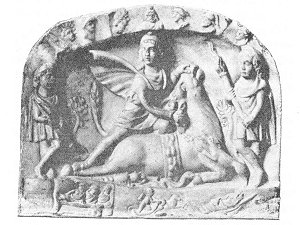
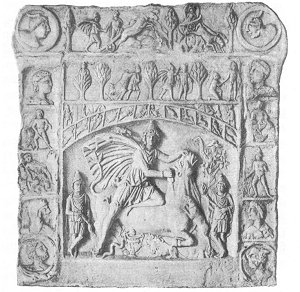
TAUROCTONOUS MITHRA. BAS-RELIEF OF WHITE MARBLE (BOLOGNA).

Important for its accessory figures. In the center, the dog, serpent, scorpion, the two torch-bearers, and above the one to the left the raven. Near each torch-bearer is a pine-tree (?). On the upper border are the busts of the seven planets in the following order from the left: The Sun, Saturn, Venus, Jupiter, Hermes, Mars, and Luna. The lower border, three figures at a banquet; infant, or Eros (?); bearded figure reclining (Oceanus).

A scrupulous respect for the traditional practices of their sect characterized the Magi of Asia Minor, and continued to be manifested with unabated ardor among their Latin successors. On the downfall of paganism, the latter still took pride in worshipping the gods according to the ancient Persian rites which Zoroaster was said to have instituted. These rites sharply distinguished their religion from all the others that were practised at the same time in Rome, and prevented its Persian origin from ever being forgotten.

If some piece of good fortune should one day unearth for us a Mithraic missal, we should be able to study there these ancient usages and to participate in imagination in the celebration of the services. Deprived as we are of this indispensable guide, we are excluded utterly from the sanctuary and know the esoteric discipline of the Mysteries only from a few indiscretions. A text of St. Jerome, confirmed by a series of inscriptions, informs us that there were seven degrees of initiation and that the mystic (μύστης, sacratus) successively assumed the names of Raven (corax), Occult (cryphius), Soldier Lion (leo), Persian (Perses), Runner of the Sun (heliodromus), and Father (pater). These strange appellations were not empty epithets with no practical bearing. On certain occasions the celebrants donned garbs suited to the title that had been accorded them. On the bas-reliefs we see them carrying the counterfeit heads of animals, of soldiers, and of Persians. (See Fig. 38, p. 159) "Some flap their wings like birds, imitating the cry of crows; others growl like lions," says a Christian writer of the fourth century; 1 "in such manner are they that are called wise basely travestied."

These sacred masks, of which the ecclesiastical writer exhibits the ridiculous side, were interpreted by pagan theologians as an allusion to the signs of the Zodiac, and even to the doctrine of metempsychosis. Such divergences of interpretation simply prove that the real meaning of these animal disguises was no longer understood. They are in reality a survival of primitive practices which have left their traces in numerous cults. We find the titles of Bear, Ox, Colt, and other similar names borne by the initiates of the different Mysteries in Greece and Asia Minor. They go back to that prehistoric period where the divinities themselves were represented under the forms of animals; and when the worshipper, in taking the name and semblance of his gods, believed that he identified himself with them. The lion-headed Kronos having become the incarnation of Time, was substituted for the lions which the forerunners of the Mithraists worshipped; and similarly the cloth and paper masks with which the Roman mystics covered their faces were substitutes for the animal skins with which their barbarous predecessors originally clothed themselves, be it that they believed they thus entered into communion with the monstrous idols which they worshipped, or that, in enveloping themselves in the pelts of their flayed victims, they conceived these bloody tunics to possess some purifying virtue.

To the primitive titles of Raven and Lion others were afterward added for the purpose of attaining the sacred number seven. The seven degrees of initiation through which the mystic was forced to pass in order to acquire perfect wisdom and purity, answered to the seven planetary spheres which the soul was forced to traverse in order to reach the abode of the blessed. 2 After having been Raven, the initiates were promoted to the rank of Occult (κρύφιος). The members of this class, hidden by some veil, probably remained invisible to the rest of the congregation. To exhibit them (ostendere) constituted a solemn act. The Soldier (miles) formed part of the sacred militia of the invincible god and waged war under his directions on the powers of evil. The dignity of Persian recalled the first origin of the Mazdean religion, and he who obtained it assumed during the sacred ceremonies the Oriental custom of donning the Phrygian cap, which had also been bestowed on Mithra. The latter having been identified with the Sun, his servitors invested themselves with the name of Runners of the Sun (Ἡλιοδρόμοι); lastly, the title "Fathers" was borrowed from the Greek Thiasi, where this honorific appellation frequently designated the directors of the community.

In this septuple division of the deities, certain additional distinctions were established. We may conclude from a passage in Porphyry that the taking of the first three degrees did not authorize participation in the Mysteries. These initiates, comparable to the Christian catechumens, were the Servants (ὑπηρετοῦντες). To enter this order it was sufficient to have been admitted to the Ravens, doubtless so called because mythology made the raven the servitor of the Sun. Only the mystics that had received the Leontics became Participants (μετέχοντες), and it is for this reason that the grade of Leo is mentioned more frequently in the inscriptions than any other. Finally, at the summit of the hierarchy were placed the Fathers, who appear to have presided over the sacred ceremonies (pater sacrorum) and to have commanded the other classes of the faithful. The head of the Fathers themselves bore the name of Pater Patrum, sometimes transformed into Pater patratus, in order to introduce an official sacerdotal title into a sect which had become Roman. These grandmasters of the adepts retained until their death the general direction of the cult. The reverence and affection which were entertained for these venerable dignitaries are indicated by their name of Father, and the mystics placed under their authority were called brethren by one another, because the fellow-initiates (consacranei) were expected to cherish mutual affection. 3

Admission (acceptio) to the lower orders could be accorded even to children. We do not know whether the initiates were obliged to remain in any one of the grades for a fixed length of time. The Fathers probably decided when the novice was sufficiently prepared to receive the higher initiation, which they conferred in person (tradere).

This ceremony of initiation appears to have borne the name of sacrament (sacramentum), doubtless because of the oath which the neophyte took and which was compared to that made by the conscripts enrolled in the army. The candidate engaged above all things not to divulge the doctrines and the rites revealed to him, but other and more special vows were exacted of him. Thus, the mystic that aspired to the title of Miles was presented with a crown on a sword. He thrust it back with his hand and caused it to fall on his shoulder, saying that Mithra was his only crown. Thereafter, he never wore one, neither at banquets nor when it was awarded to him as a military honor, replying to the person who conferred it: "It belongs to my god," that is to say, to the invincible god.

We are as poorly acquainted with the liturgy of the seven Mithraic sacraments as we are with the dogmatic instructions that accompanied them. We know, however, that conformably to the ancient Iranian rites, repeated ablutions were prescribed to neophytes as a kind of baptism designed to wash away their guilty stains. As with a certain class of Gnostics, this lustration doubtless had different effects at each stage of initiation, and it might consist according to circumstances either in a simple sprinkling of holy water, or in an actual immersion as in the cult of Isis.

Tertullian also compared the confirmation of his co-religionists to the ceremony in which they "signed" the forehead of the soldier. It appears, however, that the sign or seal impressed was not, as in the Christian liturgy, an unction, but a mark burned with a red-hot iron like that applied in the army to recruits before they were admitted to the oath. This indelible imprint perpetuated the memory of the solemn engagement by which the person under vow contracted to serve in that order of chivalry which Mithraism constituted. On reception among the Lions, there were new purifications. But this animal being the emblem of the principle of fire, the use of water, the element hostile to fire, was renounced; and, in order to preserve the initiate from the blemish of sin, honey was poured on his hands and applied to his tongue, as was the custom with new-born children. It was honey also that was presented to the Persian because of its preservative virtue, as Porphyry tells us; 4 in fact, marvellous properties appear to have been associated with this substance, which was believed to have been produced under the influence of the moon. According to the ancient ideas, it was the food of the "blessed, and its absorption by the neophyte made him a peer of the gods. 5

In the Mazdean service, the celebrant consecrated the bread and the water which he mingled with the intoxicating juice of the Haoma prepared by him, and he consumed these foods during the performance of his sacrifice. These ancient usages were preserved in the Mithraic initiations, save that for the Haoma, a plant unknown in the Occident, was substituted the juice of the vine. A loaf of bread and a goblet of water were placed before the mystic, over which the priest pronounced the sacred formula. This oblation of bread and water, with which undoubtedly wine was afterward mixed, is compared by the apologists to the Christian sacrament of the Lord's Supper. Like the latter, it was not granted until after a long novitiate.

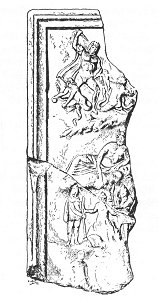
cumom08

MITHRAIC COMMUNION

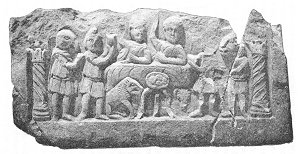
At the left the Raven and the Persian; at the right, the Soldier and the Lion. (Fragment of a bas-relief recently discovered in Konjica, Bosnia.).

It is probable that only those initiates who had attained the degree of Lions were admitted to it, and that this is the reason that the name of "Participants" was given to them. A curious bas-relief recently published shows us the spectacle of this sacred repast (Fig. 38). Before two persons stretched upon a couch covered with pillows is placed a tripod bearing four tiny loaves of bread, each marked with a cross. Around them are grouped the initiates of the different orders, and one of them, the Persian, presents to the two a drinking-horn; whilst a second vessel is held in the hands of one of the Participants. These love feasts are evidently the ritual commemoration of the banquet which Mithra celebrated with the Sun before his ascension. 6 From this mystical banquet, and especially from the imbibing of the sacred wine, supernatural effects were expected. The intoxicating liquor gave not only vigor of body and material prosperity, but wisdom of mind; it communicated to the neophyte the power to combat the malignant spirits, and what is more, conferred upon him as upon his god a glorious immortality.

The sacramental collation was accompanied, or rather preceded, by other rites of a different character. These were genuine trials imposed upon the candidate. To receive the sacred ablutions and the consecrated food, the Participant was obliged to prepare for them by prolonged abstinence and numerous austerities; he played the re of sufferer in certain dramatic expiations of strange character and of which we know neither the number nor the succession. If we can believe a Christian writer of the fourth century, 7 the eyes of the neophyte were bandaged, his hands were bound with the entrails of chickens, and he was compelled to leap over a ditch filled with water; finally, a liberator approached with a sword and sundered his loathsome bonds. Sometimes, the terrified mystic took part, if not as an actor, at least as a spectator, in a simulated murder, which in its origin was undoubtedly real. In late periods, the officiants were contented with producing a sword dipped in the blood of a man who had met a violent death. The cruelty of these ceremonies, which among the warlike tribes of the Taurus must have been downright savage orgies, was softened by contact with western civilization. In any event, they had become more fear-inspiring than fearful, and it was the moral courage of the: initiate that was tried rather than his physical endurance. The idea which was sought to be attained was the stoic "apathy," the absence of every sensitive emotion. The atrocious tortures, the impossible macerations, to which some too credulous or inventive authors have condemned the adepts of the Mysteries, must be relegated to the realm of fable, as must likewise the pretended human sacrifices which were said to have been perpetrated in the shades of the sacred crypts.

Nevertheless, it must not be supposed that Mithraism exhibited nothing more than the benignant phantasmagoria of a species of ancient freemasonry. There had subsisted in its liturgic drama vestiges of its original barbarism, of the time when in the forests, in the depths of some dark cave, corybantes, enveloped in the skins of beasts, sprinkled the altars with their blood. In the Roman towns, the secluded caverns of the mountains were replaced by subterranean vaults (spel) of far less imposing aspect (Fig. 39). But even in these artificial grottos the scenes of initiation were calculated to produce on the neophyte a profound impression. When, after having traversed the approaches of the temple, he descended the stairs of the crypt, he perceived before him in the brilliantly decorated and illuminated sanctuary the venerated image of the tauroctonous Mithra erected in the apse, then the monstrous statues of the leontocephalous Kronos, laden with attributes and mystic symbols, the meaning of which was still unknown to him. At the two sides, partly in the shadow, the assistants, kneeling on stone benches, were seen praying. Lamps ranged about the choir threw their bright rays on the images of the gods and the celebrants, who, robed in strange costumes, received the new convert. Fitful flashes of light skillfully manipulated impressed his eyes and his mind.

cumom08

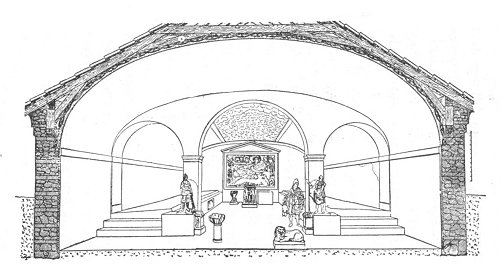
MITHRM OF CARNUNTUM, THE MODERN PETRONELL, NEAR VIENNA TO THE EAST.

(Restored by Tragan.)

This mithrm, like all others of the same style, is underground. Before the great bas-relief of Mithra slaying the bull are two altars, the one large and square in form, the other smaller and richly ornamented. The small statute on the left is Mithra being born from the rock. At the right of the entrance we see the lion of Mithra and at the left is a font for holy water. The two torch-bearers stand on the pillars which separate the aisles. The mithrm is approached by a stairway and through a square hall (or pronaos) which is considerably larger than the sanctum itself.

The sacred emotion with which he was seized lent to images which were really puerile a most formidable appearance; the vain allurements with which he was confronted appeared to him serious dangers over which his courage triumphed. The fermented beverage which he imbibed excited his senses and disturbed his reason to the utmost pitch; he murmured his mystic formulas, and they evoked before his distracted imagination divine apparitions. In his ecstasy, he believed himself transported beyond the limits of the world, and having issued from his trance he repeated, as did the mystic of Apuleius: 8 "I have transcended the boundaries of death, I have trodden the threshold of Proserpine, and having traversed all the elements I am returned to the earth. In the middle of the night I have seen the Sun scintillating with a pure light; I have approached the gods below and the gods above, and have worshipped them face to face."

The tradition of all this occult ceremonial was scrupulously observed by a priesthood instructed in the divine science and distinct from all classes of initiates. Its first founders were certainly the Oriental Magi, but we are almost entirely ignorant of the manner in which its ranks were later recruited and organized, Was it hereditary, named for life, or chosen for a fixed term? In the latter event, who had the right of choosing and what conditions did the candidates have to fulfil? None of these points is sufficiently elucidated. We can only state that the priest, who bore indifferently, as it seems, the title of sacerdos or that of antistes, was often, but not always, a member of the Fathers. We find one vicar, and sometimes several, in each temple. There is every ground for believing that a certain hierarchy existed in this "sacerdotal order." Tertullian tells us that the chief pontiff (summus Pontifex) 9 could marry but once; he doubtless designated by this Roman name the "Father of the Fathers," who appears to have exercised general jurisdiction over all the initiates residing in the city. 10 This is the only indication we possess regarding an organization which was perhaps as solidly constituted as that of the Magi in the Sassanian kingdom, or that of the Manichns of the Roman empire. The same apologist adds that the sectarians of the Persian god also had, like the Christians, their "virgins and their continents." The existence of this kind of Mithraic monachism appears to be all the more remarkable as the merit attached to celibacy is antagonistic to the spirit of Zoroastrianism.

The re of the clergy was certainly more extensive than in the ancient Greek and Roman religions. The priest was the intermediary between God and man. His functions evidently included the administration of the sacraments and the celebration of the services. The inscriptions tell us that in addition he presided at the formal dedications, or at least represented the faithful one on such an occasion along with the Fathers; but this was the least portion only of the duties he had to perform; the religious service which fell to his lot appears to have been very exacting. He doubtless was compelled to see that a perpetual fire burned upon the altars. Three times a day, at dawn, at noon, and at dusk, he addressed a prayer to the Sun, turning in the morning toward the East, at noon toward the South, at evening toward the West. The daily liturgy frequently embraced special sacrifices. The celebrant, garbed in sacerdotal robes resembling those of the Magi, sacrificed to the higher and lower gods divers victims, the blood of which was collected in a trench; or offered them libations, holding in his hands the bundle of sacred twigs which we know from the Avesta. Long psalmodies and chants accompanied with music were interspersed among the ritual acts. A solemn moment in the service,--one very probably marked by the sounding of a bell,--was that in which the image of the tauroctonous Mithra, hitherto kept veiled, was uncovered before the eyes of the initiates. In some temples, the sculptured slab, like our tabernacles, revolved on a pivot, and alternately concealed and exposed the figures that adorned its two faces.

Each day in the week, the Planet to which the day was sacred was invoked in a fixed spot in the crypt; and Sunday, over which the Sun presided, was especially holy. Further, the liturgic calendar solemnized certain dates by festivals concerning which we are unfortunately very poorly informed. Possibly the sixteenth or middle day of the month continued (as in Persia) to have Mithra for its patron. On the other hand, there is never a word in the Occident concerning the celebration of the Mithrakana, which were so popular in Asia. 11 They were doubtless merged in the celebration of the 25th of December, for a very wide-spread custom required that the new birth of the Sun (Natalis invicti), which began to wax great again on the termination of the winter solstice, should be celebrated by sacred festivals. We have good reasons for believing that the equinoxes were also days of rejoicing, the return of the deified seasons being inaugurated by some religious salutation. The initiations took place preferably at the beginning of spring, in March or in April, at the Paschal period, when Christians likewise admitted their catechumens to the rites of baptism. But concerning all these solemnities, as generally with everything connected with the heortology 12 of the Mysteries, our ignorance is almost absolute.

The Mithraic communities were not only brotherhoods united by spiritual bonds; they were also associations possessing juridic existence and enjoying the right of holding property. For the management of their affairs and the care of their temporal interests, they elected officers, who must not be confounded either with the initiates or the priests. The titles borne in the descriptions by the members of these boards of trustees prove to us that the organization of the colleges of the worshippers of Mithra did not differ from that of the other religious sodalicia, which was based upon the constitutions of the municipalities or towns. These corporations published an official list of their members, an album sacratorum, in which the latter were ranked according to the importance of their office. They had at their head a council of decurions, a directing committee named most likely in a general assembly, a sort of miniature senate, of which the first ten (decem primi) possessed, as in the cities, special privileges. They had their masters (magistri) or presidents, elected annually, their curators (curatores), upon whom fell the task of managing the finances, their attorneys (defensores), charged with presenting their cause before the courts or public bureaus; and finally, their patrons (patroni), persons of consequence, from whom they expected not only efficient protection but also pecuniary aid in replenishing their budget.

As the state granted them no subsidies, their well-being depended exclusively on private generosity. Voluntary contributions, the regular revenues of the college, scarcely covered the expenses of worship, and the least extraordinary expenditure was a heavy burden for the common purse. These associations of unmoneyed people could not, with their slender resources, construct sumptuous temples; ordinarily they acquired from some favorably disposed land-holder a piece of ground, on which they erected, or rather dug, their chapel, some other benefactor defraying the cost of the construction. Or, some wealthy burgher placed at the disposal of the mystics a cellar, where they installed themselves as best they could. If the original donor had not the means to pay for the interior decoration of the crypt and the modelling of the sacred images, other Brothers supplied the necessary sum, and a honorific inscription perpetuated the memory of their munificence. Three votive inscriptions found in Rome enable us to witness the founding of one of these Mithraic congregations. 13 A freedman. and a freeman contributed a marble altar, two other initiates consecrated a second one, and a slave likewise made his modest offering. The generous protectors obtained in return for their liberality the highest dignities in the little church. Through their efforts it was gradually furnished, and in the end could allow itself certain luxuries. Marble succeeded common stone, sculpture replaced plaster, and mosaic was substituted for painting. Finally, when the first temple fell into decay, the enriched community frequently rebuilt it with new splendor.

The number of the gifts mentioned in the epigraphic texts bears witness to the attachment of the faithful to the brotherhoods into which they had been admitted. It was owing to the constant devotion of the thousands of zealous; disciples that these societies, the organic cells of the great religious body, could live and flourish. The order was divided into a multitude of little circles, strongly knit together and practising the same rites in the same sanctuaries. The size of the temples in which they worshipped is proof that the number of members was always very limited. Even supposing that the Participants only were allowed to enter the subterranean crypt and that the initiates of inferior rank were admitted only to the vestibule (pronaos), it is impossible that these societies should have counted more than one hundred members.

When the number increased beyond measure, a new chapel was constructed and the group separated. In these compact churches, where every one knew and aided every one else, prevailed the intimacy of a large family. The clear-cut distinctions of an aristocratic society were here effaced; the adoption of the same faith had made the slave the equal, and sometimes the superior, of the decurion and the clarissimus. All bowed to the same rules, all were equally honored guests at the same festivals, and after their death they all doubtless reposed in one common sepulcher. Although no Mithraic cemetery has been discovered up to the present day, the special belief of the sect regarding the future life and its very definite rites render it quite probable that like the majority of the Roman sodalicia it formed not only religious colleges but also funerary associations. It certainly practised inhumation, and the liveliest and most ardent desire of its adepts must have been that of obtaining an interment that was at once honorable and religious, a "mansion eternal," where they could await in peace the day of the Resurrection. If the name of brothers which the initiates gave themselves was not an empty term, they were bound to render to one another at least this last duty.

The very imperfect image that we can frame of the interior life of the Mithraic conventicles aids us nevertheless in fathoming the reasons of their rapid multiplication. The humble plebeians who first entered its vaults in great numbers found in the fraternity of these congregations succor and solace. In joining them, they passed from their isolation and abandonment to become a part of a powerful organization with a fully developed hierarchy and having ramifications that spread like a dense net over the entire empire. Besides, the titles which were conferred upon them satisfied the natural desire that dwells in every man of playing a part in the world and of enjoying some consideration in the eyes of his fellows.

With these purely secular reasons were associated the more powerful motives of faith. The members of these little societies imagined themselves in the privileged possession of a body of ancient wisdom derived from the far Orient. The secrecy with which these unfathomable arcana were surrounded increased the veneration that they inspired: Omne ignoratum pro magnifico est. The gradual initiations kept alive in the heart of the neophyte the hopes of truth still more sublime, and the strange rites which accompanied them left in his ingenuous soul an ineffaceable impression. The converts believed they found, and, the suggestion being transformed into reality, actually did find, in the mystic ceremonies a stimulant and a consolation. They believed themselves purified of their guilt by the ritual ablutions, and this baptism lightened their conscience of the weight of their heavy responsibility. They came forth strengthened from these sacred banquets, which contained the promise of a better life, where the sufferings of this world would find their full compensation. The astonishing spread of Mithraism is due in large measure to these stupendous illusions, which would appear ludicrous were they not so profoundly and thoroughly human.

Nevertheless, in the competition between the rival churches that disputed under the Cars the empire of human souls, one cause of inferiority rendered the struggle unequal for the Persian sect. Whilst the majority of the Oriental cults accorded to women a considerable re in their churches, and sometimes even a preponderating one, finding in them ardent supporters of the faith, Mithra forbade their participation in his Mysteries and so deprived himself of the incalculable assistance of these propagandists. The rude discipline of the order did not permit them to take the degrees in the sacred cohorts, and, as among the Mazdeans of the Orient, they occupied only a secondary place in the society of the faithful. Among the hundreds of inscriptions that have come down to us, not one mentions either a priestess, a woman initiate, or even a donatress. But a religion which aspired to become universal could not deny a knowledge of divine things to one half of the human race, and in order to afford some opportunity for feminine devotion it contracted at Rome an alliance which certainly contributed to its success. The history of Mithraism in the Occident would not be intelligible if we neglected to consider its policy toward the rest of paganism.

Footnotes

1 Ps. Augustine, Quaest. vet. et novi Test., (T. et M., Vol. II., p. 8).
2 See supra, p. 144.
3 See infra, p. 190, footnote.
4 Porph., De antro nymph., c. 15 (T. et M., Vol. II., p. 40).
5 The liturgic use of honey has recently been elucidated by Usener, "Milch und Honig" (Hermes, LVII), 1902, p. 177 ff.
6 See above, p. 138.
7 See above, p. 153, footnote.
8 Apuleius, Metam. XI, 23, propos of the mystics of Isis.
9 Tertull., De praescr. haeret., XL.
10 Cf. supra, p. 155. I adopt here the suggestion of M. Wissova, Religion der Rer, 1902, p. 309.
11 See above, p. 9.
12 The science of festivals. From ἑορτή, festival, holiday.--Tr.
13 Corpus inscriptionum latinarum, Vol. VI., Nos. 556, 717, 734 = 30822 (T. et M., Vol. II. p. 202, nos47-48bis).

THE DOCTRINE OF THE MITHRAIC MYSTERIES

THE MYSTERIES OF MITHRA

by Franz Cumont

translated from the second revised French edition by Thomas J. McCormack

Chicago, Open Court

[1903]

THE DOCTRINE OF THE MITHRAIC MYSTERIES

FOR more than three centuries Mithraism was practised in the remotest provinces of the Roman empire and under the most diverse conditions. It is not to be supposed for a moment that during this long period its sacred traditions remained unchanged, or that the philosophies which one after another swayed the minds of antiquity, or for that matter the political and social conditions of the empire, did not exercise upon them some influence. But undoubted though it be that the Persian Mysteries underwent some modification in the Occident, the inadequacy of the data at our disposal prevents us from following this evolution in its various phases and from distinctly defining the local differences which it may have presented. All that we can do is to sketch in large outlines the character of the doctrines which were taught by it, indicating the additions and revisions which they apparently underwent. Besides, the alterations that it suffered were largely superficial. The identity of the images and hieratical formulas of the most remote periods and places, proves that before the time of its introduction into the Latin countries reformed Mazdaism had already consolidated its theology.

cumom07

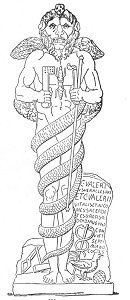
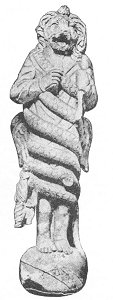
MITHRAIC KRONOS (N OR ZERVAN AKARANA) REPRESENTING BOUNDLESS TIME.

The statue here reproduced was found in the, mithrm of Ostia before mentioned, where C. Valerius Heracles and his sons dedicated it in the year 190 A.D. This leontocephalous figure is entirely nude, the body being entwined six times by a serpent, the head of which rests on the skull of the god. Four wings decorated with the symbols of the seasons issue from the back. Each hand holds a key, and the right in addition a long scepter, the symbol of authority, A thunderbolt is engraved on the breast. On the base of the statue may be seen the hammer and tongs of Vulcan, the cock and the pine-cone consecrated to culapius (or possibly to the Sun and to Attis), and the wand of Mercury--all characteristic adjuncts of the Mithraic Saturn, and symbolizing the embodiment in him of the powers of all the gods.

Contrary to the ancient Gro-Roman paganism, which was an assemblage of practices and beliefs without logical bond, Mithraism had a genuine theology, a dogmatic system, which borrowed from science its fundamental principles.

cumom07

Fig. 21.
MITHRAIC KRONOS OF FLORENCE.

The belief appears generally to prevail that Mithra was the only Iranian god that was introduced into the Occident, and that everything in his religion that does not relate directly to him was adventitious and recent. This is a gratuitous and erroneous supposition. Mithra was accompanied in his migrations by a large representation from the Mazdean Pantheon, and if he was in the eyes of his devotees the principal hero of the religion to which he gave his name, he was nevertheless not its Supreme God.

At the pinnacle of the divine hierarchy and at the origin of things, the Mithraic theology, the heir of that of the Zervanitic Magi, placed boundless Time. Sometimes they would call it Αἰών or Sulum, Κρόνος or Saturnus; but these appellations were conventional and contingent, for he was considered ineffable, bereft alike of name, sex, and passions. In imitation of his Oriental prototype, he was represented in the likeness of a human monster with the head of a lion and his body enveloped by a serpent. The multiplicity of attributes with which his statues are loaded is in keeping with the kaleidoscopic nature of his character. He bears the scepter and the bolts of divine sovereignty and holds in each hand a key as the monarch of the heavens whose portals he opens. His wings are symbolic of the rapidity of his flight.

cumom07

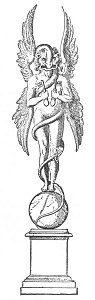
Fig. 22.
MITHRAIC KRONOS (N, OR INFINITE TIME).

Nude leontocephalous figure standing upright on a globe; in each hand a key; four wings; thrice entwined by a serpent, the head of which passes over the skull and is about to enter the mouth. Sketched by Bartoli from a description found in a mithrm discovered in the 16th century in Rome, between the Quirinal and the Viminal.

The reptile whose sinuous folds enwrap him, typifies the tortuous course of the Sun on the ecliptic; the signs of the zodiac engraved on his body and the emblems of the seasons that accompany them, are meant to represent the celestial and terrestrial phenomena that signalize the eternal flight of the years. He creates and destroys all things; he is the Lord and master of the four elements that compose the universe, he virtually unites in his person the power of all the gods, whom he alone has begotten. Sometimes he is identified with Destiny, at others with the primitive light or the primitive fire; while both conceptions rendered it possible for him to be compared with the Supreme Cause of the Stoics,--the heat which pervades all things, which has shaped all things, and which under another aspect was Fatality (Εἱμαρμένη). See Figs. 20-23; also Fig. 49.

The preachers of Mithra sought to resolve the grand problem of the origin of the world by the hypothesis of a series of successive generations. The first principle, according to an ancient belief found in India as well as in Greece, begot a primordial couple, the Heaven and the Earth; and the latter, impregnated by her brother, gave birth to the vast Ocean which was equal in power to its parents, and which appears to have formed with them the supreme triad of the Mithraic Pantheon. The relation of this triad to Kronos or Time from which it had sprung, was not clearly defined; and the starry Heavens of which the revolutions determined, as was believed, the course of all events, appear at times to have been confounded with the eternal Destiny.

cumom07

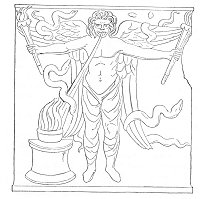
Fig. 23.
MITHRAIC LEONTOCEPHALOUS KRONOS.

Bas-relief of white marble. Found in the same mithrm as the statue of Figure 22. Naked to the waist; the limbs clothed in wide trousers; the arms extended; and in each hand a torch. From the back four wings issue, two pointing upwards and two downwards, and around each is a serpent. Before the god is a circular burning altar, and from his mouth a band representing his breath extends to the fire of the altar.

These three cosmic divinities were personified under other names less transparent. The Heavens were naught less than Ormazd or Jupiter, the Earth was identified with Spea-Armai or Juno, and the Ocean was similarly called Ap-Nap or Neptune. Like the Greek theogonies, so the Mithraic traditions narrated that Zeus succeeded Kronos, the king of the first ages, in the government of the world. The bas-reliefs show us this Mazdean Saturn placing in the hands of his son the thunderbolts which were the symbol of his sovereign power. Henceforward Jupiter with his consort Juno was to reign over all the other gods, all of whom owe to this couple their existence.

The Olympian deities were sprung in fact from the marriage of the celestial Jupiter with the terrestrial Juno. Their eldest daughter is Fortune (Fortuna primigenia), who bestows on her worshippers every grace of body and every beauty of soul. Her beneficent generosity is contrasted with Anangke, which represents the unalterable rigor of fate. Themis or the Law, the Moiror the Fates, were other personifications of Destiny, which manifests under various forms a character which was susceptible of infinite development. The sovereign couple further gave birth not only to Neptune who became their peer, but to a long line of other immortals: Artagnes or Hercules, whose heroic deeds the sacred hymns celebrated; Shahrar or Mars, who was the god of the metals and succored the pious warrior in his combats; Vulcan or Atar, the genius of fire; Mercury, the messenger of Zeus; Bacchus or Haoma, the personification of the plant that furnished the sacred drink; Silvanus or Drvpa, protector of horses and agriculture; then Anais, the goddess of the fecundating waters, who has been likened to Venus and Cybele and who, presiding over war, was also invoked under the name of Minerva; Diana or Luna, who made the honey which was used in the purifications; Vanaiti or Nike, who gave victory to kings; Asha or Arete, perfect virtue; and others besides. This innumerable multitude of divinities was enthroned with Jupiter or Zeus on the sun-tipped summits of Mt. Olympus and composed the celestial court.

Contrasted with this luminous abode, where dwelt the Most High gods in resplendent radiance, was a dark and dismal domain in the bowels of the earth. Here Ahriman or Pluto, born like Jupiter of Infinite Time, reigned with Hecate over the maleficent monsters that had issued from their impure embraces.

These demoniac confederates of the King of Hell then ascended to the assault of Heaven and attempted to dethrone the successor of Kronos; but, shattered like the Greek giants by the ruler of the gods, these rebel monsters were hurled backward into the abyss from which they had risen (Figure 24).

cumom07

Fig. 24.
FRAGMENTS OF A BAS-RELIEF IN WHITE ITALIAN MARBLE.

Found at Virunum, in Noricum, and now in the Historical Museum Rudolfinum, Klagenfurt, Austria. The central part of the monument is entirely destroyed; the head of the sun-god from the left-hand corner alone having been left (see Fig. 11), The left border represents a Hellenized illustration of Ahura-Mazda's struggle with demons, after the manner of the gigantomachy. The lower part of the same fragment exhibits the birth of Mithra.

They made their escape, however, from that place and wandered about on the surface of the earth, there to spread misery and to corrupt the hearts of men, who, in order to ward off the evils that menaced them, were obliged to appease these perverse spirits by offering them expiatory sacrifices. The initiate also knew how by appropriate rites and incantations to enlist them in his service and to employ them against the enemies whose destruction he was meditating.

The gods no longer confined themselves to the ethereal spheres which were their appanage. If theogony represents them as gathered in Olympus around their parents and sovereigns, cosmology exhibits them under another aspect. Their energy filled the world, and they were the active principles of its transformations. Fire, personified in the name of Vulcan, was the most exalted of these natural forces, and it was worshipped in all its manifestations, whether it shone in the stars or in the lightning, whether it animated living creatures, stimulated the growth of plants, or lay dormant in the bowels of the earth. In the deep recesses of the subterranean crypts It burned perpetually on the altars, and its votaries were fearful to contaminate its purity by sacrilegious contact.

They opined with primitive artlessness that fire and water were brother and sister, and they entertained the same superstitious respect for the one as for the other. They worshipped alike the saline floods which filled the deep seas and which were termed indifferently Neptune and Oceanus, the springs that gurgled from the recesses of the earth, the rivers that flowed over its surface, and the placid lakes resplendent in their limpid sheen. A perpetual spring bubbled in the vicinity of the temples, and was the recipient of the homage and the offerings of its visitors. This font perennial (fons perennis) was alike the symbolization of the material and moral boons that the inexhaustible generosity of Infinite Time scattered throughout the universe, and that of the spiritual rejuvenation accorded to wearied souls in the eternity of felicity.

The primitive earth, the nourishing earth, the mother earth (terra mater), fecundated by the waters of Heaven, occupied a like important place, if not in the ritual, at least in the doctrine of this religion; and the four cardinal winds which were correlated with the deified Seasons were invoked as genii to be both feared and loved: feared because they were the capricious arbiters of the temperature, which brought heat or cold, tempests or calms, which alternately moistened and dried the atmosphere, which produced the vegetation of the spring and withered the foliage of the autumn,--and loved as the diverse manifestations of the air itself, which is the principle of all life.

In other words, Mithraism deified the four simple bodies which, according to the physics of the ancients, composed the universe. An allegorical group, often reproduced, in which a lion represented fire, a cup water, a serpent the earth, pictured the struggle of the opposing elements, which were constantly devouring one another and whose perpetual transmutations and infinitely variable combinations provoked all the phenomena of nature (Fig. 25).

Hymns of fantastic symbolism celebrated the metamorphoses which the antitheses of these four elements produced in the world. The Supreme God drives a chariot drawn by four steeds which turn ceaselessly round in a fixed circle. The first, which bears on its shining coat the signs of the planets and constellations, is sturdy and agile and traverses the circumference of the fixed circle with extreme velocity; the second, less vigorous and less rapid in its movements, wears a somber robe, of which one side only is illuminated by the rays of the sun; the third proceeds more slowly still; and the fourth turns slowly in the same spot, champing restlessly its steel bit, whilst its companions move round it as round a stationary column in the center. The quadriga turns slowly and unimpeded, regularly completing its eternal course. But at a certain moment the fiery breath of the first horse falling upon the fourth ignites its mane, and its neighbor, exhausted by its efforts, inundates it with torrents of perspiration. Finally, a still more remarkable phenomenon takes place. The appearance of the quartette is transformed.

cumom07

Fig. 25.
GRAND MITHRAIC BAS-RELIEF OF HEDDERNHEIM, GERMANY.

In the center Mithra with the two torch-bearers; immediately above, the signs of the Zodiac; immediately above these, Mithra aiming his arrow at the rock; below the bull a group composed of the lion, the cup, and the servant. For the obverse of this bas-relief.

The steeds interchange natures in such wise that the substance of all passes over to the most robust and ardent of the group, just as if a sculptor, after having modelled figures in wax, had borrowed the attributes of one to complete the others, and had ended by merging all into a single form. Then, the conquering steed in this divine struggle, having become by his triumph omnipotent, is identified with the charioteer himself. The first horse is the incarnation of fire or ether, the second of air, the third of water, and the fourth of the earth. The accidents which befall the last-mentioned horse, the earth, represent the conflagrations and inundations which have desolated and will in the future desolate our world; and the victory of the first horse is the symbolic image of the final conflict that shall destroy the existing order of all things.

The cosmic quadriga, which draws the suprasensible Cause, has not been figured in the sacred iconography. The latter reserved for a visible god this emblematic group. The votaries of Mithra, like the ancient Persians, adored the Sun that traversed each day in its chariot the spaces of the firmament and sank at dusk extinguishing its fires in the ocean. When it appeared again on the horizon, its brilliant light scattered in flight the spirits of darkness, and it purified all creation, to which its radiance restored life. A like worship was accorded to the Moon, which voyaged in the spheres above on a cart drawn by white bulls. The animal of reproduction and of agriculture had been assigned to the goddess that presided over the increase of plants and the generation of living creatures.

The elements, accordingly, were not the only natural bodies that were deified in the Mysteries. The two luminaries that fecundated nature were worshipped here the same as in primitive Mazdaism, but the conceptions which the Aryas formed of them have been profoundly transformed by the influences of Chaldn theories.

As we have already said, the ancient belief of the Persians had been forcibly subjected in Babylon to the influence of a theology which was based on the science of its day, and the majority of the gods of Iran had been likened to the stars worshipped in the valley of the Euphrates. They acquired thus a new character entirely different from their original one, and the name of the same deity thus assumed and preserved in the Occident a double meaning. The Magi were unsuccessful in harmonizing these new doctrines with their ancient religion, for the Semitic astrology was as irreconcilable with the naturalism of Iran as it was with the paganism of Greece. But looking upon these contradictions as simple differences of degree in the perception of one and the same truth, the clergy reserved for the ite exclusively the revelation of the original Mazdean doctrines concerning the origin and destiny of man and the world, whilst the multitude were forced to remain content with the brilliant and superficial symbolism inspired by the speculations of the Chaldns. The astronomical allegories concealed from the curiosity of the vulgar the real scope of the hieratic representations, and the promise of complete illumination, long withheld, fed the ardor of faith with the fascinating allurements of mystery.

The most potent of these sidereal deities, those which were most often invoked and for which were reserved the richest offerings, were the Planets. Conformably to astrological theories, the planets were endowed with virtues and qualities for which it is frequently difficult for us to discover adequate reasons. Each of the planetary bodies presided over a day of the week, to each some one metal was consecrated, each was associated with some one degree in the initiation, and their number has caused a special religious potency to be attributed to the number seven. In descending from the empyrean to the earth, the souls, it was thought, successively received from them their passions and qualities. These planetary bodies were frequently represented on the monuments, now by symbols recalling the elements of which they were formed or the sacrifices which were offered to them, and now under the aspect of the immortal gods throned on the Greek Olympus: Helios, Selene, Ares, Hermes, Zeus, Aphrodite, Kronos. But these images have here an entirely different signification from what they possess when they stand for Ahura-Mazda, Zervan, or the other gods of Mazdaism. Then the personifications of the Heavens or of Infinite Time are not seen in them, but only the luminous stars whose wandering course can be followed amid the constellations. This double system of interpretation was particularly applied to the Sun, conceived now as identical with Mithra and now as distinct from him. In reality there were two solar divinities in the Mysteries, one Iranian and the heir of the Persian Hvare, the other Semitic, the substitute of the Babylonian Shamash, identified with Mithra.

By the side of the planetary gods who have still a double character, purely sidereal divinities received their tribute of homage. The twelve signs of the Zodiac, which in their daily revolution subject creatures to their adverse influences, were represented in all of the mithrms under their traditional aspect (Fig. 26). Each of them was without doubt the object of particular veneration during the month over which it presided, and they were customarily grouped by threes according to the Seasons to which they conformed and with the worship of which theirs was associated. (See also Fig. 49.)

But the signs of the Zodiac were not the only constellations that were incorporated by the priests in their theology. The astronomical method of interpretation, having been once adopted in the Mysteries, was freely extended and made to embrace all possible figures.

cumom07

Fig. 26.
MARBLE BAS-RELIEF FOUND IN LONDON.

In the center the tauroctonous Mithra with the torch-bearers surrounded by the twelve signs of the Zodiac. In the lower corners busts of the Winds; in the upper corners the Sun on his quadriga and the Moon on a chariot drawn by bulls. The inscription reads: Ulpius Silvanus emeritus leg(ionis) II Aug(ust votum solvit. (that is, honorably discharged at Orange).

There was scarcely any object or animal that was not in some way conceived as the symbolic image of a stellar group. Thus the raven, the cup, the dog, and the lion, that ordinarily accompany the group of the tauroctonous Mithra, were readily identified with the constellations of the same name. The two celestial hemispheres that alternately pass above and below the earth were personified and likened to the Dioscuri, who, according to the Hellenic fable, lived and died by turns.

cumom07

Fig. 27.
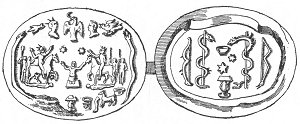
MITHRAIC CAMEO.

After Chiflet, reproduced from C. W. King.

Mythology and erudition were everywhere mingled. The hymns described a hero like the Greek Atlas who bore on his untiring shoulders the globe of Heaven, and who is regarded as the inventor of astronomy. But these demi-gods were relegated to the background; the planets and the signs of the Zodiac never ceased to preserve their incontestable primacy, for it was they above all others, according to the astrologers, that controlled the existence of men and guided the Course of things.

This was the capital doctrine that Babylon introduced into Mazdaism: belief in Fatality, the conception of an inevitable Destiny controlling the events of this world and inseparably conjoined with the revolution of the starry heavens.

cumom07

MITHRAIC CAMEO.

Showing Mithra born from the rock between the Dioscuri, surrounded by Mithraic symbols, among them the cup and bread of the Eucharist. (Reproduced from Walsh.)

This Destiny, identified with Zervan, became the Supreme Being which engendered all things and ruled the universe. The development of the universe is subject to immutable laws and its various parts are united in the most intimate solidarity. The position of the planets, their mutual relations and energies, at every moment different, produce the series of terrestrial phenomena. Astrology, of which these postulates were the dogmas, certainly owes some share of its success to the Mithraic propaganda, and Mithraism is therefore partly responsible for the triumph in the West of this pseudo-science with its long train of errors and terrors.

The rigorous logic of its deductions assured to this stupendous chimera a more complete domination over reflecting minds than the belief in the infernal powers and in the invocation of spirits, although the latter commanded greater sway over popular credulity. The independent power attributed by Mazdaism to the principle of evil afforded justification for all manner of occult practices. Necromancy, oneiromancy, belief in the evil eye and in talismans, in witchcraft and conjurations, in fine, all the puerile and sinister aberrations of ancient paganism, found their justification in the re assigned to demons who incessantly interfered in the affairs of men. The Persian Mysteries are not free from the grave reproach of having condoned, if not of having really taught, these various superstitions. And the title "Magus" became in the popular mind, not without good reason, a synonym for "magician."

Yet neither the conception of an inexorable necessity unpityingly forcing the human race toward an unknown goal, nor even the fear of malevolent spirits bent on its destruction, was competent to attract the multitudes to the altars of the Mithraic gods. The rigor of these somber doctrines was tempered by a belief in benevolent powers sympathizing with the sufferings of mortals. Even the planets were not, as in the didactic works of the theoretical astrologists, cosmic powers whose favorable or sinister influence waxed great or diminished conformably to the revolutions of a circle fixed for all eternity. They were, as in the doctrine of the old Chaldn religion, divinities that saw and heard, that rejoiced or lamented, whose wrath might be appeased, and whose favor might be gained by prayers and by offerings. The faithful reposed their confidence in the support of these benevolent protectors who combated without respite the powers of evil.

The hymns that celebrated the exploits of the gods have unfortunately almost all perished, and we know these epic traditions only through the monuments which served to illustrate them. Nevertheless, the character of this sacred poetry is recognizable in the dris which has come down to us. Thus, the labors of Verethraghna, the Mazdean Hercules, were chanted in Armenia. It is told here how he strangled the dragons and aided Jupiter in his triumphant combat with the monstrous giants; and like the votaries of the Avesta, the Roman adepts of Mazdaism compared him to a bellicose and destructive boar.

But the hero that enjoyed the greatest re in these warlike tales was Mithra. Certain mighty deeds, which in the books of Zoroastrianism were attributed to other divinities, were associated with his person. He had become the center of a cycle of legends which alone explain the preponderant place that was accorded him in this religion. It is because of the astounding feats accomplished by him that this god, who did not hold supreme rank in the celestial hierarchy, has given his name to the Persian Mysteries that were disseminated in the Occident.

For the ancient Magi, Mithra was, as we have seen, the god of light, and as the light is borne by the air he was thought to inhabit the Middle Zone between Heaven and Hell, and for this reason the name of μεσίτης was given to him. In order to signalize this attribute in the ritual, the sixteenth or middle day of each month was consecrated to him. When he was identified with Shamash, his priests in investing him with the appellation of "intermediary" doubtless had in mind the fact that, according to the Chaldn doctrines, the sun occupied the middle place in the planetary choir.

cumom07

Fig. 29.

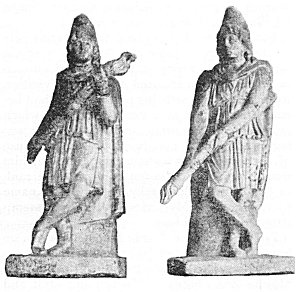
STATUES OF TORCH-BEARERS.

(Museum of Palermo.)

But this middle position was not exclusively a position in space; it was also invested with an important moral significance. Mithra was the "mediator" between the unapproachable and unknowable god that reigned in the ethereal spheres and the human race that struggled and suffered here below. Shamash had already enjoyed analogous functions in Babylon, and the Greek philosophers also saw in the glittering globe that poured down upon this world its light, the ever-present image of the invisible Being, of whom reason alone could conceive the existence.

It was in this adventitious quality of the genius of the solar light that Mithra was best known in the Occident, and his monuments frequently suggest this borrowed character. It was customary to represent him between two youthful figures, one with an uplifted, the other with an inverted, torch. These youths bore the enigmatic epithets of Cauti and Cautopati, and were naught else than the double incarnation of his person (Figs. 18 and 29). These two dadophori, as they were called, and the tauroctonous hero formed together a triad, and in this "triple Mithra" was variously seen either the star of day, whose coming at morn the cock announced, who passed at midday triumphantly into the zenith and at night languorously fell toward the horizon; or the sun which, as it waxed in strength, entered the constellation of Taurus and marked the beginning of spring,--the sun whose conquering ardors fecundated nature in the heart of summer and the sun that afterwards, enfeebled, traversed the sign of the Scorpion and announced the return of winter. From another point of view, one of these torchbearers was regarded as the emblem of heat and of life, and the other as the emblem of cold and of death. Similarly, the tauroctonous group was variously explained with the aid of an astronomical symbolism more ingenious than rational. Yet these sidereal interpretations were nothing more than intellectual diversions designed to amuse the neophytes prior to their receiving the revelation of the esoteric doctrines that constituted the ancient Iranian legend of Mithra.

cumom07

Fig. 30.
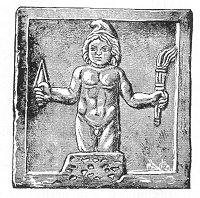
MITHRA BORN FROM THE ROCK.

Bas-relief found in the crypt of St. Clements at Rome.

The story of this legend is lost, but the bas-reliefs recount certain episodes of it, and its contents appear to have been somewhat as follows:

The light bursting from the heavens, which were conceived as a solid vault, became, in the mythology of the Magi, Mithra born from the rock. The tradition ran that the "Generative Rock," of which a standing image was worshipped in the temples, had given birth to Mithra. on the banks of a river, under the shade of a sacred tree, and that shepherds alone, ensconced in a neighboring mountain, had witnessed the miracle of his entrance into the world.

cumom07

Fig. 31.
MITHRA BORN FROM THE ROCK.

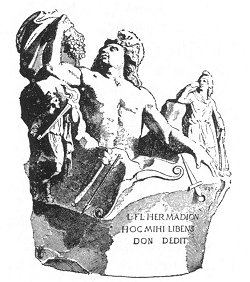
Holding in his hand the Grape which in the West replaced the Haoma of the Persians.

They had seen him issue forth from the rocky mass, his head adorned with a Phrygian cap, armed with a knife, and carrying a torch that had illuminated the somber depths. below (Fig. 30). Worshipfully the shepherds drew near, offering the divine infant the first fruits of their flock and their harvests. But the young hero was naked and exposed to the winds that blew with violence: he had concealed himself in the branches of a fig-tree, and detaching the fruit from the tree with the aid of his knife, he ate of it, and stripping it of its leaves he made himself garments. Thus equipped for the battle, he was able henceforward to measure his strength with the other powers, that peopled the marvellous world into which he had entered. For although the shepherds were pasturing their flocks when he was born, all these things came to pass before there were men on earth.

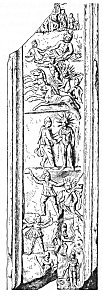
The god with whom Mithra first measured his strength was the Sun. The latter was compelled to render homage to the superiority of his rival and to receive from him his investiture. His conqueror placed upon his head the radiant crown that he has borne in his daily course ever since his downfall. Then he caused him to rise again, and extending to him his right hand concluded with him a solemn covenant of friendship. And ever after, the two allied heroes faithfully supported each other in all their enterprises (Fig. 32).

The most extraordinary of these epic adventures was Mithra's combat with the bull, the first living creature created by Ormazd.

cumom07

Fig. 32.
FRAGMENT OF THE BAS-RELIEF OF VIRUNUM.

Showing scenes from the life of Mithra. Among them Mithra crowning the sun-god with a radiate halo, his ascension in the solar chariot to Heaven, and his smiting the rock from which the waters flowed.

This ingenious fable carries us back to the very beginnings of civilization. It could never have risen save among a people of shepherds and hunters with whom cattle, the source of all wealth, had become an object of religious veneration.

cumom07

Fig. 33.
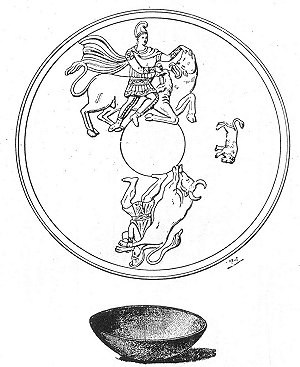
THE TAUROCTONOUS (BULL-SLAYING) MITHRA AND THE TAUROPHOROUS (BULL-BEARING) MITHRA; BETWEEN THEM THE DOG.

Clay cup found at Lanuvium.

In the eyes of such a people, the capture of a wild bull was an achievement so highly fraught with honor as to be apparently no derogation even for a god.

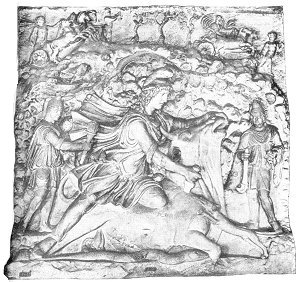
The redoubtable bull was grazing in a pasture on the mountain-side; the hero, resorting to a bold stratagem, seized it by the horns and succeeded in mounting it. The infuriated quadruped, breaking into a gallop, struggled in vain to free itself from its rider; the latter, although unseated by the bull's mad rush, never for a moment relaxed his hold; he suffered himself to be dragged along, suspended from the horns of the animal, which, finally exhausted by its efforts, was forced to surrender. Its conqueror then seizing it by its hind hoofs, dragged it backwards over a road strewn with obstacles (Fig. 33) into the cave which served as his home.

This painful journey (Transitus) of Mithra became the symbol of human sufferings. But the bull, it would appear, succeeded in making its escape from its prison, and roamed again at large over the mountain pastures. The Sun then sent the raven, his messenger, to carry to his ally the command to slay the fugitive. Mithra received this cruel mission much against his will, but submitting to the decree of Heaven he pursued the truant beast with his agile dog, succeeded in overtaking it just at the moment when it was taking refuge in the cave which it had quitted, and seizing it by the nostrils with one hand, with the other he plunged deep into its flank his hunting-knife. Then came an extraordinary prodigy to pass.

cumom07

Fig. 34.
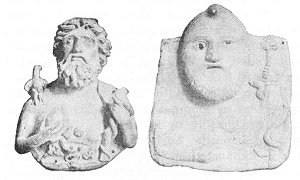
TWO BRONZE PLAQUES (VATICAN).

The one to the left has the head of Jupiter (Silvanus?). The right hand holds a pine-cone, the left a branch entwined by a serpent. On the right shoulder is an eagle, and the breast is decorated with Mithraic figures in relief: the tauroctonous Mithra, a cup, the head of a ram, and a five-rayed disc. The right-hand bust is that of a bearded Oriental with Phrygian cap, holding in the right hand a pine-cone and in the left a torch entwined by a serpent--a crude piece of work and probably of Asiatic origin.

From the body of the moribund victim sprang all the useful herbs and plants that cover the earth with their verdure. From the spinal cord of the animal sprang the wheat that gives us our bread, and from its blood the vine that produces the sacred drink of the Mysteries. In vain did the Evil Spirit launch forth his unclean demons against the anguish-wrung animal, in order to poison in it the very sources of life; the scorpion, the ant, the serpent, strove in vain to consume the genital parts and to drink the blood of the prolific quadruped; but they were powerless to impede the miracle that was enacting. The seed of the bull, gathered and purified by the Moon, produced all the different species of useful animals, and its soul, under the protection of the dog, the faithful companion of Mithra, ascended into the celestial spheres above, where, receiving the honors of divinity, it became under the name of Silvanus the guardian of herds. Thus, through the sacrifice which he had so resignedly undertaken, the tauroctonous hero became the creator of all the beneficent beings on earth; and, from the death which he had caused, was born a new life, more rich and more fecund than the old.

Meanwhile, the first human couple had been called into existence, and Mithra was charged with keeping a watchful eye over this privileged race. It was in vain the Spirit of Darkness invoked his pestilential scourges to destroy it; the god always knew how to balk his mortiferous designs. Ahriman first desolated the land by causing a protracted drought, and its inhabitants, tortured by thirst, implored the aid of his ever-victorious adversary. The divine archer discharged his arrows against a precipitous rock, and here gushed forth from it a spring of living water to which the suppliants thronged to cool their parched palates. But a still more terrible cataclysm followed, which menaced all nature. A universal deluge depopulated the earth, which was overwhelmed by the waters of the rivers and the seas. One man alone, secretly advised by the gods, had constructed a boat and had saved himself, together with his cattle, in an ark which floated on the broad expanse of waters. Then a great conflagration ravaged the world and consumed utterly both the habitations of men and of beasts. But the creatures of Ormazd also ultimately escaped this new peril, thanks to celestial protection, and henceforward the human race was permitted to wax great and multiply in peace.

The heroic period of history was now closed, and the terrestrial mission of Mithra accomplished. In a Last Supper, which the initiated commemorated by mystical love feasts, he celebrated with Helios and the other companions of his labors the termination of their common struggles. Then the gods ascended to the Heavens. Borne by the Sun on his radiant quadriga, Mithra crossed the Ocean, which sought in vain to engulf him (Fig. 35), and took up his habitation with the rest of the immortals.

cumom07

Fig. 35.
BAS-RELIEF OF APULUM, DACIA.

In the center, the tauroctonous Mithra with the two torch-bearers; to the left, Mithra mounted on the bull, and Mithra taurophorous; to the right, a lion stretched lengthwise above a cup (symbols of fire and water). Upper border: Bust of Luna; new-born Mithra reclining near the banks of a stream; shepherd standing, with lambs; bull in a hut and bull in a boat; underneath, the seven altars; Mithra drawing a bow; bust of the Sun. Lower border: Banquet of Mithra and the Sun; Mithra mounting the quadriga of the Sun; the Ocean surrounded by a serpent.

But from the heights of Heaven he never ceased to protect the faithful ones that piously served him.

This mythical recital of the origin of the world enables us to understand the importance which the tauroctonous god enjoyed in his religion, and to comprehend better what the pagan theologians endeavored to express by the title "mediator." Mithra is the creator to whom Jupiter-Ormazd committed the task of establishing and of maintaining order in nature. He is, to speak in the philosophical language of the times, the Logos that emanated from God and shared His omnipotence; who, after having fashioned the world as demiurge, continued to watch faithfully over it. The primal defeat of Ahriman had not reduced him to absolute impotence; the struggle between the good and the evil was still conducted on earth between the emissaries of the sovereign of Olympus and those of the Prince of Darkness; it raged in the celestial spheres in the opposition of propitious and adverse stars, and it reverberated in the hearts of men,--the epitomes of the universe.

Life is a battle, and to issue forth from it victorious the law must be faithfully fulfilled that the divinity himself revealed to the ancient Magi. What were the obligations that Mithraism imposed upon its followers? What were those "commandments" to which its adepts had to bow in order to be rewarded in the world to come? Our incertitude on these points is extreme, for we have not the shadow of a right to identify the precepts revealed in the Mysteries with those formulated in the Avesta. Nevertheless, it would appear certain that the ethics of the Magi of the Occident had made no concession to the license of the Babylonian cults and that it had still preserved the lofty character of the ethics of the ancient Persians. Perfect purity had remained for them the cult toward which the life of the faithful should tend. Their ritual required repeated lustrations and ablutions, which were believed to wash away the stains of the soul. This catharsis or purification both conformed to the Mazdean traditions and was in harmony with the general tendencies of the age. Yielding to these tendencies, the Mithraists carried their principles even to excess, and their ideals of perfection verged on asceticism. Abstinence from certain foods and absolute continence were regarded as praiseworthy.

Resistance to sensuality was one of the aspects of the combat with the principle of evil. To support untiringly this combat with the followers of Ahriman, who, under multiple forms, disputed with the gods the empire of the world, was the duty of the servitors of Mithra. Their dualistic system was particularly adapted to fostering individual effort and to developing human energy. They did not lose themselves, as did the other sects, in contemplative mysticism; for them, the good dwelt in action. They rated strength higher than gentleness, and preferred courage to lenity. From their long association with barbaric religions, there was perhaps a residue of cruelty in their ethics. A religion of soldiers, Mithraism exalted the military virtues above all others.

cumom07

Fig. 36.
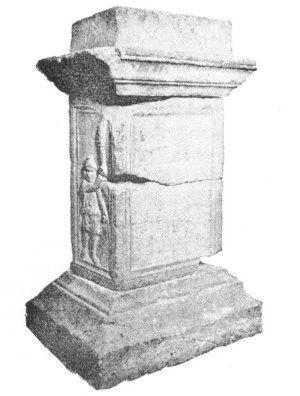
VOTIVE INSCRIPTION TO MITHRA NABARZE (VICTORIOUS).

Found at Sarmizegetusa.

In the war which the zealous champion of piety carries on unceasingly with the malign demons, he is assisted by Mithra. Mithra is the god of help, whom one never invokes in vain, an unfailing haven, the anchor of salvation for mortals in all their trials, the dauntless champion who sustains his devotees in their frailty, through all the tribulations of life. As with the Persians, so here he is still the defender of truth and justice, the protector of holiness, and the intrepid antagonist of the powers of darkness. Eternally young and vigorous, he pursues them without mercy; "always awake, always alert," it is impossible to surprise him; and from his never-ceasing combats he always emerges the victor. This is the idea that unceasingly occurs in the inscriptions, the idea expressed by the Persian surname Nabarze (Fig. 36), by the Greek and Latin epithets of ἀνίκητος, invictus, insuperabilis. As the god of armies, Mithra caused his prot to triumph over their barbarous adversaries, and likewise in the moral realm he gave them victory over the instincts of evil, inspired by the Spirit of Falsehood, and he assured them salvation both in this world and in that to come.

Like all the Oriental cults, the Persian Mysteries mingled with their cosmogonic fables and their theological speculations, ideas of deliverance and redemption. They believed in the conscious survival after death of the divine essence that dwells within us, and in punishments and rewards beyond the tomb.

The souls, of which an infinite multitude peopled the habitations of the Most High, descended here below to animate the bodies of men, either because they were compelled by bitter necessity to fall into this material and corrupt world, or because they had dropped of their own accord upon the earth to undertake here the battle against the demons. When after death the genius of corruption took possession of the body, and the soul quitted its human prison, the devas of darkness and the emissaries of Heaven disputed for its possession. A special decree decided whether it was worthy to ascend again into Paradise. If it was stained by an impure life, the emissaries of Ahriman dragged it down to the infernal depths, where they inflicted upon it a thousand tortures; or perhaps, as a mark of its fall, it was condemned to take up its abode in the body of some unclean animal. If, on the contrary, its merits outweighed its faults, it was borne aloft to the regions on high.

The heavens were divided into seven spheres, each of which was conjoined with a planet. A sort of ladder, composed of eight superposed gates, the first seven of which were constructed of different metals, was the symbolic suggestion in the temples, of the road to be followed to reach the supreme region of the fixed stars. To pass from one story to the next, each time the wayfarer had to enter a gate guarded by an angel of Ormazd. The initiates alone, to whom the appropriate formulas had been taught, knew how to appease these inexorable guardians. As the soul traversed these different zones, it rid itself, as one would of garments, of the passions and faculties that it had received in its descent to the earth. It abandoned to the Moon its vital and nutritive energy, to Mercury its desires, to Venus its wicked appetites, to the Sun its intellectual capacities, to Mars its love of war, to Jupiter its ambitious dreams, to Saturn its inclinations. It was naked, stripped of every vice and every sensibility, when it penetrated the eighth heaven to enjoy there, as an essence supreme, and in the eternal light that bathed the gods, beatitude without end. 1

It was Mithra, the protector of truth, that presided over the judgment of the soul after its decease. It was he, the mediator, that served as a guide to his faithful ones in their courageous ascent to the empyrean; he was the celestial father that received them in his resplendent mansion, like children who had returned from a distant voyage.

The happiness reserved for these quintessentialized monads in a spiritual world is rather difficult to conceive, and doubtless this doctrine had but feeble attraction for vulgar minds. Another belief, which was added to the first by a sort of superftation, offered the prospect of more material enjoyment. The doctrine of the immortality of the soul was rounded off by the doctrine of the resurrection of the flesh.

The struggle between the principles of good and evil is not destined to continue into all eternity. When the age assigned for its duration shall have rolled away, the scourges sent by Ahriman will compass the destruction of the world. A marvellous bull, analogous to the primitive bull, will then again appear on earth, and Mithra will redescend and reawaken men to life. All will sally forth from the tombs, will assume their former appearance, and recognize one another. Humanity entire will unite in one grand assembly, and the god of truth will separate the good from the bad. Then in a supreme sacrifice, he will immolate the divine bull; will mingle its fat with the consecrated wine, and will offer to the just this miraculous beverage which will endow them all with immortality. Then Jupiter-Ormazd, yielding to the prayers of the beatified ones, will cause to fall from the heavens a devouring fire which will annihilate all the wicked. The defeat of the Spirit of Darkness will be achieved, and in the general conflagration Ahriman and his impure demons will perish and the rejuvenated universe enjoy unto all eternity happiness without end.

We who have never experienced the Mithraic spirit of grace are apt to be disconcerted by the incoherence and absurdity of this body of doctrine, such as it has been shown forth in our reconstruction. A theology at once naive and artificial here combines primitive myths, the naturalistic tendency of which is still transparent, with an astrological system whose logical structure only serves to render its radical falsity all the more palpable. All the impossibilities of the ancient polytheistic fables here subsist side by side with philosophical speculations on the evolution of the universe and the destiny of man. The discordance between tradition and reflection is extremely marked here and it is augmented by the contrariety between the doctrine of fatalism and that of the efficacy of prayer and the need of worship. But this religion, like any other, must not be estimated by its metaphysical verity. It would ill become us to-day to dissect the cold corpse of this faith in order to ascertain its inward organic vices. The important thing is to understand how Mithraism lived and grew great, and why it failed to win the empire of the world.

Its success was in great part undoubtedly due to the vigor of its ethics, which above all things favored action. In an epoch of anarchy and emasculation, its mystics found in its precepts both stimulus and support. The conviction that the faithful ones formed part of a sacred army charged with sustaining with the Principle of Good the struggle against the power of evil, was singularly adapted to provoking their most pious efforts and transforming them into ardent zealots.

The Mysteries exerted another powerful influence, also, in fostering some of the most exalted aspirations of the human soul: the desire for immortality and the expectation of final justice. The hopes of life beyond the tomb which this religion instilled in its votaries were one of the secrets of its power in these troublous times, when solicitude for the life to come disturbed all minds.

But several other sects offered to their adepts just as consoling prospects of a future life. The special attraction of Mithraism dwelt, therefore, in other qualities of its doctrinal system. Mithraism, in fact, satisfied alike both the intelligence of the educated and the hearts of the simple-minded. The apotheosis of Time as First Cause and that of the Sun, its physical manifestation, which maintained on earth heat and light, were highly philosophical conceptions. The worship rendered to the Planets and to the Constellations, the course of which determined terrestrial events, and to the four Elements, whose infinite combinations produced all natural phenomena, is ultimately reducible to the worship of the principles and agents recognized by ancient science, and the theology of the Mysteries was, in this respect, nothing but the religious expression of the physics and astronomy of the Roman world.

This theoretical conformity of revealed dogmas with the accepted ideas of science was calculated to allure cultivated minds, but it had no hold whatever upon the ignorant souls of the populace. These, on the other hand, were eminently amenable to the allurements of a doctrine that deified the whole of physical and tangible reality. The gods were everywhere, and they mingled in every act of life; the fire that cooked the food and warmed the bodies of the faithful, the water that allayed their thirst and cleansed their persons, the very air that they breathed, and the light that illuminated their paths, were the objects of their adoration. Perhaps no other religion ever offered to its sectaries in a higher degree than Mithraism opportunities for prayer and motives for veneration. When the initiated betook himself in the evening to the sacred grotto concealed in the solitude of the forests, at every step new sensations awakened in his heart some mystical emotion. The stars that shone in the sky, the wind that whispered in the foliage, the spring or brook that babbled down the mountain-side, even the earth that he trod under his feet, were in his eyes divine, and all surrounding nature provoked in him a worshipful fear for the infinite forces that swayed the universe.

Footnotes

1 This Mithraic doctrine has recently been compared with other analogous beliefs and studied in detail by M. Bossuet. "Die Himmelreise der Seele" (Archiv f Relikionswissenschaft, Vol. IV., 1901, p. 160 ff.).

MITHRA AND THE IMPERIAL POWER OF ROME.

THE MYSTERIES OF MITHRA

by Franz Cumont

translated from the second revised French edition by Thomas J. McCormack

Chicago, Open Court

[1903]

MITHRA AND THE IMPERIAL POWER OF ROME.

OWING to the relatively late epoch of their propagation, the Mysteries of Mithra escaped the persecutions that had been the destiny of the other Oriental cults that had preceded them in Rome, especially that of Isis. Among the astrologers or "Chaldns" who had been expelled from Italy at various times under the first emperors, there may possibly have been some that rendered homage to the Persian gods; but these wandering soothsayers, who, in spite of the pronunciamentos of the senate, which were as impotent as they were severe, invariably made their appearance again in the capital, no more preached a definite religion than they constituted a regular clergy. When, toward the end of the first century, Mithraism began to spread throughout the Occident, the haughty reserve or outspoken hostility which had anciently characterized the attitude of the Roman policy toward foreign missionaries began to give way to a spirit of benevolent tolerance, where not of undisguised favor. Nero (54-68 A.D.) had already expressed a desire to be initiated into the ceremonies of Mazdaism by the Magi whom King Tiridates of Armenia had brought with him to Rome, and this last-mentioned prince had worshipped in Nero an emanation of Mithra himself.

Unfortunately, we have no direct information regarding the legal status of the associations of the Cultores Solis invicti Mithr No text tells us whether the existence of these brotherhoods was at first simply tolerated, or whether, having been recognized by the State, they acquired at the outset the right of owning property and of transacting business. In any event, it is quite unlikely that a religion that had always counted so many adherents in the administration and the army should have been left by the sovereign for any length of time in an anomalous condition. Perhaps, in order to acquire legal standing, these religious societies were organized as burial associations, and acquired thus the privileges accorded to this species of corporations. It would appear, however, that they had resorted to a still more efficacious expedient. From the moment of the discovery of traces of the Persian cult in Italy, we find it intimately associated with that of the Magna Mater (or Great Mother) of Pessinus, which had been solemnly adopted by the Roman people three centuries before. Further, the sanguinary ceremony of the taurobolium, or baptism in the blood of a bull, which had, under the influence of the old Mazdean belief, been adopted into the liturgy of the Phrygian goddess, was encouraged, probably from the period of Marcus Aurelius (161-180 A.D.), by grants of civil immunities. 1 True, we are still in doubt whether this association of the two deities was officially confirmed by the senate or the prince. Had this been done, the foreign god would at once have acquired the rights of Italian citizenship and would have been accorded the same privileges with Cybele or the Bellona of Comana. But even lacking all formal declaration on the part of the public powers, there is every reason to believe that Mithra, like Attis, whom he had been made to resemble, was linked in worship with the Great Mother and participated to the full in the official protection which the latter enjoyed. Yet the clergy appear never to have received a regular donation from the treasury, although the imperial fiscus and the municipal coffers were in exceptional cases opened for their benefit.

To-ward the end of the second century, the more or less circumspect complaisance with which the Cars had looked upon the Iranian Mysteries was suddenly transformed into effective support. Commodus (180-192 A.D.) was admitted among their adepts and participated in their secret ceremonies, and the discovery of numerous votive inscriptions, either for the welfare of this prince or bearing the date of his reign, gives us some inkling of the impetus which this imperial conversion imparted to the Mithraic propaganda. After the last of the Antonine emperors had thus broken with the ancient prejudice, the protection of his successors appears to have been definitely assured to the new religion.

cumom06

Fig. 19.
PEDESTAL FOUND AT CARNUNTUM.

The gift of Diocletian, Valerius, and Licinius.

From the first years of the third century onward it had its chaplain in the palace of the Augusti, and its votaries are seen to offer vows and sacrifices for the protection of Severus and Philippus. Aurelian (270-275 A.D.), who instituted the official cult of the Sol invictus, could have had only sentiments of sympathy with the god that was regarded as identical with the one whom he caused his pontiffs to worship. In the year 307 A.D., Diocletian, Galerius, and Licinius, at their conference in Carnuntum, dedicated with one accord a temple to Mithra fautori imperii sui (Figure 19 ), and the last pagan that occupied the throne of the Cars, Julian the Apostate, was an ardent votary of this tutelar god, whom he caused to be worshipped in Constantinople.

Such unremitting favor on the part of monarchs of so divergent types and casts of mind cannot have been the result of a passing vogue or of individual fancies, It must have had deeper causes. If for two hundred years the rulers of the empire show so great a predilection for this foreign religion, born among the enemies whom the Romans never ceased to combat, they were evidently constrained to do so by some reason of state. In point of fact, they found in its doctrines a support for their personal policy and a staunch advocacy of the autocratic pretensions which they were so energetically endeavoring to establish.

We know the slow evolution which gradually transformed the principate that Augustus had founded into a monarchy existing by the grace of God. The emperor, whose authority was theoretically derived from the nation, was at the outset simply the first magistrate of Rome.

As the heir of the tribunes and as supreme pontiff, he was, by very virtue of his office, already inviolable and invested with a sacred character; but, just as his power, which was originally limited by law, ended after a succession of usurpations in complete absolutism, so also by a parallel development the prince, the plenipotentiary of the nation, became the representative of God on earth, nay, even God himself (dominus et deus). Immediately after the battle of Actium (31 B.C.), we see arising a movement which is diametrically opposed to the original democratic fiction of Carism. The Asiatic cities forthwith made haste to erect temples in honor of Augustus and to render homage to him in a special cult. The monarchical memories of these peoples had never faded. They had no understanding for the subtle distinctions by which the Italians were endeavoring to overreach themselves. For them, a sovereign was always a king (βασιλεύς) and a god (θεός). This transformation of the imperial power was a triumph of the Oriental genius over the Roman mind,--the triumph of the religious idea over the conception of law.

Several historians have studied in detail the organization of this worship of the emperors and have shed light on its political importance. But they have not discerned so clearly perhaps the nature of its theological foundation. It is not sufficient to point out that at a certain epoch the princes not only received divine honors after their death, but were also made the recipients of this homage during their reign. It must be explained why this deification of a living person, how this new species of apotheosis, which was quite contrary to common sense and to sound Roman tradition, was in the end almost universally adopted. The sullen resistance of public opinion was overcome when the religions of Asia vanquished the masses of the population. These religions propagated in Italy dogmas which tended to raise the monarchs above the level of humankind, and if they won the favor of the Cars, and particularly of those who aspired to absolute power, it is because they supplied a dogmatic justification of their despotism. In place of the old principle of popular sovereignty was substituted a reasoned faith in supernatural influence. We shall now essay to show what part Mithraism played in this significant transformation, concerning which our historical sources only imperfectly inform us.

Certain plausible appearances have led some people to suppose that the Romans drew all ideas of this class from Egypt. Egypt, whose institutions in so many directions inspired the administrative reforms of the empire, was also in a position to furnish it with a consummate model of a theocratic government. According to the ancient beliefs of that country, not only did the royal race derive its origin from the sun-god R but the soul of each sovereign was a double detached from the sun-god Horus. All the Pharaohs were thus successive incarnations of the great day-star. They were not only the representatives of divinities, but living gods worshipped on the same footing with those that traversed the skies, and their insignia resembled those of this divinity.

The Achenides, who became masters of the valley of the Nile, and after them also the Ptolemies, inherited the homage which had been paid to the ancient Egyptian kings, and it is certain that Augustus and his successors, who scrupulously respected all the religious usages of the country as well as its political constitution, there suffered themselves to be made the recipients of the same character that a tradition of thirty centuries had accorded to the potentates of Egypt.

From Alexandria, where even the Greeks themselves accepted it, this theocratic doctrine was propagated to the farthest confines of the empire. The priests of Isis were its most popular missionaries in Italy. The proselytes whom they had made in the highest classes of society became imbued with it; the emperors, whose secret or avowed ambitions this attribute flattered, soon encouraged it openly. Yet, although their policy would have been favored by a diffusion of the Egyptian doctrine, they were still impotent to impose its tenets at once and unrestrictedly. From the first century on they had suffered themselves to be called deus noster by their domestic servants and their ministers, who were already half Oriental, but they had not the audacity at that period to introduce this name into their official titles. Certain of the Cars, a Caligula or a Nero, could dream of playing on the stage of the world the re which the Ptolemies played in their smaller kingdom. They could persuade themselves that different gods had taken life in their own persons; but enlightened Romans were invariably outraged at their extravagances. The Latin spirit rebelled against the monstrous fiction created by the Oriental imagination. The apotheosis of a reigning prince encountered obstinate adversaries even in a much later time, among the last of the pagans. For the general acceptance of the doctrine a theory far less crude than that of the Alexandrian epiphany was needed. And it was the religion of Mithra that furnished this doctrine.

The Persians, like the Egyptians, prostrated themselves before their sovereigns, but they nevertheless did not regard them as gods. When they rendered homage to the "demon" of their king, as they did at Rome to the "genius" of Car (genius Caris), they worshipped only the divine element that resided in every man and formed part of his soul. The majesty of the monarchs was sacred solely because it descended to them from Ahura-Mazda, whose divine wish had placed them on their throne. They ruled "by the grace" of the creator of heaven and earth. The Iranians pictured this "grace" as a sort of supernatural fire as a dazzling aureole, or nimbus of "glory," which belonged especially to the gods, but which also shed its radiance upon princes and consecrated their power. The Hvaren as the Avesta calls it, illuminated legitimate sovereigns and withdrew its light from usurpers as from impious persons, who were soon destined to lose, along with its possession, both their crowns and their lives. On the other hand, those who were deserving of obtaining and protecting it received as their reward unceasing prosperity, great fame, and perpetual victory over their enemies.

This peculiar conception of the Persians had no counterpart in the other mythologies, and the foreign nations of antiquity likened the Mazdean "Glory," not very correctly, to Fortune. The Semites identified it with their Gad the Grecians translated the name by Τύχη, or Tyche. The different dynasties that succeeded the fall of the Achenides and endeavored to trace back their genealogy to some member of the ancient reigning house, naturally rendered homage to this special Tyche whose protection was at once the consequence and the demonstration of their legitimacy. We see the Hvarenhonored alike, and for the same motives, by the kings of Cappadocia, Pontus, and Bactriana; and the Seleucids, who long ruled over Iran, were also regarded as the prot of the Fortune who had been sent by the Supreme God. In his burial inscription, Antiochus of Commagene appears to have gone so far as to identify himself with the goddess. The Mazdean ideas concerning monarchical power thus spread into Occidental Asia at the same time with Mithraism. But, like this latter, it was interwoven with Semitic doctrines. The belief that fatality gave and took away the crown again made its appearance even among the Achenides. Now, according to the Chaldns, destiny is necessarily determined by the revolution of the starry heavens, and the brilliant celestial body that appears to command all its comrades was considered as the royal star par excellence. Thus, the invincible Sun (Ἥλιος ἀνίκητος), identified with Mithra, was during the Alexandrian period generally considered as the dispenser of the Hvarenthat gives victory. The monarch upon whom this divine grace descended was lifted above ordinary mortals and revered by his subjects as a peer of the gods. After the downfall of the Asiatic principalities, the veneration of which their dynasties had been the object was transferred to the Roman emperors. The Orientals forthwith saluted in the persons of these rulers the elect of God, to whom the Fortune of kings had given omnipotent power. According as the Syrian religions, and especially the Mysteries of Mithra, were propagated in Rome, the ancient Mazdean theory, more or less tainted with Semitism, found increasing numbers of champions in the official Roman world. We see it making its appearance there, at first timidly but afterward more and more boldly, in the sacred institutions and the official titles of the emperors, the meaning of which it alone enables us to fathom.

Since the republican epoch the "Fortune of the Roman people" had been worshipped under different names at Rome. This ancient national cult soon became impregnated with the beliefs of the Orient, where not only every country but every city worshipped its own divine Destiny. When Plutarch tells us that Tyche forsook the Assyrians and the Persians, crossed Egypt and Syria, and took her abode on the Palatine Hill, his metaphor is true in quite a different sense from that which he had in mind. Also the emperors, imitating their Asiatic predecessors, easily succeeded in causing to be worshipped by the side of this goddess of the State, that other goddess who was the special protectress of their own person. The Fortuna Augusti had appeared on the coins since Vespasian, and as formerly the subjects of the Diadochi, so now those of the Cars, swore by the Fortune of their princes. The superstitious devotion of these rulers to their patron goddess was so great that in the second century at least they constantly had before them, even during sleep or on voyages, a golden statue of the goddess, which on their death they transmitted to their successor and which they invoked under the name of Fortuna regia, a translation of Τύκη βασιλέως. In fact, when this safeguard abandoned them they were doomed to destruction or at least to reverses and calamities; as long as it abided with them, they knew only success and prosperity.

After the reign of Commodus (180-192 A.D.), from which the triumph at Rome of the Oriental cults and especially of the Mithraic Mysteries dates, we see the emperors officially taking the titles of pius, felix, and invictus, which appellations from the third century on regularly formed part of the imperial protocols. These epithets were inspired by the special fatalism which Rome had borrowed from the Orient. The monarch is pius (pious) because his devotion alone can secure the continuance of the special favor which Heaven has bestowed on him; he is felix, happy, or rather fortunate (εὐτυχής), for the definite reason that he is illuminated by the divine Grace; and finally he is "invincible" because the defeat of the enemies of the empire is the most signal indication that his tutelary "Grace" has not, ceased to attend him. Legitimate authority is not given by heredity or by a vote of the senate, but by the gods; and it is manifested in the shape of victory.

All this conforms to the ancient Mazdean ideas, and the employment of the last of the three adjectives mentioned further betrays the influence of the astrological theories which were mingled with Parseeism. Invictus, Ἁνίκητος, is, as we have seen, the ordinary attribute of the sidereal gods imported from the Orient, and especially so of the Sun. The emperors evidently chose this appellation to emphasize their resemblance to the celestial divinity, the idea of whom it immediately evoked. The doctrine that the fate of states, like that of individuals, was inseparably conjoined With the course of the stars, was accompanied with the corollary that the chief of the planetary bodies was arbiter of the Fortune of kings. It was he that raised them to their thrones, or deposed them; it was he that assured to them their triumphs and visited upon them their disasters. The Sun is regarded as the companion (comes) of the emperor and as his personal saviour (conservator). We have already seen that Diocletian revered in Mithra the fautor imperii sui, or patron of his empire.

In assuming the surname invictus (invincible), the Cars formally announced the intimate alliance which they had contracted with the Sun, and they tended more and more to emphasize their likeness to him. The same reason induced them to assume the still more ambitious epithet of "eternal," which, having long been employed in ordinary usage, was in the third century finally introduced into the official formularies. This epithet, like the first, is borne especially by the solar divinities of the Orient, the worship of whom spread in Italy at the beginning of our era. Applied to the sovereigns, it reveals more clearly than the first-named epithet the conviction that from their intimate companionship with the Sun they were united to him by an actual identity of nature.

This conviction is also manifested in the usages of the court. The celestial fire which shines eternally among the stars, always victorious over darkness, had as its emblem the inextinguishable fire that burned in the palace of the Cars and which was carried before them in the official ceremonies. This lamp, constantly lighted, had also served the Persian kings as an image of the perpetuity of their power; and it passed with the mystical ideas of which it was the expression to the Diadochi, and from them to the Romans.

Also, the radiate crown which, in imitation of the Seleucids and the Ptolemies, the emperors had adopted since Nero as the symbol of their sovereignty, is fresh evidence of these politico-religious tendencies. Symbolical of the splendor of the Sun and of the rays which he gave forth, it appeared to render the monarch the simulacrum of the planet-god whose brilliancy dazzles the eyes.

What was the sacred relation established between the radiant disc which illuminated the heavens and the human image which represented it on earth? The loyalist zeal of the Orientals knew no bounds in its apotheosis. The Sassanian kings, as the Pharaohs before them, proclaimed themselves "brothers of the sun and the moon"; and the Cars were almost similarly regarded in Asia as the successive Avatars of Helios. Certain autocrats approved of being likened to this divinity and caused statues to be erected that showed them adorned with his attributes. They suffered themselves even to be worshipped as emanations of Mithra. But these insensate pretensions were repudiated by the sober sense of the Latin peoples. As above remarked, the Occident studiously eschewed such absolute affirmations; they were content with metaphors; they were fond of comparing the sovereign who governed the inhabited world and whom nothing that occurred in it could escape, to the celestial luminary that lighted the universe and controlled its destinies. They preferred to use obscure expressions which admitted of all kinds of interpretations. They conceded that the prince was united with the immortals by some relation of kinship, but they were chary of precisely defining its character. Nevertheless, the conception that the Sun had the emperor under his protection and that supernatural effluvia descended from the one to the other, gradually led to the notion of their consubstantiality.

Now, the psychology taught in the Mysteries furnished a rational explanation of this consubstantiality and supplied it almost with a scientific foundation. According to these doctrines the souls pre-existed in the empyrean, and when they descended to earth to animate the bodies in which they were henceforward to be confined, they traversed the spheres of the planets and received from each some of its planetary qualities. For all the astrologers, the Sun, as before remarked, was the royal star, and it was consequently he that gave to his chosen ones the virtues of sovereignty and called them to kingly dominion.

It will be seen immediately how these theories favored the pretensions of the Cars. They were lords of the world by right of birth (deus et dominus natus), because they had been destined to the throne by the stars from their very advent into the world. They were divine, for there were in them some of the elements of the Sun, of which they were in a sense the passing incarnation. Descended from the starry heavens, they returned there after their death to pass eternity in the company of the gods, their equals. The common mortal pictured the emperor after his death, like Mithra at the end of his career, as borne heavenward by Helios in his resplendent chariot.

Thus, the dogmatology of the Persian Mysteries combined two theories of different origin, both of which tended to lift princes above the- level of humankind. On the one side, the ancient Mazdean conception of Hvarenhad become the "Fortune of the King," illuminating him with celestial grace and bringing him victory. On the other hand, the idea that the soul of the monarch, at the moment when destiny caused its descent to the terrestrial spheres, received from the Sun its dominating power, gave rise to the contention that its recipient shared in the divinity of that star, and was its representative on earth.

These beliefs may appear to us to-day as absurd, or even monstrous, but they controlled nevertheless for centuries millions of men of the most different types and nationalities, and united them under the banner of the same monarchical faith. If the educated classes, who through literary tradition always preserved some remnant of the ancient republican spirit, cherished a measure of skepticism in this regard, the popular sentiment certainly accepted these theocratical chimeras, and suffered themselves to be governed by them as long as paganism lasted. It may even be said that these conceptions survived the breaking of the idols, and that the veneration of the masses as well as the ceremonial of the court never ceased to consider the person of the sovereign as endued with essence superhuman.

Aurelian (270-275 A.D.) had essayed to establish an official religion broad enough to embrace all the cults of his dominions and which would have served, as it had among the Persians, both as the justification and the prop of imperial absolutism. His hopes, however, were blasted, mostly by the recalcitrance of the Christians. But the alliance of the throne with the altar, of which the Cars of the third century had dreamed, was realized under another form; and by a strange mutation of fortune the Church itself was called upon to support the edifice whose foundations it had shattered. The work for which the priests of Serapis, of Baal, and of Mithra had paved the way was achieved without them and in opposition to them. Nevertheless, they had been the first to preach in Occidental parts the doctrine of the divine right of kings, and had thus become the initiators of a movement of which the echoes were destined to resound even "to the last syllable of recorded time."

Footnotes

1 See the Chapter "Mithra and the Religions of the Empire."

THE DISSEMINATION OF MITHRAISM IN THE ROMAN EMPIRE

THE MYSTERIES OF MITHRA

by Franz Cumont

translated from the second revised French edition by Thomas J. McCormack

Chicago, Open Court

[1903]

THE DISSEMINATION OF MITHRAISM IN THE ROMAN EMPIRE

IT MAY be said, in a general way, that Mithra remained forever excluded from the Hellenic world. The ancient authors of Greece speak of him only as a foreign god worshipped by the kings of Persia. Even during the Alexandrian epoch he had not descended from the plateau of Asia Minor to the shores of Ionia. In all the countries washed by the ean Sea, only a single late inscription in the Pirs recalls his existence, and we seek in vain for his name among the numerous exotic divinities worshipped at Delos in the second century before our era. Under the empire, it is true, mithrms are found in divers ports of the coast of Phoenicia and Egypt, near Aradus, Sidon, and Alexandria; but these isolated monuments only throw into stronger relief the absence of every vestige of the Mithraic Mysteries in the interior of the country. The recent discovery of a temple of Mithra at Memphis would appear to be an exception that confirms the rule, for the Mazdean deity was probably not introduced into that ancient city until the time of the Romans. He has not been mentioned hitherto in any inscription of Egypt or Assyria, and there is likewise nothing to show that altars were erected to him even in the capital of the Seleucid In these semi-Oriental empires the powerful organization of the indigenous clergy and the ardent devotion of the people for their national idols appear to have arrested the progress of the invader and to have paralyzed his influence.

One characteristic detail shows that the Iranian yazata never made many converts in the Hellenic or Hellenized countries. Greek onomatology, which furnishes a considerable series of theophorous or god-bearing names indicating the popularity which the Phrygian and Egyptian divinities enjoyed, has no Mithrion, Mithrocles, Mithrodorus, or Mithrophilus, to show as the counterparts of its Menophili, its Metrodoti, its Isidori, and its Serapions. All the derivatives of Mithra are of barbaric formation. Although the Thracian Bendis, the Asian Cybele, the Serapis of the Alexandrians, and even the Syrian Baals, were successively received with favor in the cities of Greece, that country never extended the hand of hospitality to the tutelar deity of its ancient enemies.

His distance from the great centers of ancient civilization explains the belated arrival of Mithra in the Occident. Official worship was rendered at Rome to the Magna Mater of Pessinus as early as 204 B.C.; Isis and Serapis made their appearance there in the first century before our era, and long before this they had counted their worshippers in Italy by multitudes. The Carthaginian Astarte had a temple in the capital from the end of the Punic Wars; the Bellona of Cappadocia from the period of Sulla; the Dea Syria of Hierapolis from the beginning of the empire, when the Persian Mysteries were still totally unknown there. And yet these deities were those of a nation or a city only, while the domain of Mithra extended from the Indus to the Pontus Euxinus.

But this domain, even in the epoch of Augustus, was still situated almost entirely beyond the frontiers of the empire; and the central plateau of Asia Minor, which had long resisted the Hellenic civilization, remained even more hostile to the culture of Rome. This region of steppes, forests, and pastures, intersected by precipitous declivities, and having a climate more rigorous than that of Germany, had no attractions for foreigners, and the indigenous dynasties which, despite the state of vassalage to which they had been reduced, still held their ground under the early Cars, encouraged the isolation that had been their distinction for ages. Cilicia, it is true, had been organized as a Roman province in the year 102 B.C., but a few points only on the coast had been occupied at that period, and the conquest of the country was not completed until two centuries later. Cappadocia was not incorporated until the reign of Tiberius, the western part of Pontus until the reign of Nero, and Commagene and Lesser Armenia not definitively until the reign of Vespasian. Not until then were regular and immediate relations established between these remote countries and the Occident. The exigencies of administration and the organization of defence, the mutations of governors and officers, the relieving of procurators and revenue officers, the levies of troops of infantry and cavalry, and finally the permanent establishment of three legions along the frontier of the Euphrates, provoked a perpetual interchange of men, products, and ideas between these mountainous districts hitherto closed to the world, and the European provinces. Then came the great expeditions of Trajan, of Lucius Verus, of Septimius Severus, the subjection of Mesopotamia, and the foundation of numerous colonies in Osrhoene and as far as Nineveh, which formed the links of a great chain binding Iran with the Mediterranean. These successive annexations of the Cars were the first cause of the diffusion of the Mithraic religion in the Latin world. It began to spread there under the Flavians and developed under the Antonines and the Severi, just as did another cult practised alongside of it in Commagene, namely that of Jupiter Dolichenus, 1 which made at the same time the tour of the Roman empire.

According to Plutarch, 2 Mithra was introduced much earlier into Italy. The Romans, by this account, are said to have been initiated into his Mysteries by the Cilician pirates conquered by Pompey. Plutarch's testimony has nothing improbable in it. We know that the first Jewish community established trans Tiberim (across the Tiber) was composed of captives that the same Pompey had brought back from the capture of Jerusalem (63 B.C.). Owing to this particular event, it is possible that towards the end of the republic the Persian god actually had found a few faithful devotees in the mixed populace of the capital. But mingled with the multitudes of fellow worshippers that practised foreign rites, his little group of votaries did not attract attention. The yazata was the object of the same distrust as the Asiatics that worshipped him. The influence of this small band of sectaries on the great mass of the Roman population was virtually as infinitesimal as is to-day the influence of Buddhistic societies on modern Europe.

It was not until the end of the first century that the name of Mithra began to be generally bruited abroad in Rome. When Statius wrote the first canto of the Thebaid, about eighty years after Christ, he had already seen typical representations of the tauroctonous hero, 3 and it appears from the testimony of Plutarch that in his time (46-125 A.D.) the Mazdean sect already enjoyed a certain notoriety in the Occident. 4 This conclusion is confirmed by epigraphic documents. The most ancient inscription to Mithra which we possess is a bilingual inscription of a freedman of the Flavians (69-96 A.D.). Not long after, a marble group is consecrated to him by a slave of T. Claudius Livianus who was pretorian prefect under Trajan (102 A.D.) (Figure 10). The invincible god must also have penetrated about the same time into central Italy, at Ners in the country of the ui; a text of the year 172 A.D. has been discovered which speaks of a mithrm that had "crumbled to pieces from old age." The appearance of the invader in the northern part of the empire is almost simultaneous. It is undoubted that the fifteenth legion brought the Mysteries to Carnuntum on the Danube about the beginning of the reign of Vespasian, and we also know that about 148 A.D. they were practised by the troops in Germany. Under the Antonines, especially from the beginning of the reign of Commodus, the proofs of their presence abound in all countries. At the end of the second century, the Mysteries were celebrated at Ostia in at least four temples.

We cannot think of enumerating all the cities in which our Asiatic cult was established, nor of stating in each case the reasons why it was introduced. Despite their frequency, the epigraphic texts and sculptured monuments throw but very imperfect light on the local history of Mithraism.
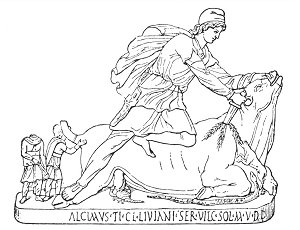
cumom05

Fig. 10.
TAUROCTONOUS MITHRA.

(Marble group of the second century, British Museum.)

The remarkable feature of this group is that not blood, but three spikes of wheat, issue from the wound of the bull. According to the Mithraic theory, wheat and the vine sprang from the spinal cord and the blood of the sacrificed animal (see the Chapter on "The Doctrine of the Mithraic Mysteries").

It is impossible for us to follow the detailed steps in its advancement, to distinguish the concurrent influences exercised by the different churches, to draw up a picture of the work of conversion, pursuing its course from city to city and province to province. All that we can do is to indicate in large outlines in what countries the new faith was propagated and who were in general the champions that advocated it.

The principal agent of its diffusion was undoubtedly the army. The Mithraic religion is predominantly a religion of soldiers, and it was not without good reason that the name of milites was given to a certain grade of initiates. The influence of the army may appear less capable of affording an explanation when one reflects that under the emperors the legions were quartered in stationary encampments, and from the time of Hadrian at least (117-138 A.D.) they were severally recruited from the provinces in which they were stationed. But this general rule was subject to numerous exceptions. Thus, for example, the Asiatics contributed for a long time the bulk of the effective troops in Dalmatia and Msia, and for a certain period in Africa also. Furthermore, the soldier who after several years of service in his native country had been promoted to the rank of centurion was as a rule transferred to some foreign station; and after he had passed through the different stages of his second charge he was often assigned to a new garrison, so that the entire body of centurions of any one legion constituted "a sort of microcosm of the empire." 5 These officers were a potent source of influence, for their very position insured to them a considerable moral influence over the conscripts whom it was their vocation to instruct. In addition to this individual propaganda, which is almost totally withdrawn from our ken, the temporary or permanent transfers of single detachments, and sometimes of entire regiments, to remotely situated fortresses or camps brought together people of all races and beliefs. Finally, there were to be found side by side with the legionaries who were Roman citizens, an equal, if not a greater, number of foreign auxilia, who did not, like their comrades, enjoy the privilege of serving in their native country. Indeed, in order to forestall local uprisings, it was a set part of the imperial policy to remove these foreign troops as far as possible from the country of their origin. Thus, under the Flavians, the indigenous alor cohorts formed but a minimal fraction of the auxiliaries that guarded the frontiers of the Rhine and the Danube.

Among the recruits summoned from abroad to take the place of the national troops sent to distant parts were numerous Asiatics, and perhaps no country of the Orient furnished, relatively to the extent of its territory, a greater number of Roman soldiers than Commagene, where Mithraism had struck deepest root. In addition to horsemen and legionaries, there were levied in this country, probably at the time of its union with the empire, at least six cohorts of allies (auxilia). Numerous also were the native soldiers of Cappadocia, Pontus, and Cilicia, not to speak of Syrians of all classes; and the Cars did not scruple even to enroll those agile squadrons of Parthian cavalry with whose warlike qualities they had, to their own cost, but too often been made acquainted.

The Roman soldier was, as a rule, pious and even superstitious. The many perils to which he was exposed caused him to seek unremittingly the protection of Heaven, and an incalculable number of dedicatory inscriptions bears witness both to the vivacity of his faith and to the variety of his beliefs. The Orientals especially, transported for twenty years and more into countries which were totally strange to them, piously preserved the memories of their national divinities, and whenever the opportunity offered, they did not fail to assemble for the purpose of rendering them devotion. They had experienced the need of conciliating the great lord (Baal), whose anger as little children they had learned to fear. Their worship also offered an occasion for reunion, and for recalling to memory under the gloomy climates of the North their distant country. But their brotherhoods were not exclusive; they gladly admitted to their rites those of their companions in arms, of whatever origin, whose aspirations the official religion of the army failed to satisfy, and who hoped to obtain from the foreign god more efficacious succor in their combats, or, in case of death, a happier lot in the life to come. Afterwards, these neophytes, transferred to other garrisons according to the exigencies of the service or the necessities of war, from converts became converters, and formed about them a new nucleus of proselytes. In this manner, the Mysteries of Mithra, first brought to Europe by semi-barbarian recruits from Cappadocia or Commagene, were rapidly disseminated to the utmost confines of the ancient world.

From the banks of the Black Sea to the mountains of Scotland and to the borders of the great Sahara Desert, along the entire length of the Roman frontier, Mithraic monuments abound. Lower Msia, which was not explored until very recently, has already furnished a number of them,--a circumstance which will not excite our astonishment when it is remembered that Oriental contingents supplied in this province the deficiency of native conscripts. To say nothing of the port of Tomi, legionaries practised the Persian cult at Tromis, at Durostorum, and at scus, as well as at the Tropm Traiani, which the discovery of the monuments of Adam-Klissi has recently rendered celebrated.

In the interior of the country, this cult penetrated to Montana and to Nicopolis; and it is doubtless from these northern cities that it crossed the Balkans and spread into the northern parts of Thrace, notably above Serdica (Sofia) and as far as the environs of Philippopolis in the valley of the Hebrus. Ascending the Danube, it gained a footing at Viminacium, the capital of Upper Msia; but we are ignorant of the extent to which it spread in this country, which is still imperfectly explored. The naval flotilla that patrolled the waters of this mighty river was manned and even commanded by foreigners, and the fleet undoubtedly disseminated the Asiatic religion in all the ports it touched.

We are better informed regarding the circumstances of the introduction of Mithraism into Dacia. When in 107 A.D. Trajan annexed this barbarous kingdom to the Roman empire, the country, exhausted by six years of obstinate warfare, was little more than a desert. To repopulate it, the emperor transported to it, as Eutropius 6 tells us, multitudes of colonists "ex toto orbe Romano," from all the territories of Rome. The population of this country was even more mixed in the second century than it is to-day, where all the races of Europe are still bickering and battling with one another. Besides the remnants of the ancient Dacians, were found here Illyrians and Pannonians, Galatians, Carians, and Asiatics, people from Edessa and Palmyra, and still others besides, all of whom continued to practise the religions of their native countries. But none of these cults prospered more than the Mysteries of Mithra, and one is astounded at the prodigious development that this religion took during the 150 years that the Roman domination lasted in this region. It flourished not only in the capital of the province, Sarmizegetusa, and in the cities that sprang up near the Roman camps, like Potasa and notably Apulum, but along the entire extent of the territory occupied by the Romans. Whereas one cannot find in Dacia, so far as I know, the slightest vestige of a Christian community, from the fortress Szamos Ujvar to the northern frontier and as far as Romula in Wallachia, multitudes of inscriptions, of sculptures, and of altars which have escaped the destruction of mithrms have been found. These dris especially abound in the central portions of the country, along the great causeway that followed the course of the valley of the Maros, the principal artery by which the civilization of Rome spread into the mountains of the surrounding country. The single colony of Apulum counted certainly four temples of the Persian deity, and the spelm of Sarmizegetusa, recently excavated, still contains the fragments of a round fifty of bas-reliefs and other votive tablets which the piety of the faithful had there consecrated to their god.

Likewise in Pannonia, the Iranian religion implanted itself in the fortified cities that formed the chain of Roman defences along the Danube, in Cusum, Intercisa, Aquincum, Brigetio, Carnuntum, Vindobona, and even in the hamlets of the interior. It was especially powerful in the two principal places of this double province, in Aquincum and in Carnuntum; and in both of these cities the causes of its greatness are easily discovered. The first-named city, where in the third century the Mysteries were celebrated in at least five temples scattered over its entire area, was the headquarters of the legio II adjutrix, 7 which had been formed in the year 70 A.D. by Vespasian from sailors of the fleet stationed at Ravenna. Among the freedmen thus admitted into the regular army, the proportion of Asiatics was considerable, and it is probable that from the very beginning Mithraism counted a number of adepts in this irregular legion. When towards the year 120 A.D. it was established by Hadrian in Lower Pannonia, it undoubtedly brought with it to this place the Oriental cult to which it appears to have remained loyal to the day of its dissolution. The legio I adjutrix, which had a similar origin, probably sowed the fertile seeds of Mithraism in like manner in Brigetio, when under Trajan its camp was transferred to that place.

We can determine with even greater precision the manner in which the Persian god arrived at Carnuntum. In 71 or 72 A.D., Vespasian caused this important strategic position to be occupied by the legio XV Apollinaris, which for the preceding eight or nine years had been warring in the Orient. Sent in 63 A.D. to the Euphrates to reinforce the army which Corbulo was leading against the Parthians, it had taken part during the years 67 to 70 A.D. in suppressing the uprisings of the Jews, and had subsequently accompanied Titus to Alexandria. The losses which this veteran legion had suffered in these sanguinary campaigns were doubtless made good with recruits levied in Asia. These conscripts were for the most part probably natives of Cappadocia, and it was they that, after their transportation to the Danube with the old rank and file of the legion, there first offered sacrifices to the Iranian god whose name had been hitherto unknown in the region north of the Alps. There has been found at Carnuntum a votive Mithraic inscription due to a soldier of the Apollinarian legion bearing the characteristic name of Barbarus. The first worshippers of the Sol Invictus consecrated to him on the banks of the river a semicircular grotto, which had to be restored from its ruins in the third century by a Roman knight, and whose high antiquity is evidenced in all its details. When, some forty years after its arrival in the Occident, Trajan again transported the fifteenth legion to the Euphrates, the Persian cult had already struck deep roots in the capital of Upper Pannonia. Not only the fourteenth legion, gemina Martia, which replaced that which had returned to Asia, but also the sixteenth and the thirteenth gemin certain detachments of which were, as it appears, connected with the first-mentioned legion, succumbed to the allurements of the Mysteries and counted initiates in their own ranks. Soon the first temple was no longer adequate, and a second was built, which--and this is an important fact--immediately adjoined the temple of Jupiter Dolichenus of Commagene. A municipality having developed alongside the camp and the conversions continuing to multiply, a third mithrm was erected, probably towards the beginning of the second century, and its dimensions surpass those of all similar structures hitherto discovered. It was enlarged by Diocletian and the princes associated with him in 307 A.D., when they held their conference at Carnuntum. Thus these princes sought to give public testimony of their devotion to Mithra in this holy city, which of all those in the North probably contained the most ancient sanctuaries of the Mazdean sect.

This warlike post, the most important in the entire region, seems also to have been the religious center from which the foreign cult radiated into the smaller towns of the surrounding country. Stix-Neusiedl, where it was certainly practised from the middle of the second century, was only a dependent village of this powerful city. But farther to the south the temple of Scarbantia was enriched by a decurio coloniCarnunti. Towards the east the territory of uinoctium has furnished a votive inscription to the PetrGenetrici, and still farther off at Vindobona (Vienna) the soldiers of the tenth legion had likewise learned doubtless from the neighboring camp, to celebrate the Mysteries. Even in Africa, traces are found of the influence which the great Pannonian city exercised on the development of Mithraism.

Several leagues from Vienna, passing across the frontier of Noricum, we come upon the hamlet of Commagen the name of which is doubtless due to the fact that a squadron of Commageneans (an ala Commagenorum) was there quartered. One is not surprised, therefore, to learn that a bas-relief of the tauroctonous god has been discovered here. Nevertheless, in this province, as in Rhia, the army does not seem to have taken, as it did in Pannonia, an active part in the propagation of the Asiatic religion. A belated Inscription of a speculator legionis I Noricorum is the only one in these countries that mentions a soldier; and generally the monuments of the Mysteries are very sparsely scattered in the valley of the Upper Danube, where the Roman troops were concentrated. They are not found in increased numbers until the other slope of the Alps is reached, and the epigraphy of this last-named region forbids us to assign to them a military origin.

cumom05

Fig. 11.
SUN-GOD.

(Fragment from the grand bas-relief of Virunum, in Noricum.

On the other hand, the marvellous extension that Mithraism took in the two Germanies is undoubtedly due to the powerful army corps that defended that perpetually menaced territory. We find here an inscription dedicated by a centurion to the Soli Invicto Mithr about the year 148 A.D., and it is probable that in the middle of the second century this god had already obtained a goodly number of converts in the Roman garrisons. All the regiments appear to have been seized with the contagion: the legions VIII Augusta, XII Primigenia, and XXX Ulpia, the cohorts and auxiliary al as well as the picked troops of citizen volunteers.
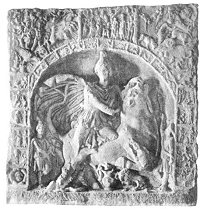
cumom05

Fig. 12.
MITHRAIC BAS-RELIEF OF OSTERBURKEN.

(Discovered in 1861 near the ruins of a Roman fort, in the Odenwald, Hesse.

So general a diffusion prevents us from telling exactly from what side the foreign religion entered this country, but it may be assumed without fear of error that, save possibly at a certain few points, it was not imported directly from the Orient, but was transmitted through the agency of the garrisons on the Danube; and if we wish to assign absolutely the circumstances of its origin we may take it for granted, with every likelihood of truth, that the eighth legion, which was transferred from Msia to Upper Germany in the year 70 A.D., first practised there the religion which was soon destined to become the preponderating one of this country.

Of all countries Germany is that in which the greatest number of mithrms, or places of Mithraic worship, has been discovered. Germany has given us the bas-reliefs having the greatest dimensions and furnishing the most complete representations; and certainly no god of paganism ever found in this nation as many enthusiastic devotees as Mithra. The Agri Decumates, a strip of land lying on the right bank of the Rhine and forming the military confines of the empire, together with the advance posts of the Roman military system between the river Main and the fortified walls of the limes, have been marvellously fertile in discoveries. North of Frankfort, near the village of Heddernheim, the ancient civitas Taunensium, three important temples have been successively exhumed (Figs. 13, 14), three others existed in Friedberg in Hesse and three more have been dug out in the surrounding country.
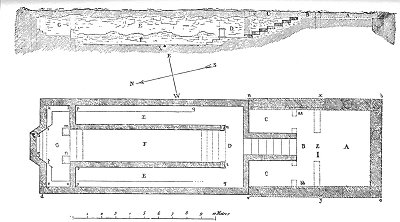
cumom05

PLAN OF A MITHRM DISCOVERED AT HEDDERNHEIM.

A. Pronaos with colonnade.--B. Entrance to stairway.--CC. Sacristy (apparatorium?)--D. Vestibule.--E. Benches ranged along the sides.--F. Space reserved for celebrants.--G. Apse containing the sacred images.

On the other side, along the entire course of the Rhine, from Augst (Raurica) near Basel as far as Xanten (Vetera), passing through Strassburg, Mayence, Neuwied, Bonn, Cologne, and Dormagen, a series of monuments have been found which show clearly the manner in which the new faith spread like an epidemic, and was disseminated into the very heart of the barbarous tribes of the Ubians and Batavians.
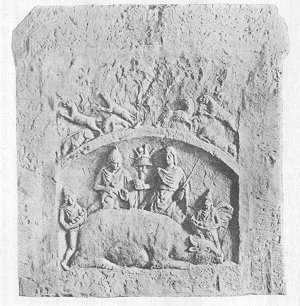
cumom05

Fig. 14.
REVERSE OF THE GRAND MITHRAIC BAS-RELIEF OF HEDDERNHEIM, GERMANY.

The influence of Mithraism among the troops massed along the Rhenish frontier is also proved by the extension of this religion into the interior of Gaul.

cumom05

Fig. 15.
BAS-RELIEF OF NEUENHEIM, NEAR HEIDELBERG, GERMANY.

This monument, which escaped mutilation at the hands of the early fanatics, was discovered in 1838 in a cave near Neuenheim, a village on the southern slope of the Heiligenberg, near Heidelberg, by workmen who were laying the foundation of a farmhouse. It is interesting as distinctly showing in a series of small bas-reliefs twelve important scenes from the life of Mithra, including the following: His birth from the rocks (top of left border), his capture of the bull, which he carries to the cave (right hand border), his ascent to Ahura-Mazda (top border). The second scene from the top of the left border is likewise interesting; it represents Kronos (Zervan) handing to Zeus (Ahura-Mazda) the scepter of the government of the world.

A soldier of the eighth legion dedicated an altar to the Deo Invicto at Geneva, which lay on the military road from Germany to the Mediterranean; and other traces of the Oriental cult have been found in modern Switzerland and the French Jura. In Sarrebourg (Pons Saravi) at the mouth of the pass leading from the Vosges Mountains, by which Strassburg communicated and still communicates with the basins of the Mosel and the Seine, a spelm has recently been exhumed that dates from the third century; another, of which the principal bas-relief, carved from the living rock, still subsists to our day, existed at Schwarzerden, between Metz and Mayence. It would be surprising that the great city of Treves, the regular residence of the Roman military commanders, has preserved only some dris of inscriptions and statues, did not the important re which this city played under the successors of Constantine explain the almost total disappearance of the monuments of paganism. Finally, in the valley of the Meuse, not far from the route that joins Cologne with Bavay (Bagacum), some curious remains of the Mysteries have been discovered.

From Bavay, this route leads to Boulogne (Gesoriacum), the naval base of the classis Britannica or Britannic fleet. The statues of the two dadophors, or torch-bearers, which have been found here and were certainly chiselled on the spot, were doubtless offered to the god by some foreign mariner or officer of the fleet. It was the object of this important naval station to keep in daily touch with the great island that lay opposite, and especially with London, which even at this epoch was visited by numerous merchants. The existence of a mithrm in this principal commercial and military depot of Britain should not surprise us. Generally speaking, the Iranian cult was in no country so completely restricted to fortified places as in Britain. Outside of York (Eburacum), where the headquarters of the troops of the province were situated, it was disseminated only in the west of the country, at Caleon (Isca) and at Chester (Deva), where camps had been established to repel the inroads of the Gallic tribes of the Silures and the Ordovices; and finally in the northern outskirts of the country along the wall of Hadrian, which protected the territory of the empire from the incursions of the Picts and the Caledonians. All the stations of this line of ramparts appear to have had their Mithraic temple, where the commander of the place (prectus) furnished an example of devotion for his subordinates. It is evident, therefore, that the Asiatic god had penetrated in the train of the army to these northern regions, but it is impossible to determine precisely the period at which he reached this place or the troops by whom he was carried there. But there is reason for believing that Mithra was worshipped in these countries from the middle of the second century, and that Germany 8 served as the intermediary agent between the far Orient

"Et penitus toto divisos orbe Britannos."

At the other extremity of the Roman world the Mysteries were likewise celebrated by soldiers. They had their adepts in the third legion encamped at Lambe and in the posts that guarded the defiles of the Aurasian Mountains or that dotted the frontiers of the Sahara Desert. Nevertheless, they do not appear to have been as popular to the south of the Mediterranean as in the countries to the north, and their propagation has assumed here a special character. Their monuments, nearly all of which date from later epochs, are due to the officers, or at least to the centurions, many of whom were of foreign origin, rather than to the simple soldiers, nearly all of whom were levied in the country which they were charged to defend. The legionaries of Numidia remained faithful to their indigenous gods, who were either Punic or Berber in origin, and only rarely adopted the beliefs of the companions with whom their vocation of arms had thrown them in contact. Apparently, therefore, the Persian religion was practised in Africa almost exclusively by those whom military service had called to these countries from abroad; and the bands of the faithful were composed for the most part, if not of Asiatics, at least of recruits drawn from the Danubian provinces.

Finally, in Spain, the country of the Occident which is poorest in Mithraic monuments, the connection of their presence with that of the garrisons is no less manifest. Throughout the entire extent of this vast peninsula, in which so many populous cities were crowded together, they are almost totally lacking, even in the largest centers of urban population. Scarcely the faintest vestige of an inscription is found in Emerita and Tarraco, the capitals of Lusitania and Tarraconensis. But in the uncivilized valleys of Asturias and Gallia the Iranian god had an organized cult. This fact will be immediately connected with the prolonged sojourn of a Roman legion in this country, which remained so long unsubjugated. Perhaps the conventicles of the initiated also included veterans of the Spanish cohorts who, after having served as auxiliaries on the Rhine and the Danube, returned to their native hearths converted to the Mazdean faith.

The army thus united in the same fold citizens and emigrants from all parts of the world; kept up an incessant interchange of officers and centurions and even of entire army-corps from one province to another, according to the varying needs of the day; in fine, threw out to the remotest frontiers of the Roman world a net of perpetual communications. Yet this was not the only way in which the military system contributed to the dissemination of Oriental religions. After the expiration of their term of service, the soldiers continued in their places of retirement the practices to which they had become accustomed under the standards of the army; and they soon evoked in their new environment numerous imitators. Frequently they settled in the neighborhood of their latest station, in the little towns which had gradually replaced in the neighborhood of the military camps the shops of the sutlers. At times, too, they would choose their homes in some large city of the country where they had served, to pass there with their old comrades in arms the remainder of their days. Lyons always sheltered within its walls a large number of these veteran legionaries of the German army, and the only Mithraic inscription that London has furnished us was written by a soldier emeritus of the troops of Britain. It was customary also for the emperor to send discharged soldiers to some region where a colony was to be founded; Elusa in Aquitania was probably made acquainted with the Asiatic cult by Rhenish veterans whom Septimius Severus (193-211 A.D.) established in this region. Frequently, the conscripts whom the military authorities transported to the confines of the empire retained at heart their love for their native country, with which they never ceased to sustain relations; but when, after twenty or twenty-five years of struggle and combat, they returned to their native country, they preferred to the gods of their own city or tribe, the foreign deity whose mysterious worship some military comrade had taught them in distant lands.

Nevertheless, the propagation of Mithraism in the towns and country districts of the provinces in which no armies were stationed was due in great measure to other agencies. By her continued conquests in Asia, Rome had subjected to her domination numerous Semitic provinces. After the founding of the empire had assured peace to the entire Roman world and permanently insured the safety of commerce, these new subjects, profiting by the special aptitudes of their race, could be seen gradually concentrating in their hands the entire traffic of the Levant. As the Phnicians and Carthaginians formerly, so now the Syrians populated with their colonies all the shores of the Mediterranean. In the Hellenic epoch they had established themselves in the commercial centers of Greece, and notably at Delos. A number of these merchants now flocked to the vicinity of Rome, settling at Pozzuoli and at Ostia. They appear to have carried on business in all the maritime cities of the Occident. They are found in Italy at Ravenna, Aquileia, and Tergeste; at Salonin Dalmatia, and as far distant as Malaga in Spain. Their mercantile activity even led them into the distant interior of these countries at every point where there was the least prospect of profit. In the valley of the Danube they penetrated as far as Sarmizegetusa and Apulum in Dacia, and as far as Sirmium in Pannonia. In Gaul, this Oriental population was particularly dense. They reached Bordeaux by the Gironde and ascended the Rhone as far as Lyons. After occupying the banks of this river, they flocked into the interior of the province, and Treves, the great capital of the north, attracted them in hordes. They literally filled the Roman world. Even the later invasions of the barbarians were impotent to dampen their spirit of enterprise. Under the Merovingians they still spoke their Semitic idiom at Orleans. Their emigration was only checked when the Saracens destroyed the navigation of the Mediterranean.

The Syrians were distinguished in all epochs by their ardent zeal. No people, not even the Egyptians, defended their idols with such great pertinacity against the Christians. So, when they founded a colony, their first care was to organize their national cults, and the mother country frequently allowed them generous subsidies towards the performance of this pious duty. It was in this manner that the deities of Heliopolis, of Damascus, and Palmyra first penetrated to Italy.

The word Syrian had in popular usage a very vague significance. This word, which was an abbreviation of Assyrian, was frequently confounded with it, and served to designate generally all the Semitic populations anciently subject to the kings of Nineveh, as far east as, and even beyond, the Euphrates. It embraced, therefore, the sectaries of Mithra established in the valley of this river; and as Rome extended her conquests in this quarter, the worshippers of the Persian god necessarily became more and more numerous among the "Syrians" who dwelt in the Latin cities.

Nevertheless, the majority of the merchants that founded the commercial houses of the Occident were servitors of the Semitic Baals, and those who invoked Mithra were generally Asiatics in humbler conditions of life. The first temples which this god possessed in the west of the empire were without doubt mainly frequented by slaves. The mangones, or slavemongers, procured their human merchandise preferably from the provinces of the Orient. From the depths of Asia Minor they drove to Rome hordes of slaves purchased from the great landed proprietors of Cappadocia and of Pontus; and this imported population, as one ancient writer has put it, ultimately came to form distinct towns or quarters in the great capital. But the supply did not suffice for the increasing consumption of depopulated Italy. War also was a mighty purveyor of human chattels. When we remember that Titus, in a single campaign in Jud (70 A.D.), reduced to slavery 90,000 Jews, our imagination becomes appalled at the multitudes of captives that the incessant struggles with the Parthians, and particularly the conquests of Trajan, must have thrown on the markets of the Occident.

But whether taken en masse after some great victory, or acquired singly by the professional traffickers in human flesh, these slaves were particularly numerous in the maritime towns, to which their transportation was cheap and easy. They introduced here, concurrently with the Syrian merchants, the Oriental cults and particularly that of Mithra. This last-named god has been found established in an entire series of ports on the Mediterranean. We signalize above all his presence at Sidon in Phnicia and at Alexandria in Egypt. In Italy, if Pozzuoli and its environs, including Naples, have furnished relatively few monuments of the Mysteries, the reason is that this city had ceased in the second century to be the great entrep from which Rome derived its supplies from the Levant. The Tyrian colony of Pozzuoli, at one time wealthy and powerful, complains in the year 172 A.D. of being reduced to a small settlement. After the immense structures of Claudius and Trajan were erected at Ostia, this latter city inherited the prosperity of its Campanian rival; and the result was that all the Asiatic religions soon had here their chapels and their congregations of devotees. Yet none enjoyed greater favor than that of the Iranian god.

cumom05

Fig 16.
PLAN OF A MITHRM DISCOVERED IN OSTIA, AT THE MOUTH OF THE TIBER.

BB. Benches ranged along the sides.--C. Entrance.--D. Exit leading to the Baths of Antoninus.--E. Elevated choir bearing the sacred images.--F. Stairway.--G. Retiring room.--HH. Niches for statues.--II. Supporting walls.

The inscription trace in the mosaic of the pavement reads: Soli invict(o) Mit(hr d(onum) d(edit) L Agrius Calendio.

cumom05

Fig. 17. SILVANUS.

Mosaic in a niche of the vestibule of the mithrm of Fig. 16, in Ostia, near the Baths of Antoninus. Silvanus holds in one hand a fir branch, in the other a hatchet. See the Chapter on "The Doctrine of the Mithraic Mysteries."

In the second century, at least four or five spel had been dedicated to him. One of them, constructed at the latest in 162 A.D., and communicating with the baths of Antoninus, was situated on the very spot where the foreign ships landed (Fig. 16), and another one adjoined the metroon, or sanctuary in which the official cult of the Magna Mater was celebrated. To the south the little hamlet of Antium (Porto d'Anzio) had followed the example of its powerful neighbor; while in Etruria, Rusell(Grosseto) and Pislikewise accorded a favorable reception to the Mazdean deity.

In the east of Italy, Aquileia is distinguished for the number of its Mithraic inscriptions. As Trieste to-day, so Aquileia in antiquity was the market in which the Danubian provinces exchanged their products for those of the South. Pola, at the extremity of Istria, the islands of Arba and Brattia, and the sea-ports of the coast of Dalmatia, Senia, Iader, Salon Narona, Epidaurus, including Dyrrachium in Macedonia, have all preserved more or less numerous and indubitable vestiges of the influence of the invincible god, and distinctly mark the path which he followed in his journey to the commercial metropolis of the Adriatic. (See Frontispiece.)

His progress may also be followed in the western Mediterranean. In Sicily at Syracuse and Palermo, on the coast of Africa at Carthage, Rusicada, Icosium, Carea, on the opposite shores of Spain at Malaga and Tarraco, Mithraic associations were successively formed in the motley population which the sea had carried to these cities. And farther to the north, on the Gulf of Lyons, the proud Roman colony of Narbonne doffed its exclusiveness in his favor.

cumom05

Fig. 18.
STATUES OF TORCH-BEARERS (DADOPHORI)

From the same mithrm at Ostia, now in the Lateran. See the Chapter on "The Doctrine of the Mithraic Mysteries."

In Gaul, especially, the correlation which we have discovered between the spread of the Mysteries and the extension of Oriental traffic is striking. Both were principally concentrated between the Alps and the Cennes, or to be more precise, in the basin of the Rhone, the course of which had been the main route of its penetration. Sextantio, near Montpellier, has given us the epitaph of a pater sacrorum, and Aix in the Provence a presumably Mithraic representation of the sun on his quadriga. Then, ascending the river, we find at Arles a statue of the leontocephalous Kronos who was worshipped in the Mysteries; at Bourg-Saint-Andl, near Montimar, a representation of the tauroctonous god sculptured from the living rock near a spring; at Vaison, not far from Orange, a dedicatory inscription made on the occasion of an initiation; at Vienne, a spelm from which, among other monuments, has been obtained the most unique bas-relief of the lion-headed god hitherto discovered. Finally, at Lyons, which is known from the history of Christianity to have had direct relations with Asia Minor, the success of the Persian religion was certainly considerable. Farther up the river, its presence has been proved at Geneva on the one hand and at Besann and Mandeure on the Doubs, a branch of the Saone, on the other. An unbroken series of sanctuaries which were without doubt in constant communication with one another thus bound together the shores of the great inland sea and the camps of Germany.

Sallying forth from the flourishing cities of the valley of the Rhone, the foreign cult crept even into the depths of the mountains of Dauphiny, Savoy, and Bugey. Labie near Gap, Lucey not far from Belley, and Vieu-en-Val Romey have preserved for us inscriptions, temples, and statues dedicated by the faithful. As we have said, the Oriental merchants did not restrict their activity to establishing agencies in the maritime and river ports; the prospect of more lucrative trade attracted them to the villages of the interior, where competition was less active. The dispersion of the Asiatic slaves was even more complete. Scarcely had they disembarked from their ships, when they were scattered haphazard in every direction by the auctioneers, and we find them in all the different countries discharging the most diverse functions.

In Italy, a country of great estates and ancient municipalities, either they went to swell the armies of slaves who were tilling the vast domains of the Roman aristocracy, or they were afterwards promoted to the rank of superintendents (actor, villicus) and became the masters of those whose miserable lot they had formerly shared. Sometimes they were acquired by some municipality, and as public servants (servi publici) they carried out the orders of the magistrates or entered the bureaus of the administrations. It is difficult to realize the rapidity with which the Oriental religions were in this way able to penetrate to regions which it would appear they could never possibly have attained. A double inscription at Ners in the heart of the Apennines, informs us that in the year 172 of our era a slave, the treasurer of the town, had restored a mithrm that had fallen into ruins. At Venusia, a Greek inscription Ἡλίῳ Μίθρᾳ was dedicated by the steward of some wealthy burgher, and his name Sagaris at once proves his servile rank and Asiatic origin. The examples could be multiplied. There is not a shadow of a doubt that these obscure servitors of the foreign god were the most active agents in the propagation of the Mysteries, not only within the limits of the city of Rome itself, and in the other great cities of the country, but throughout the entire extent of Italy, from Calabria to the Alps. We find the Iranian cult practised at Grumentum, in the heart of Lucania; then, as we have already said, at Venusia in Apulia, and at Nersin the country of the ui, also at Aveia in the land of the Vestini; then in Umbria, along the Flaminian road, at Interamna, at Spoletum, where one can visit a spelm decorated with paintings, and at Sentinum, where there has been discovered a list of the patrons of a collegium of Mithraists; likewise, in Etruria this religion followed the Cassian way and established itself at Sutrium, at Bolsena, and perhaps at Arretium and at Florence. Its traces are no less well marked and significant to the north of the Apennines. They appear only sporadically in Emilia, where the provinces of Bologna and Modena alone have preserved some interesting dris, as they do also in the fertile valley of the Po. Here Milan, which rapidly grew to prosperity under the empire, appears to be the only locality in which the exotic religion enjoyed great favor and official protection. Some fragments of inscriptions exhumed at Tortona, Industria, and Novara are insufficient to prove that it attained in the remainder of the country any wide-spread diffusion.

It is certainly remarkable that we have unearthed far richer booty in the wild defiles of the Alps than in the opulent plains of upper Italy. At Introbbio, in the Val Sassina to the east of Lake Como, in the Val Camonica, watered by the river Oglio, altars were dedicated to the invincible god. But the monuments which were consecrated to him especially abound along the river Adige (Etsch) and its tributaries, near the grand causeway which led in antiquity as it does to-day over the Brenner pass and Puster-Thal to the northern slope of the Alps into Rhia and Noricum. At Trent, there is a mithrm built near a cascade; near San-Zeno, bas-reliefs have been found in the rocky gorges; at Castello di Tuenno, fragments of votive tablets carved on both faces have been unearthed; on the banks of the Eisack, there has been found a dedicatory inscription to Mithra and to the Sun; and Mauls finally has given us the celebrated sculptured plaque discovered in the sixteenth century and now in the museum at Vienna.

The progress of Mithraism in this mountainous district was not checked at the frontiers of Italy. If, pursuing our way through the valley of the Drave, we seek for the vestiges which it left in this region, we shall immediately discover them at Teurnia and especially at Virunum, the largest city of Noricum, in which in the third century two temples at least had been opened to the initiated. A third one was erected not far from the same place in a grotto in the midst of the forest.

The city of Aquileia 9 was undoubtedly the religious metropolis of this Roman colony, and its important church founded many missions in the surrounding region. The cities that sprang up along the routes leading from this port across Pannonia to the military strongholds on the Danube almost without exception favorably received the foreign god: they were ona, the Latobici, Neviodunum, and principally Siscia, on the course of the Save; and then toward the north Adrans, Celeia, Poetovio, received him with equal favor. In this manner, his devotees who were journeying from the shores of the Adriatic to Msia, on the one hand, or to Carnuntum on the other, could be received at every stage of their journey by co-religionists.

In these regions, as in the countries south of the Alps, Oriental slaves acted as the missionaries of Mithra. But the conditions under which their propaganda was conducted were considerably different. These slaves were not employed in this country, as they were in the latifundia and the cities of Italy, as agricultural laborers, or stewards of wealthy land-owners, or municipal employees. Depopulation had not created such havoc here as in the countries of the old civilization, and people were not obliged to employ foreign hands for the cultivation of their fields or the administration of their cities. It was not individuals or municipalities, but the state itself, that was here the great importer of human beings. The procurators, the officers of the treasury, the officers of the imperial domains, or as in Noricum the governors themselves, had under their orders a multitude of collectors of taxes, of treasurers, and clerks of all kinds, scattered over the territory which they administered; and as a rule these subaltern officers were not of free birth. Likewise, the great entrepreneurs who leased the products of the mines and quarries, or the customs returns, employed for the execution of their projects a numerous staff of functionaries, both hired and slave. From people of this class, who were either agents of the emperor or publicans whom he appointed to represent him, are those whose titles recur most frequently in the Mithraic inscriptions of southern Pannonia and Noricum.

In all the provinces, the lowly employees of the imperial service played a considerable part in the diffusion of foreign religions. just as these officers of the central power were representatives of the political unity of the empire in contrast with its regional particularism, so also they were the apostles of the universal religions as opposed to the local cults. They formed, as it were, a second army under the orders of their prince, and their influence on the evolution of paganism was analogous to that of the army proper. Like the soldiers, they too were recruited in great numbers from the Asiatic countries; like them, they too were perpetually changing their residence as they were promoted in station; and the lists of their bureaus, like those of the legions, comprised individuals of all nationalities.

Thus, the imperial administration transferred from one government to another, along with its clerks and quartermasters, a knowledge of the Mithraic Mysteries. In a characteristic discovery made at Carea in Cappadocia, a slave, probably of indigenous origin, an arcarius dispensatoris Augusti (a clerk of the imperial treasury), dedicates in very good Latin an image of the Sun to Mithra. In the interior of Dalmatia, where the monuments of the Persian god are rather sparsely scattered for the reason that this province was early stripped of its legions, employees of the treasury, the postal and the customs service, left nevertheless their names on some inscriptions. In the frontier provinces especially, the financial agents of the Cars must have been numerous, not only because the import duties on merchandise had to be collected here, but because the heaviest drain on the imperial treasuries was the cost of maintaining the army. It is therefore natural to find cashiers, tax-gatherers, and revenue-collectors (dispensatores, exactores, procuratores), and other similar titles mentioned in the Mithraic texts of Dacia and Africa.

Here, therefore, is the second way in which the Iranian god penetrated to the towns adjoining the military camps, where, as we have seen, he was worshipped by the Oriental soldiers. The general domestic service, as well as the political functions, of these administrators and officers, was the cause of the transportation of public and private slaves to all garrisons; while the constantly renewed needs of the multitudes here assembled attracted to these points merchants and traders from all parts of the world. Then again, as we have pointed out, the veterans themselves afterwards settled in the ports and the large cities, where they were thrown in contact with merchants and slaves. In affirming categorically that Mithra was introduced in this or that manner in a certain region, our generalization manifestly cannot lay claim to absolute exactitude. The concurrent causes of the spread of the Mysteries are so intermingled and intertwined, that it would be a futile task to attempt to unravel strand by strand the fibers of this entangled snarl. Having as our sole guide, as we frequently do, inscriptions of uncertain date, on which by the side of the name of the god appears simply that of an initiate or priest, it is impossible to determine in each single case the circumstances which have fostered the progress of the new religion. The more fleeting influences are almost absolutely removed from our ken. On the accession of Vespasian (69 A.D.), did the prolonged sojourn in Italy of Syrian troops, who were faithful worshippers of the Sun, have any lasting results? Did the army which Alexander Severus (222-235 A.D.) conducted into Germany, and which, as Lampridius has recorded, 10 was potentissima per Armenios et Osrhnos et Parthos (viz., very largely composed of Armenians, Osrhnians, and Parthians), impart a new impulse to the Mithraic propaganda on the banks of the Rhine? Did any of the high functionaries that Rome sent annually to the frontier of the Euphrates embrace the beliefs of the people over whom they ruled? Did priests from Cappadocia or Pontus ever embark for the Occident after the manner of the missionaries of the Syrian goddess, in the expectation of wresting there a livelihood from the credulity of the masses? Even under the republic Chaldn astrologers roamed the great causeways of Italy, and in the time of Juvenal the soothsayers of Commagene and Armenia vended their oracles in Rome. These subsidiary methods of propagation, which were generally resorted to by the Oriental religions, may also have been put to profitable use by the disseminators of Mithraism; but the most active agents of its diffusion were undoubtedly the soldiers, the slaves, and the merchants. Apart from the detailed proofs already adduced, the presence of Mithraic monuments in places where war and commerce were, constantly conducted, and in the countries where the vast current of Asiatic emigration was discharged, is sufficient to establish our hypothesis.

The absence of these monuments in other regions is also clear proof of our position. Why are no vestiges of the Persian Mysteries found in Asia Propria, in Bithynia, in Galatia, in the provinces adjoining those where they were practised for centuries? Because the production of these countries exceeded their consumption, because their foreign commerce was in the hands of Greek ship-owners, because they exported men instead of importing them, and because from the time of Vespasian at least no legion was charged with the defence or surveillance of their territory. Greece was protected from the invasion of foreign gods by its national pride, by its worship of its glorious past, which is the most characteristic trait of the Grecian spirit under the empire. But the absence of foreign soldiers and slaves also deprived it of the least occasion of lapsing from its national religion. Lastly, Mithraic monuments are almost completely missing in the central and western parts of Gaul, in the Spanish peninsula, and in the south of Britain, and they are rare even in the interior of Dalmatia. In these places also no permanent army was stationed; there was consequently no importation of Asiatics; while there was also in these countries no great center of international commerce to attract them.

On the other hand, the city of Rome is especially rich in discoveries of all kinds, more so in fact than any of the provinces. In fact Mithra found in no other part of the empire conditions so eminently favorable to the success of his religion. Rome always had a large garrison made up of soldiers drawn from all parts of the empire, and the veterans of the army, after having been honorably discharged, flocked thither in great numbers to spend the remainder of their days. An opulent aristocracy resided here, and their palaces, like those of the emperor, were filled with thousands of Oriental slaves. It was the seat of the central imperial administration, the official slaves of which thronged its bureaus. Finally, all whom the spirit of adventure, or disaster, had driven hither in search of fame and fortune flocked to this "caravansary of the universe," and carried thither their customs and their religions. Collaterally, the presence in Rome of numbers of Asiatic princelings, who lived there, either as hostages or fugitives, with their families and retinues, also abetted the propagation of the Mazdean faith.

Like the majority of the foreign gods, Mithra undoubtedly had his first temples outside of the pomoerium, or religious limits. Many of his monuments have been discovered beyond these boundaries, especially in the vicinity of the prorian camp; but before the year 181 A.D. he had overleaped the sacred barriers and established himself in the heart of the city. It is unfortunately impossible to follow step by step his progress in the vast metropolis. Records of exact date and indubitable origin are too scarce to justify us in reconstructing the local history of the Persian religion in Rome. We can only determine in a general way the high degree of splendor which it attained there. Its vogue is attested by a hundred or more inscriptions, by more than seventy-five fragments of sculpture, and by a series of temples and chapels situated in all parts of the city and its environs. The most justly celebrated of these spel is the one that still existed during the Renaissance in a cave of the Capitol, and from which the grand Borghesi bas-relief now in the Louvre was taken. To all appearances, this monument dates from the end of the second century.

It was at this period that Mithra emerged from the partial obscurity in which he had hitherto lived, to become one of the favorite gods of the Roman aristocracy and the imperial court. We have seen him arrive from the Orient a despised deity of the deported or emigrant Asiatics. It is certain that he achieved his first conquests among the lower classes of society, and it is an important fact that Mithraism long remained the religion of the lowly. The most ancient inscriptions are eloquent evidence of the truth of this assertion, for they emanated without exception from slaves or freedmen, from soldiers active or retired. But the high destinies to which freedmen were permitted to aspire under the empire are well known; while the sons of veterans or of centurions not infrequently became citizens of wealth and influence. Thus, by a natural evolution the religion transplanted to Latin soil was bound to wax great in wealth as well as in influence, and soon to count among its sectaries influential functionaries at the capital, and church and town dignitaries in the municipalities. Under the Antonines (138-180 A.D.), literary men and philosophers began to grow interested in the dogmas and rites of this Oriental cult. The wit Lucian parodied their ceremonies 11 ; and in 177 A.D. Celsus in his True Discourse undoubtedly pits its doctrines against those of Christianity. 12 At about the same period a certain Pallas devoted to Mithraism a special work, and Porphyry cites a certain Eubulus who had published Mithraic Researches 13 in several books. If this literature were not irrevocably lost to us, we should doubtless re-read in its pages the story of entire Roman squadrons, both officers and soldiers, passing over to the faith of the hereditary enemies of the empire, and of great lords converted by the slaves of their own establishments. The monuments frequently mention the names of slaves beside those of freedmen, and sometimes it is the former that have attained the highest rank among the initiates. In these societies, the last frequently became the first, and the first the last,--to all appearances at least.

One capital result emerges from the detailed facts which we have adduced. It is that the spread of the Persian Mysteries must have taken place with extreme rapidity. With the suddenness of a flash of gunpowder, they make their appearance almost simultaneously in countries far removed from one another: in Rome, at Carnuntum on the Danube, and in the Agri Decumates. Manifestly, this reformed church of Mazdaism exercised on the society of the second century a powerful fascination, of which to-day we can only imperfectly ascertain the causes.

But to the natural allurements which drew crowds to the feet of the tauroctonous god was added an extrinsic element of the highest efficacy: the imperial favor. Lampridius 14 informs us that Commodus (180-192 A.D.) was initiated into the Mysteries and took part in the bloody ceremonies of its liturgy, and the inscriptions prove that this condescension of the monarch toward the priests of Mithra created an immense stir in the Roman world, and told enormously in favor of the Persian religion. From this moment the exalted dignitaries of the empire are seen to follow the example of their sovereign and to become zealous cultivators of the Iranian cult. Tribunes, prefects, legates, and later perfectissimi and clarissimi, are frequently mentioned as authors of the votive inscriptions; and until the downfall of paganism the aristocracy remained attached to the solar god that had so long enjoyed the favor of princes. But to understand the political and moral motives of the kindly reception which these dignitaries accorded to the new faith, it will be necessary to expound the Mithraic doctrines concerning the sovereign power and their connection with the theocratic claims of the Cars.

Footnotes

1 Named from the city of Doliche, now Doluk, in Commagene.
2 Plutarch, Vit. Pomp., 24 (T. et M., Vol. II., p. 35 d.).
3 Statius, Theb., 1., 717: Persei sub rupibus antri Indignata sequi torquentem cornua Mithram.
4 Plut., l. c.
5 Jung, Fasten der Provinz Dacien, 1894, p. xlv.
6 Eutropius, VIII, 6.
7 One of the legions raised by the proconsuls in the Roman provinces for the purpose of strengthening the veteran army.--Trans.
8 See supra.
9 Cf. supra, p. 67. See also Frontispiece.
10 Lamprid., Alex. Sev., c. 61; cf. Capitol., Maximin., c. 11.
11 Lucian, Menipp. c. 6 et seq. Cf. Deor. concil., c. 9; Jup. trag., c. 8, 13 (T. et M., Vol. II, p. 22).
12 Origen, Contra. Cels., I. 9 (T. et M., Vol. II, p. 30).
13 Porphyr,. De antr. nymph., c. 5; De abstin., II. 56, IV. 16 (cf. T. et M., Vol. II, p. 39 et seq. and I., p. 26 et seq.
14 Lamprid., Commod., c. 9 ( T. et M., Vol. II, p. 21). See infra, Chap. III.

THE ORIGINS OF MITHRAISM

THE MYSTERIES OF MITHRA

by Franz Cumont

translated from the second revised French edition by Thomas J. McCormack

Chicago, Open Court

[1903]

THE ORIGINS OF MITHRAISM

IN THAT unknown epoch when the ancestors of the Persians were still united with those of the Hindus, they were already worshippers of Mithra. The hymns of the Vedas celebrated his name, as did those of the Avesta, and despite the differences obtaining between the two theological systems of which these books were the expression, the Vedic Mitra and the Iranian Mithra have preserved so many traits of resemblance that it is impossible to entertain any doubt concerning their common origin. Both religions saw in him a god of light, invoked together with Heaven, bearing in the one case the name of Varuna and in the other that of Ahura; in ethics he was recognized as the protector of truth, the antagonist of falsehood and error. But the sacred poetry of India has preserved of him an obscured memory only. A single fragment, and even that partially effaced, is all that has been specially dedicated to him. He appears mainly in incidental allusions,--the silent witnesses of his ancient grandeur. Still, though his physiognomy is not so distinctly limned in the Sanskrit literature as it is in the Zend writings, the faintness of its outlines is not sufficient to disguise the primitive identity of his character.

According to a recent theory, this god, with whom the peoples of Europe were unacquainted, was not a member of the ancient Aryan pantheon. Mitra-Varuna, and the five other Adityas celebrated by the Vedas, likewise Mithra-Ahura and the Amshaspands, who, according to the Avestan conception surround the Creator, are on this theory nothing but the sun, the moon, and the planets, the worship of which was adopted by the Indo-Iranians "from a neighboring people, their superiors in the knowledge of the starry firmament," who could be none other than the Accadian or Semitic inhabitants of Babylonia. 1 But this hypothetical adoption, if it really took place, must have occurred in a prehistoric epoch, and, without attempting to dissipate the obscurity of these primitive times, it will be sufficient for us to state that the tribes of Iran never ceased to worship Mithra from their first assumption of worldly power till the day of their conversion to Islam.

In the Avesta, Mithra is the genius of the celestial light. He appears before sunrise on the rocky summits of the mountains; during the day he traverses the wide firmament in his chariot drawn by four white horses, and when night falls he still illumines with flickering glow the surface of the earth, "ever waking, ever watchful." He is neither sun, nor moon, nor stars, but with "his hundred ears and his hundred eyes" watches constantly the world. Mithra hears all, sees all, knows all: none can deceive him. By a natural transition he became for ethics the god of truth and integrity, the one that was invoked in solemn oaths, that pledged the fulfilment of contracts, that punished perjurers.

The light that dissipates darkness restores happiness and life on earth; the heat that accompanies it fecundates nature. Mithra is "the lord of wide pastures," the one that renders them fertile. "He giveth increase, he giveth abundance, he giveth cattle, he giveth progeny and life." He scatters the waters of the heavens and causes the plants to spring forth from the ground; on them that honor him, he bestows health of body, abundance of riches, and talented posterity. For he is the dispenser not only of material blessings but of spiritual advantages as well. His is the beneficent genius that accords peace of conscience, wisdom, and honor along with prosperity, and causes harmony to reign among all his votaries. The devas, who inhabit the places of darkness, disseminate on earth along with barrenness and suffering all manner of vice and impurity. Mithra, "wakeful and sleepless, protects the creation of Mazda" against their machinations. He combats unceasingly the spirits of evil; and the iniquitous that serve them feel also the terrible visitations of his wrath. From his celestial eyrie he spies out his enemies; armed in fullest panoply he swoops down upon them, scatters and slaughters them. He desolates and lays waste the homes of the wicked, he annihilates the tribes and the nations that are hostile to him. On the other hand he is the puissant ally of the faithful in their warlike expeditions. The blows of their enemies "miss their mark, for Mithra, sore incensed, receives them"; and he assures victory unto them that "have had fit instruction in the Good, that honor him and offer him the sacrificial libations." 2

This character of god of hosts, which has been the predominating trait of Mithra from the days of the Achenides, undoubtedly became accentuated in the period of confusion during which the Iranian tribes were still at war with one another; but it is after all only the development of the ancient conception of struggle between day and night. In general, the picture that the Avesta offers us of the old Aryan deity, is, as we have already said, similar to that which the Vedas have drawn in less marked outlines, and it hence follows that Mazdaism left its main primitive foundation unaltered.

Still, though the Avestan hymns furnish the distinctest glimpses of the true physiognomy of the ancient god of light, the Zoroastrian system, in adopting his worship, has singularly lessened his importance. As the price of his admission to the Avestan Heaven, he was compelled to submit to its laws. Theology had placed Ahura-Mazda on the pinnacle of the celestial hierarchy, and thenceforward it could recognize none as his peer. Mithra was not even made one of the six Amshaspands that aided the Supreme Deity in governing the universe. He was relegated, with the majority of the ancient divinities of nature, to the host of lesser genii or yazatas created by Mazda. He was associated with some of the deified abstractions which the Persians had learned to worship. As protector of warriors, he received for his companion, Verethraghna, or Victory; as the defender of the truth, he was associated with the pious Sraosha, or Obedience to divine law, with Rashnu, Justice, with Arsht, Rectitude. As the tutelar genius of prosperity, he is invoked with Ashi-Vahi, Riches, and with Pe Abundance. In company with Sraosha and Rashnu, he protects the soul of the just against the demons that seek to drag it down to Hell, and under their guardianship it soars aloft to Paradise. This Iranian belief gave birth to the doctrine of redemption by Mithra, which we find developed in the Occident.

At the same time, his cult was subjected to a rigorous ceremonial, conforming to the Mazdean liturgy. Sacrificial offerings were made to him of "small cattle and large, and of flying birds." These immolations were preceded or accompanied with the usual libations of the juice of Haoma, and with the recitation of ritual prayers,--the bundle of sacred twigs (baresman) always in the hand. But before daring to approach the altar, the votary was obliged to purify himself by repeated ablutions and flagellations. These rigorous prescriptions recall the rite of baptism and the corporeal tests imposed on the Roman neophytes before initiation.

Mithra, thus, was adopted in the theological system of Zoroastrianism; a convenient place was assigned to him in the divine hierarchy; he was associated with companions of unimpeachable orthodoxy; homage was rendered to him on the same footing with the other genii. But his puissant personality had not bent lightly to the rigorous restrictions that had been imposed upon him, and there are to be found in the sacred text vestiges of a more ancient conception, according to which he occupied in the Iranian pantheon a much more elevated position. Several times he is invoked in company with Ahura: the two gods form a pair, for the light of Heaven and Heaven itself are in their nature inseparable. Furthermore, if it is said that Ahura created Mithra as he did all things, it is likewise said that he made him just as great and worthy as himself. Mithra is indeed a yazata, but he is also the most potent and most glorious of the yazata. "Ahura-Mazda established him to maintain and watch over all this moving world." 3 It is through the agency of this ever-victorious warrior that the Supreme Being destroys the demons and causes even the Spirit of Evil, Ahriman himself, to tremble.

Compare these texts with the celebrated passage in which Plutarch 4 expounds the dualistic doctrine of the Persians: Oromazes dwells in the domain of eternal light "as far above the sun as the sun is distant from the earth"; Ahriman reigns in the realm of darkness, and Mithra occupies an intermediary place between them. The beginning of the Bundahish 5 expounds a quite similar theory, save that in place of Mithra it is the air (Vayu) that is placed between Ormazd and Ahriman. The contradiction is only one of terms, for according to Iranian ideas the air is indissolubly conjoined with the light, which it is thought to support. In fine, a supreme god, enthroned in the empyrean above the stars, where a perpetual serenity exists; below him an active deity, his emissary and chief of the celestial armies in their ceaseless combat with the Spirit of Darkness, who from the bowels of Hell sends forth his devas to the surface of the earth,--this is the religious conception, far simpler than that of Zoroastrianism, which appears to have been generally accepted among the subjects of the Achenides.

The conspicuous re that the religion of the ancient Persians accorded to Mithra is attested by a multitude of proofs. He alone, with the goddess Anita, is invoked in the inscriptions of Artaxerxes alongside of Ahura-Mazda. The "great kings" were certainly very closely attached to him, and looked upon him as their special protector. It is he whom they call to bear witness to the truth of their words, and whom they invoke on the eve of battle. They unquestionably regarded him as the god that brought victory to monarchs; he it was, they thought, who caused that mysterious light to descend upon them which, according to the Mazdean belief, is a guaranty of perpetual success to princes, whose authority it consecrates.

The nobility followed the example of the sovereign. The great number of theophorous, or god-bearing, names, compounded with that of Mithra, which were borne by their members from remotest antiquity, is proof of the fact that the reverence for this god was general among them.

Mithra occupied a large place in the official cult. In the calendar the seventh month was dedicated to him and also doubtless the sixteenth day of each month. At the time of his festival, the king, if we may believe Ctesias, 6 was permitted to indulge in copious libations in his honor and to execute the sacred dances. Certainly this festival was the occasion of solemn sacrifices and stately ceremonies. The Mithrakana were famed throughout all Hither Asia, and in their form Mihrag were destined, in modern times, to be celebrated at the commencement of winter by Mussulman Persia. The fame of Mithra extended to the borders of the ean Sea; he is the only Iranian god whose name was popular in ancient Greece, and this fact alone proves how deeply he was venerated by the nations of the great neighboring empire.

The religion observed by the monarch and by the entire aristocracy that aided him in governing his vast territories could not possibly remain confined to a few provinces of his empire. We know that Artaxerxes Ochus had caused statues of the goddess Anita to be erected in his different capitals, at Babylon, Damascus, and Sardis, as well as at Susa, Ecbatana, and Persepolis. Babylon, in particular, being the winter residence of the sovereigns, was the seat of a numerous body of official clergy, called Magi, who sat in authority over the indigenous priests. The prerogatives that the imperial protocol guaranteed to this official clergy could not render them exempt from the influence of the powerful sacerdotal caste that flourished beside them. The erudite and refined theology of the Chaldns was thus superposed on the primitive Mazdean belief, which was rather a congeries of traditions than a well -established body of definite dogmas. The legends of the two religions were assimilated, their divinities -were identified, and the Semitic worship of the stars (astrolatry), the monstrous fruit of long-continued scientific observations, became amalgamated with the nature-myths of the Iranians. Ahura-Mazda was confounded with Bel, who reigned over the heavens; Anita was likened to Ishtar, who presided over the planet Venus; while Mithra became the Sun, Shamash. As Mithra in Persia, so Shamash in Babylon is the god of justice; like him, he also appears in the east, on the summits of mountains, and pursues his daily course across the heavens in a resplendent chariot; like him, finally, he too gives victory to the arms of warriors, and is the protector of kings. The transformation wrought by Semitic theories in the beliefs of the Persians was of so profound a character that, centuries after, in Rome, the original home of Mithra was not infrequently placed on the banks of the Euphrates. According to Ptolems, 7 this potent solar deity was worshipped in all the countries that stretched from India to Assyria.

But Babylon was a step only in the propagation of Mazdaism. Very early the Magi had crossed Mesopotamia and penetrated to the heart of Asia Minor. Even under the first of the Achenides, it appears, they established themselves in multitudes in Armenia, where the indigenous religion gradually succumbed to their cult, and also in Cappadocia, where their altars still burned in great numbers in the days of the famous geographer Strabo. They swarmed, at a very remote epoch, into distant Pontus, into Galatia, into Phrygia. In Lydia even, under the reign of the Antonines, their descendants still chanted their barbaric hymns in a sanctuary attributed to Cyrus. These communities, in Cappadocia at least, were destined to survive the triumph of Christianity and to be perpetuated until the fifth century of our era, faithfully transmitting from generation to generation their manners, usages, and modes of worship.

At first blush the fall of the empire of Darius would appear to have been necessarily fatal to these religious colonies, so widely scattered and henceforward to be severed from the country of their birth. But in point of fact it was precisely the contrary that happened, and the Magi found in the Diadochi, the successors of Alexander the Great, no less efficient protection than that which they enjoyed under the Great King and his satraps. After the dismemberment of the empire of Alexander (323 B.C.), there were established in Pontus, Cappadocia, Armenia, and Commagene, dynasties which the complaisant genealogists of the day feigned to trace back to the Achenian kings. Whether these royal houses were of Iranian extraction or not, their supposititious descent nevertheless imposed upon them the obligation of worshipping the gods of their fictitious ancestors. In opposition to the Greek kings of Pergamon and Antioch, they represented the ancient traditions in religion and politics. These princes and the magnates of their entourage took a sort of aristocratic pride in slavishly imitating the ancient masters of Asia. While not evincing outspoken hostility to other religions practised in their domains, they yet reserved especial favors for the temples of the Mazdean divinities. Oromazes (Ahura-Mazda), Omanos (Vohumano), Artagnes (Verethraghna), Anais (Anita), and still others received their homage. But Mithra, above all, was the object of their predilection. The monarchs of these nations cherished for him a devotion that was in some measure personal, as the frequency of the name Mithradates in all their families attests. Evidently Mithra had remained for them, as he had been for Artaxerxes and Darius, the god that granted monarchs victory,--the manifestation and enduring guaranty of their legitimate rights.

This reverence for Persian customs, inherited from legendary ancestors, this idea that piety is the bulwark of the throne and the sole condition of success, is explicitly affirmed in the pompous inscription 8 engraved on the colossal tomb that Antiochus I., Epiphanes, of Commagene (69-34 B.C.), erected on a spur of the mountain-range Taurus, commanding a distant view of the valley of the Euphrates (Figure I). But, being a descendant by his mother of the Seleucidof Syria, and supposedly by his father of Darius, son of Hystaspes, the king of Commagene merged the memories of his double origin, and blended together the gods and the rites of the Persians and the Greeks, just as in his own dynasty the name of Antiochus alternated with that of Mithridates.

Similarly in the neighboring countries, the Iranian princes and priests gradually succumbed to the growing power of the Grecian civilization. Under the Achenides, all the different nations lying between the Pontus Euxinus and Mount Taurus were suffered by the tolerance of the central authority to practise their local cults, customs, and languages. But in the great confusion caused by the collapse of the Persian empire, all political and religious barriers were demolished. Heterogeneous races had suddenly come in contact with one another, and as a result Hither Asia passed through a phase of syncretism analogous to that which is more distinctly observable under the Roman empire.

cumom04

KING ANTIOCHUS AND MITHRA.
(Bas-relief of the colossal temple built by Antiochus I. of Commagene, 69-31 B.C., on the Nemrood Dagh, a spur of the Taurus Mountains.

The contact of all the theologies of the Orient and all the philosophies of Greece produced the most startling combinations, and the competition between the different creeds became exceedingly brisk. Many of the Magi, from Armenia to Phrygia and Lydia, then doubtless departed from their traditional reserve to devote themselves to active propaganda, and like the Jews of the same epoch they succeeded in gathering around them numerous proselytes. Later, when persecuted by the Christian emperors, they were obliged to revert to their quondam exclusiveness, and to relapse into a rigorism that became more and more inaccessible.

It was undoubtedly during the period of moral and religious fermentation provoked by the Macedonian conquest that Mithraism received approximately its definitive form. It was already thoroughly consolidated when it spread throughout the Roman empire. Its dogmas and its liturgic traditions must have been firmly established from the beginning of its diffusion. But unfortunately we are unable to determine precisely either the country or the period of time in which Mazdaism assumed the characteristics that distinguished it in Italy. Our ignorance of the religious movements that agitated the Orient in the Alexandrian epoch, the almost complete absence of direct testimony bearing on the history of the Iranian sects during the first three centuries before our era, are our main obstacles in obtaining certain knowledge of the development of Parseeism. The most we can do is to unravel the principal factors that combined to transform the religion of the Magi of Asia Minor, and endeavor to show how in different regions varying influences variously altered its original character.

In Armenia, Mazdaism had coalesced with the national beliefs of the country and also with a Semitic element imported from Syria. Mithra remained one of the principal divinities of the syncretic theology that issued from this triple influence. As in the Occident, some saw in Mithra the genius of fire, others identified him with the sun; and fantastic legends were woven about his name. He was said to have sprung from the incestuous intercourse of Ahura-Mazda with his own mother, and again to have been the offspring of a common mortal. We shall refrain from dwelling upon these and other singular myths. Their character is radically different from the dogmas accepted by the Occidental votaries of the Persian god. That peculiar admixture of disparate doctrines which constituted the religion of the Armenians appears to have had no other relationship with Mithraism than that of a partial community of origin.

In the remaining portions of Asia Minor the changes which Mazdaism underwent were far from being as profound as in Armenia. The opposition between the indigenous cults and the religion whose Iranian origin its votaries delighted in recalling, never ceased to be felt. The pure doctrine of which the worshippers of fire were the guardians could not reconcile itself easily with the orgies celebrated in honor of the lover of Cybele. Nevertheless, during the long centuries that the emigrant Magi lived peacefully among the autochthonous tribes, certain amalgamations of the conceptions of the two races could not help being effected. In Pontus, Mithra is represented on horseback like Men, the lunar god honored throughout the entire peninsula. In other places, he is pictured in broad, slit trousers (anaxyrides), recalling to mind the mutilation of Attis. In Lydia, Mithra-Anita became Sabazius-Anais. Other local divinities likewise lent themselves to identification with the powerful yazata. It would appear as if the priests of these uncultured countries had endeavored to make their popular gods the compeers of those whom the princes and nobility worshipped. But we have too little knowledge of the religions of these countries to determine the precise features which they respectively derived from Parseeism or imparted to it. That there was a reciprocal influence we definitely know, but its precise scope we are unable to ascertain. Still, however superficial it may have been, 9 it certainly did prepare for the intimate union which was soon to be effected in the West between the Mysteries of Mithra and those of the Great Mother.

cumom04

Fig. 2.
IMPERIAL COINS OF TRAPEZUS (TREBIZOND), A CITY OF PONTUS.

Representing a divinity on horseback resembling both Men and Mithra, and showing that in Pontus the two were identified.

a. Bronze coins. Obverse: Bust of Alexander Severus, clad in a paludamentum; head crowned with laurel. Reverse: The composite Men-Mithra in Oriental costume, wearing a Phrygian cap, and mounted on a horse that advances toward the right. In front, a flaming altar. On either side, the characteristic Mithraic torches, respectively elevated and reversed. At the right, a tree with branches overspreading the horseman. In front, a raven bending towards him. (218 A.D.)

b. A similar coin.

c. Obverse: Alexander Severus. Reverse: Men-Mithra on horseback advancing towards the right. In the foreground, a flaming altar; in the roar, a tree upon which a raven is perched.

d. A similar coin, having on its obverse the bust of Gordianus III.

cumom04

Fig. 3.
BACTRIAN COINS.

On the coins of the Scythian kings Kanerkes and Hooerkes, who reigned over Kabul and the Northwest of India from 87 to 120 A.D., the image of Mithra is found in company with those of other Persian, Greek, and Hindu gods. These coins have little direct connection with the Mysteries as they appeared in the Occident, but they merit our attention as being the only representations of Mithra which are found outside the boundaries of the Roman world.

a. Obverse: An image of King Kanerkes. Reverse: An image of Mithra.

b. The obverse has a bust of King Hooerkes, and the reverse an image of Mithra as a goddess.

c. Bust of Hooerkes with a lunar and a solar god (Mithra) on its reverse side.

d. Bust of Hooerkes, with Mithra alone on its reverse.

e, f, g. Similar coins.

When, as the outcome of the expedition of Alexander (334-323 B.C.), the civilization of Greece spread throughout all Hither Asia, it impressed itself upon Mazdaism as far east as Bactriana. Nevertheless, Iranism, if we may employ such a designation, never surrendered to Hellenism. Iran proper soon recovered its moral autonomy, as well as its political independence; and generally speaking, the power of resistance offered by Persian traditions to an assimilation which was elsewhere easily effected is one of the most salient traits of the history of the relations of Greece with the Orient. But the Magi of Asia Minor, being much nearer to the great foci of Occidental culture, were more vividly illumined by their radiation. Without suffering themselves to be absorbed by the religion of the conquering strangers, they combined their cults with it. In order to harmonize their barbaric beliefs with the Hellenic ideas, recourse was had to the ancient practice of identification. They strove to demonstrate that the Mazdean heaven was inhabited by the same denizens as Olympus: Ahura-Mazda as Supreme Being was confounded with Zeus; Verethraghna, the victorious hero, with Heracles; Anita, to whom the bull was consecrated, became Artemis Tauropolos, and the identification went so far as to localize in her temples the fable of Orestes. Mithra, already regarded in Babylon as the peer of Shamash, was naturally associated with Helios; but he was not subordinated to him, and his Persian name was never replaced in the liturgy by a translation, as had been the case with the other divinities worshipped in the Mysteries.

cumom04

Fig. 4
TYPICAL REPRESENTATION OF MITHRA.
(Famous Borghesi bas-relief in white marble, now in the Louvre, Paris, but originally taken from the mithrm of the Capitol.)

Mithra is sacrificing the bull in the cave. The characteristic features of the Mithra monuments are all represented here: the youths with the upright and the inverted torch, the snake, the dog, the raven, Helios, the god of the sun, and Selene, the goddess of the moon. Owing to the Phrygian cap, the resemblance of the face to that of Alexander, and the imitation of the motif of the classical Greek group of Nike sacrificing a bull,--all characteristics of the Diadochian epoch,--the original of all the works of this type has been attributed to an artist of Pergamon. (T. et M., p. 194.)

cumom04

Fig. 5.
TAUROCTONOUS MITHRA.

Artistic Type.

(Bas-relief, formerly in domo AndreCinquin now in St. Petersburg.

The synonomy thus speciously established between appellations having no relationship did not remain the exclusive diversion of the mythologists; it was attended with the grave consequence that the vague personifications conceived by the Oriental imagination now assumed the precise forms with which the Greek artists had invested the Olympian gods.

cumom04

Fig. 6.
TAUROCTONOUS MITHRA.

Artistic Type (Second Century).

(Grand group of white marble, now in the Vatican.

Possibly they had never before been represented in the guise of the human form, or if images of them existed in imitation of the Assyrian idols they were doubtless both grotesque and crude. In thus imparting to the Mazdean heroes all the seductiveness of the Hellenic ideal, the conception of their character was necessarily modified; and, pruned of their exotic features, they were rendered more readily acceptable to the Occidental peoples. One of the indispensable conditions for the success of this exotic religion in the Roman world was fulfilled when towards the second century before our era a sculptor of the school of Pergamon composed the pathetic group of Mithra Tauroctonos, to which universal custom thenceforward reserved the place of honor in the apse of the spel. 10

cumom04

Fig. 7.
TAUROCTONOUS MITHRA.

Early Artistic Type.

(Bas-relief of white marble, Rome, now in the Museum of Fine Arts, Boston.)

But not only did art employ its powers to soften the repulsive features which these rude Mysteries might possess for minds formed in the schools of Greece; philosophy also strove to reconcile their doctrines with its teachings, or rather the Asiatic priests pretended to discover in their sacred traditions the theories of the philosophic sects. None of these sects so readily lent itself to alliance with the popular devotion as that of the Stoa, and its influence on the formation of Mithraism was profound. An ancient myth sung by the Magi is quoted by Dion Chrysostomos 11 on account of its allegorical resemblance to the Stoic cosmology; and many other Persian ideas were similarly modified by the pantheistic conceptions of the disciples of Zeno. Thinkers accustomed themselves more and more to discovering in the dogmas and liturgic usages of the Orientals the obscure reflections of an ancient wisdom, and these tendencies harmonized too much with the pretensions and the interest of the Mazdean clergy not to be encouraged by them with every means in their power.

But if philosophical speculation transformed the character of the beliefs of the Magi, investing them with a scope which they did not originally possess, its influence was nevertheless upon the whole conservative rather than revolutionary. The very fact that it invested legends which were ofttimes puerile with a symbolical significance, that it furnished rational explanations for usages which were apparently absurd, did much towards insuring their perpetuity. If the theological foundation of the religion was sensibly modified, its liturgic framework remained relatively fixed, and the changes wrought in the dogma were in accord with the reverence due to the ritual. The superstitious formalism of which the minute prescriptions of the Vendidad were the expression is certainly prior to the period of the Sassanids. The sacrifices which the Magi of Cappadocia offered in the time of Strabo (circa 63 B.C.-21 A.D.) are reminiscent of all the peculiarities of the Avestan liturgy. It was the same psalmodic prayers before the altar of fire; and the same bundle of sacred twigs (baresman); the same oblations of milk, oil, and honey; the same precautions lest the breath of the officiating priest should contaminate the divine flame. The inscription of Antiochus of Commagene (69-34 B.C.) in the rules that it prescribes gives evidence of a like scrupulous fidelity to the ancient Iranian customs. The king exults in having always honored the gods of his ancestors according to the tradition of the Persians and the Greeks; he expresses the desire that the priests established in the new temple shall wear the sacerdotal vestments of the same Persians, and that they shall officiate conformably to the ancient sacred custom. The sixteenth day of each month, which is to be specially celebrated, is not to be the birthday of the king alone, but also the day which from time immemorial was specially consecrated to Mithra.

cumom04

Fig. 8.
KING ANTIOCHUS AND AHURA-MAZDA.

(Bas-relief of the temple of Antiochus I. of Commagene, 69-34 B.C., on the Nemrood Dagh, a spur of the Taurus Mountains.

Many, many years after, another Commagenean, Lucian of Samosata, in a passage apparently inspired by practices he had witnessed in his own country, could still deride the repeated purifications, the interminable chants, and the long Medean robes of the sectarians of Zoroaster. 12 Furthermore, he taunted them with being ignorant even of Greek and with mumbling an incoherent and unintelligible gibberish. 13

The conservative spirit of the Magi of Cappadocia, which bound them to the time-worn usages that had been handed down from generation to generation, abated not one jot of its power after the triumph of Christianity; and St. Basil 14 has recorded the fact of its persistence as late as the end of the fourth century. Even in Italy it is certain that the Iranian Mysteries never ceased to retain a goodly proportion of the ritual forms that Mazdaism had observed in Asia Minor time out of mind. 15 The principal innovation consisted in substituting for the Persian as the liturgic language, the Greek, and later perhaps the Latin. This reform presupposes the existence of sacred books, and it is probable that subsequently to the Alexandrian epoch the prayers and canticles that had been originally transmitted orally were committed to writing, lest their memory should fade forever. But this necessary accommodation to the new environments did not prevent Mithraism from preserving to the very end a ceremonial which was essentially Persian.

The Greek name of "Mysteries" which writers have applied to this religion should not mislead us. The adepts of Mithraism did not imitate the Hellenic cults in the organization of their secret societies, the esoteric doctrine of which was made known only after a succession of graduated initiations. In Persia itself the Magi constituted an exclusive caste, which appears to have been subdivided into several subordinate classes. And those of them who took up their abode in the midst of foreign nations different in language and manners were still more jealous in concealing their hereditary faith from the profane. The knowledge of their arcana gave them a lofty consciousness of their moral superiority and insured their prestige over the ignorant populations that surrounded them. It is probable that the Mazdean priesthood in Asia Minor as in Persia was primitively the hereditary attribute of a tribe, in which it was handed down from father to son; that afterwards its incumbents consented, after appropriate ceremonies of initiation, to communicate its secret dogmas to strangers, and that these proselytes were then gradually admitted to all the different ceremonies of the cult. The Iranian diaspora is comparable in this respect, as in many others, with that of the Jews. Usage soon distinguished between the different classes of neophytes, ultimately culminating in the establishment of a fixed hierarchy. But the complete revelation of the sacred beliefs and practices was always reserved for the privileged few; and this mystic knowledge appeared to increase in excellence in proportion as it became more occult.

All the original rites that characterized the Mithraic cult of the Romans unquestionably go back to Asiatic origins: the animal disguises used in certain ceremonies are a survival of a very widely-diffused prehistoric custom which still survives in our day; the practice of consecrating mountain caves to the god is undoubtedly a heritage of the time when temples were not yet constructed; the cruel tests imposed on the initiated recall the bloody mutilations that the servitors of Mand of Cybele perpetrated. Similarly, the legends of which Mithra is the hero cannot have been invented save in a pastoral epoch. These antique traditions of a primitive and crude civilization subsist in the Mysteries by the side of a subtle theology and a lofty system of ethics.

An analysis of the constituent elements of Mithraism, like a cross-section of a geological formation, shows the stratifications of this composite mass in their regular order of deposition. The basal layer of this religion, its lower and primordial stratum, is the faith of ancient Iran, from which it took its origin.

Above this Mazdean substratum was deposited in Babylon a thick sediment of Semitic doctrines, and afterwards the local beliefs of Asia Minor added to it their alluvial deposits. Finally, a luxuriant vegetation of Hellenic ideas burst forth from this fertile soil and partly concealed from view its true original nature.

This composite religion, in which so many heterogeneous elements were welded together, is the adequate expression of the complex civilization that flourished in the Alexandrian epoch in Armenia, Cappadocia, and Pontus. If Mithridates Eupator had realized his ambitious dreams, this Hellenized Parseeism would doubtless have become the state-religion of a vast Asiatic empire. But the course of its destinies was changed by the vanquishment of this great adversary of Rome (66 B.C.). The dris of the Pontic armies and fleets, the fugitives driven out by the war and flocking in from all parts of the Orient, disseminated the Iranian Mysteries among that nation of pirates that rose to power under the protecting shelter of the mountains of Cilicia. Mithra became firmly established in this country, in which Tarsus continued to worship him until the downfall of the empire (Figure 9). Supported by its bellicose religion, this republic of adventurers dared to dispute the supremacy of the seas with the Roman colossus. Doubtless they considered themselves the chosen nation, destined to carry to victory the religion of the invincible god. Strong in the consciousness of his protection, these audacious mariners boldly pillaged the most venerated sanctuaries of Greece and Italy, and the Latin world rang for the first time with the name of the barbaric divinity that was soon to impose upon it his adoration.

cumom04

Fig. 9.
MITHRAIC MEDALLION OF BRONZE FROM TARSUS, CILICIA.

Obverse: Bust of Gordianus III., clad in a paludamentum and wearing a rayed crown. Reverse: Mithra, wearing a rayed crown and clad in a floating chlamys, a tunic covered by a breast-plate, and anaxyrides (trousers), seizes with his left band the nostrils of the bull, which he has forced to its knees, while in his right hand he holds aloft a knife with which he is about to slay the animal.

Footnotes

1 Oldenberg, Die Religion des Veda, 1894, p. 185.
2 Zend-Avesta, Yasht, X., Passim.
3 Yasht, X., 103.
4 Plutarch, De Iside et Osiride, 46-47; Textes et monuments, Vol. II., p. 33.
5 West, Pahlavi Texts, I. (also, Sacred Books of the East, V.), 1890, p. 3, et seq.
6 Ctesias apud Athen., X., 45 (Textes et monuments, hereafter cited as "T. et M.," Vol. II., p. 10).
7 Ptol., Tetrabibl., II., 2.
8 Michel, Recueil inscr. gr., No. 735. Compare T. et M., Vol. II., p. 89, No. 1.
9 M. Jean Rille (udes de thlogie et d'hist. publ. en hommage la facultde Montauban, Paris 1901, p. 336) is inclined to accord a considerable share in the formation of Mithraism to the religions of Asia; but it is impossible in the present state of our knowledge to form any estimate of the extent of this influence.
10 Compare the Chapter on ''Mithraic Art."
11 Dion Chrys., Or., XXXVI., 39, et seq. (T. et M., Vol. II., p. 60, No. 461).
12 Luc., Menipp., c. 6 (T. et M., Vol. II., p. 22).
13 Luc., Deorum conc., c. 9, Jup. Trag., c. 8, c. 13 (T. et M., ibid.)
14 Basil., Epist. 238 ad Epiph. (T. et M., Vol. I., p. 10, No. 3). Compare Priscus, fr. 31 (I. 342 Hist. min., Dind.).
15 See the Chapter on "Liturgy, Clergy."

The Origin and Deeds of the Goths, Index

JORDANES

THE ORIGIN AND DEEDS OF THE GOTHS

551 AD

translated by Charles C. Mierow

Princeton University Press, 1915

Introductory Note

Jordanes, as he himself tells us a couple of times, was of Gothic descent and wrote this work as a summary of Cassiodorus' much longer treatment of the history of the Goths. Because Cassiodorus' book no longer survives, Jordanes' treatment is often our only source for some of the Gothic history it describes. He wrote the Getica during the later stages of the reign of Justinian, not too long after the demise of the Ostrogothic kingdom in Italy.

Jordanes divided his work, apart from the brief introduction and conclusion, into four main sections (reflected in the contents below). These are :

1) a Geographical Introduction;

2) the United Goths;

3) the Visigoths;

4) and the Ostrogoths.

Other large sections, such as the discussion of the Huns, he treats as digressions of a sort (the more interesting or important of these have been added to the contents below). Mierow prefaces his translation with a detailed literary analysis of all the topics in the text; this is not, however, reproduced here.

The text of the translation presented here was scanned from a printed copy of Mierow's book and checked carefully for errors (a few misprints in that book have been corrected as well). This hypertext version has been designed for the use of students of Ancient History at the University of Calgary. I have included the (Roman) chapter and (arabic) section numbers to facilitate specific citation (or to find a specific reference; these numbers may be found in Mierow's translation as well, though the section numbers are in his margins) and have added internal links for purposes of navigation.

J. Vanderspoel,

Department of Greek, Latin and Ancient History, University of Calgary

Contents

  1. Preface

  2. Geographical Introduction

  3. The United Goths

  4. The Goths in the Third Century A.D.

  5. Origin of the Huns

  6. The Divided Goths (Visigoths)

  7. Attila the Hun; The Battle of the Catalaunian Fields

  8. The Divided Goths (Ostrogoths)

  9. Conclusion

The Origin and Deeds of the Goths, Conclusions

JORDANES

THE ORIGIN AND DEEDS OF THE GOTHS

551 AD

translated by Charles C. Mierow

Princeton University Press, 1915

Conclusion

And now we have recited the origin of the Goths, the noble line of the Amali and the deeds of brave men. This glorious race yielded to a more glorious prince and surrendered to a more valiant leader, whose fame shall be silenced by no ages or cycles of years; for the victorious and triumphant Emperor Justinian and his consul Belisarius shall be named and known as Vandalicus, Africanus and Geticus.

Thou who readest this, know that I have followed the writings of my ancestors, and have culled a few flowers from their broad meadows to weave a chaplet for him who cares to know these things. Let no one believe that to the advantage of the race of which I have spoken--though indeed I trace my own descent from it--I have added aught besides what I have read or learned by inquiry. Even thus I have not included all that is written or told about them, nor spoken so much to their praise as to the glory of him who conquered them.

The Origin and Deeds of the Goths, The Divided Goths: Ostrogoths

JORDANES

THE ORIGIN AND DEEDS OF THE GOTHS

551 AD

translated by Charles C. Mierow

Princeton University Press, 1915

The Divided Goths: Ostrogoths

Since I have followed the stories of my ancestors and retold to the best of my ability the tale of the period when both tribes, Ostrogoths and Visigoths, were united, and then clearly treated of the Visigoths apart from the Ostrogoths, I must now return to those ancient Scythian abodes and set forth in like manner the ancestry and deeds of the Ostrogoths. It appears that at the death of their king, Hermanaric, they were made a separate people by the departure of the Visigoths, and remained in their country subject to the sway of the Huns; yet Vinitharius of the Amali retained the insignia of his rule.

He rivalled the valor of his grandfather Vultuulf, although he had not the good fortune of Hermanaric. But disliking to remain under the rule of the Huns, he withdrew a little from them and strove to show his courage by moving his forces against the country of the Antes. When he attacked them, he was beaten in the first encounter. Thereafter he did valiantly and, as a terrible example, crucified their king, named Boz, together with his sons and seventy nobles, and left their bodies hanging there to double the fear of those who had surrendered.

When he had ruled with such license for barely a year, Balamber, king of the Huns, would no longer endure it, but sent for Gesimund, son of Hunimund the Great. Now Gesimund, together with a great part of the Goths, remained under the rule of the Huns, being mindful of his oath of fidelity. Balamber renewed his alliance with him and led his army up against Vinitharius. After a long contest, Vinitharius prevailed in the first and in the second conflict, nor can any say how great a slaughter he made of the army of the Huns.

But in the third battle, when they met each other unexpectedly at the river named Erac, Balamber shot an arrow and wounded Vinitharius in the head, so that he died. Then Balamber took to himself in marriage Vadamerca, the grand-daughter of Vinitharius, and finally ruled all the people of the Goths as his peaceful subjects, but in such a way that one ruler of their own number always held the power over the Gothic race, though subject to the Huns.

And later, after the death of Vinitharius, Hunimund ruled them, the son of Hermanaric, a mighty king of yore; a man fierce in war and of famous personal beauty, who afterwards fought successfully against the race of the Suavi. And when he died, his son Thorismud succeeded him, in the very bloom of youth. In the second year of his rule he moved an army against the Gepidae and won a great victory over them, but is said to have been killed by falling from his horse.

When he was dead, the Ostrogoths mourned for him so deeply that for forty years no other king succeeded in his place, and during all this time they had ever on their lips the tale of his memory. Now as time went on, Valamir grew to man's estate. He was the son of Thorismud's cousin Vandalarius. For his son Beremud, as we have said before, at last grew to despise the race of the Ostrogoths because of the overlordship of the Huns, and so had followed the tribe of the Visigoths to the western country, and it was from him Veteric was descended. Veteric also had a son Eutharic, who married Amalasuentha, the daughter of Theodoric, thus uniting again the stock of the Amali which had divided long ago. Eutharic begat Athalaric and Mathesuentha. But since Athalaric died in the years of his boyhood, Mathesuentha was taken to Constantinople by her second husband, namely Germanus, a cousin of the Emperor Justinian, and bore a posthumous son, whom she named Germanus.

But that the order we have taken for our history may run its due course, we must return to the stock of Vandalarius, which put forth three branches. This Vandalarius, the son of a brother of Hermanaric and cousin of the aforesaid Thorismud, vaunted himself among the race of the Amali because he had begotten three sons, Valamir, Thiudimer and Vidimer. Of these Valamir ascended the throne after his parents, though the Huns as yet held the power over the Goths in general as among other nations.

It was pleasant to behold the concord of these three brothers; for the admirable Thiudimer served as a soldier for the empire of his brother Valamir, and Valamir bade honors be given him, while Vidimer was eager to serve them both. Thus regarding one another with common affection, not one was wholly deprived of the kingdom which two of them held in mutual peace. Yet, as has often been said, they ruled in such a way that they respected the dominion of Attila, king or the Huns. Indeed they could not have refused to fight against their kinsmen the Visigoths, and they must even have committed parricide at their lord's command. There was no way whereby any Scythian tribe could have been wrested from the power of the Huns, save by the death of Attila,--an event the Romans and all other nations desired. Now his death was as base as his life was marvellous.

Shortly before he died, as the historian Priscus relates, he took in marriage a very beautiful girl named Ildico, after countless other wives, as was the custom of his race. He had given himself up to excessive joy at his wedding, and as he lay on his back, heavy with wine and sleep, a rush of superfluous blood, which would ordinarily have flowed from his nose, streamed in deadly course down his throat and killed him, since it was hindered in the usual passages. Thus did drunkenness put a disgraceful end to a king renowned in war. On the following day, when a great part of the morning was spent, the royal attendants suspected some ill and, after a great uproar, broke in the doors. There they found the death of Attila accomplished by an effusion of blood, without any wound, and the girl with downcast face weeping beneath her veil.

Then, as is the custom of that race, they plucked out the hair of their heads and made their faces hideous with deep wounds, that the renowned warrior might be mourned, not by effeminate wailings and tears, but by the blood of men. Moreover a wondrous thing took place in connection with Attila's death. For in a dream some god stood at the side of Marcian, Emperor of the East, while he was disquieted about his fierce foe, and showed him the bow of Attila broken in that same night, as if to intimate that the race of Huns owed much to that weapon. This account the historian Priscus says he accepts upon truthful evidence. For so terrible was Attila thought to be to great empires that the gods announced his death to rulers as a special boon.

We shall not omit to say a few words about the many ways in which his shade was honored by his race. His body was placed in the midst of a plain and lay in state in a silken tent as a sight for men's admiration. The best horsemen of the entire tribe of the Huns rode around in circles, after the manner of circus games, in the place to which he had been brought and told of his deeds in a funeral dirge in the following manner:

"The chief of the Huns, King Attila, born of his sire Mundiuch, lord of bravest tribes, sole possessor of the Scythian and German realms--powers unknown before--captured cities and terrified both empires of the Roman world and, appeased by their prayers, took annual tribute to save the rest from plunder. And when he had accomplished all this by the favor of fortune, he fell, not by wound of the foe, nor by treachery of friends, but in the midst of his nation at peace, happy in his joy and without sense of pain. Who can rate this as death, when none believes it calls for vengeance?"

When they had mourned him with such lamentations, a strava, as they call it, was celebrated over his tomb with great revelling. They gave way in turn to the extremes of feeling and displayed funereal grief alternating with joy. Then in the secrecy of night they buried his body in the earth. They bound his coffins, the first with gold, the second with silver and the third with the strength of iron, showing by such means that these three things suited the mightiest of kings; iron because he subdued the nations, gold and silver because he received the honors of both empires. They also added the arms of foemen won in the fight, trappings of rare worth, sparkling with various gems, and ornaments of all sorts whereby princely state is maintained. And that so great riches might be kept from human curiosity, they slew those appointed to the work--a dreadful pay for their labor; and thus sudden death was the lot of those who buried him as well as of him who was buried.

After they had fulfilled these rites, a contest for the highest place arose among Attila's successors,--for the minds of young men are wont to be inflamed by ambition for power,--and in their rash eagerness to rule they all alike destroyed his empire. Thus kingdoms are often weighed down by a superfluity rather than by a lack of successors. For the sons of Attila, who through the license of his lust formed almost a people of themselves, were clamoring that the nations should be divided among them equally and that warlike kings with their peoples should be apportioned to them by lot like a family estate.

When Ardaric, king of the Gepidae, learned this, he became enraged because so many nations were being treated like slaves of the basest condition, and was the first to rise against the sons of Attila. Good fortune attended him, and he effaced the disgrace of servitude that rested upon him. For by his revolt he freed not only his own tribe, but all the others who were equally oppressed; since all readily strive for that which is sought for the general advantage. They took up arms against the destruction that menaced all and joined battle with the Huns in Pannonia, near a river called Nedao.

There an encounter took place between the various nations Attila had held under his sway. Kingdoms with their peoples were divided, and out of one body were made many members not responding to a common impulse. Being deprived of their head, they madly strove against each other. They never found their equals ranged against them without harming each other by wounds mutually given. And so the bravest nations tore themselves to pieces. For then, I think, must have occurred a most remarkable spectacle, where one might see the Goths fighting with pikes, the Gepidae raging with the sword, the Rugi breaking off the spears in their own wounds, the Suavi fighting on foot, the Huns with bows, the Alani drawing up a battle-line of heavy-armed and the Heruli of light-armed warriors.

Finally, after many bitter conflicts, victory fell unexpectedly to the Gepidae. For the sword and conspiracy of Ardaric destroyed almost thirty thousand men, Huns as well as those of the other nations who brought them aid. In this battle fell Ellac, the elder son of Attila, whom his father is said to have loved so much more than all the rest that he preferred him to any child or even to all the children of his kingdom. But fortune was not in accord with his father's wish. For after slaying many of the foe, it appears that he met his death so bravely that, if his father had lived, he would have rejoiced at his glorious end.

When Ellac was slain, his remaining brothers were put to flight near the shore of the Sea of Pontus, where we have said the Goths first settled. Thus did the Huns give way, a race to which men thought the whole world must yield. So baneful a thing is division, that they who used to inspire terror when their strength was united, were overthrown separately. The cause of Ardaric, king of the Gepidae, was fortunate for the various nations who were unwillingly subject to the rule of the Huns, for it raised their long downcast spirits to the glad hope of freedom. Many sent ambassadors to the Roman territory, where they were most graciously received by Marcian, who was then emperor, and took the abodes allotted them to dwell in.

But the Gepidae by their own might won for themselves the territory of the Huns and ruled as victors over the extent of all Dacia, demanding of the Roman Empire nothing more than peace and an annual gift as a pledge of their friendly alliance. This the Emperor freely granted at the time, and to this day that race receives its customary gifts from the Roman Emperor.

Now when the Goths saw the Gepidae defending for themselves the territory of the Huns and the people of the Huns dwelling again in their ancient abodes, they preferred to ask for lands from the Roman Empire, rather than invade the lands of others with danger to themselves. So they received Pannonia, which stretches in a long plain, being bounded on the east by Upper Moesia, on the south by Dalmatia, on the west by Noricum and on the north by the Danube. This land is adorned with many cities, the first of which is Sirmium and the last Vindobona.

But the Sauromatae, whom we call Sarmatians, and the Cemandri and certain of the Huns dwelt in Castra Martis, a city given them in the region of Illyricum. Of this race was Blivila, Duke of Pentapolis, and his brother Froila and also Bessa, a Patrician in our time. The Sciri, moreover, and the Sadagarii and certain of the Alani with their leader, Candac by name, received Scythia Minor and Lower Moesia.

Paria, the father of my father Alanoviiamuth (that is to say, my grandfather), was secretary to this Candac as long as he lived. To his sister's son Gunthigis, also called Baza, the Master of the Soldiery, who was the son of Andag the son of Andela, who was descended from the stock of the Amali, I also, Jordanes, although an unlearned man before my conversion, was secretary. The Rugi, however, and some other races asked that they might inhabit Bizye and Arcadiopolis. Hernac, the younger son of Attila, with his followers, chose a home in the most distant part of Lesser Scythia. Emnetzur and Ultzindur, kinsmen of his, won Oescus and Utus and Almus in Dacia on the bank of the Danube, and many of the Huns, then swarming everywhere, betook themselves into Romania, and from them the Sacromontisi and the Fossatisii of this day are said to be descended.

There were other Goths also, called the Lesser, a great people whose priest and primate was Vulfila, who is said to have taught them to write. And to-day they are in Moesia, inhabiting the Nicopolitan region as far as the base of Mount Haemus. They are a numerous people, but poor and unwarlike, rich in nothing save flocks of various kinds and pasture-lands for cattle and forests for wood. Their country is not fruitful in wheat and other sorts of grain. Certain of them do not know that vineyards exist elsewhere, and they buy their wine from neighboring countries. But most of them drink milk.

Let us now return to the tribe with which we started, namely the Ostrogoths, who were dwelling in Pannonia under their king Valamir and his brothers Thiudimer and Vidimer. Although their territories were separate, yet their plans were one. For Valamir dwelt between the rivers Scarniunga and Aqua Nigra, Thiudimer near Lake Pelso and Vidimer between them both. Now it happened that the sons of Attila, regarding the Goths as deserters from their rule, came against them as though they were seeking fugitive slaves, and attacked Valamir alone, when his brothers knew nothing of it.

He sustained their attack, though he had but few supporters, and after harassing them a long time, so utterly overwhelmed them that scarcely any portion of the enemy remained. The remnant turned in flight and sought the parts of Scythia which border on the stream of the river Danaper, which the Huns call in their own tongue the Var. Thereupon he sent a messenger of good tidings to his brother Thiudimer, and on the very day the messenger arrived he found even greater joy in the house of Thiudimer. For on that day his son Theodoric was born, of a concubine Erelieva indeed, and yet a child of good hope.

Now after no great time King Valamir and his brothers Thiudimer and Vidimer sent an embassy to the Emperor Marcian, because the usual gifts which they received like a New Year's present from the Emperor, to preserve the compact of peace, were slow in arriving. And they found that Theodoric, son of Triarius, a man of Gothic blood also, but born of another stock, not of the Amali, was in great favor, together with his followers. He was allied in friendship with the Romans and obtained an annual bounty, while they themselves were merely held in disdain.

Thereat they were aroused to frenzy and took up arms. They roved through almost the whole of Illyricum and laid it waste in their search for spoil. Then the Emperor quickly changed his mind and returned to his former state of friendship. He sent an embassy to give them the past gifts, as well as those now due, and furthermore promised to give these gifts in future without any dispute. From the Goths the Romans received as a hostage of peace Theodoric, the young child of Thiudimer, whom we have mentioned above. He had now attained the age of seven years and was entering upon his eighth. While his father hesitated about giving him up, his uncle Valamir besought him to do it, hoping that peace between the Romans and the Goths might thus be assured. Therefore Theodoric was given as a hostage by the Goths and brought to the city of Constantinople to the Emperor Leo and, being a goodly child, deservedly gained the imperial favor.

Now after firm peace was established between Goths and Romans, the Goths found that the possessions they had received from the Emperor were not sufficient for them. Furthermore, they were eager to display their wonted valor, and so began to plunder the neighboring races round about them, first attacking the Sadagis who held the interior of Pannonia. When Dintzic, king of the Huns, a son of Attila, learned this, he gathered to him the few who still seemed to have remained under his sway, namely, the Ultzinzures, and Angisciri, the Bittugures and the Bardores. Coming to Bassiana, a city of Pannonia, he beleaguered it and began to plunder its territory.

Then the Goths at once abandoned the expedition they had planned against the Sadagis, turned upon the Huns and drove them so ingloriously from their own land that those who remained have been in dread of the arms of the Goths from that time down to the present day.

When the tribe of the Huns was at last subdued by the Goths, Hunimund, chief of the Suavi, who was crossing over to plunder Dalmatia, carried off some cattle of the Goths which were straying over the plains; for Dalmatia was near Suavia and not far distant from the territory of Pannonia, especially that part where the Goths were then staying.

So then, as Hunimund was returning with the Suavi to his own country, after he had devastated Dalmatia, Thiudimer the brother of Valamir, king of the Goths, kept watch on their line of march. Not that he grieved so much over the loss of his cattle, but he feared that if the Suavi obtained this plunder with impunity, they would proceed to greater license. So in the dead of night, while they were asleep, he made an unexpected attack upon them, near Lake Pelso. Here he so completely crushed them that he took captive and sent into slavery under the Goths even Hunimund, their king, and all of his army who had escaped the sword. Yet as he was a great lover of mercy, he granted pardon after taking vengeance and became reconciled to the Suavi. He adopted as his son the same man whom he had taken captive, and sent him back with his followers into Suavia.

But Hunimund was unmindful of his adopted father's kindness. After some time he brought forth a plot he had contrived and aroused the tribe of the Sciri, who then dwelt above the Danube and abode peaceably with the Goths. So the Sciri broke off their alliance with them, took up arms, joined themselves to Hunimund and went out to attack the race of the Goths. Thus war came upon the Goths who were expecting no evil, because they relied upon both of their neighbors as friends. Constrained by necessity they took up arms and avenged themselves and their injuries by recourse to battle.

In this battle, as King Valamir rode on his horse before the line to encourage his men, the horse was wounded and fell, overthrowing its rider. Valamir was quickly pierced by his enemies' spears and slain. Thereupon the Goths proceeded to exact vengeance for the death of their king, as well as for the injury done them by the rebels. They fought in such wise that there remained of all the race of the Sciri only a few who bore the name, and they with disgrace. Thus were all destroyed.

The kings [of the Suavi], Hunimund and Alaric, fearing the destruction that had come upon the Sciri, next made war upon the Goths, relying upon the aid of the Sarmatians, who had come to them as auxiliaries with their kings Beuca and Babai. They summoned the last remnants of the Sciri, with Edica and Hunuulf, their chieftains, thinking they would fight the more desperately to avenge themselves. They had on their side the Gepidae also, as well as no small reforcements from the race of the Rugi and from others gathered here and there. Thus they brought together a great host at the river Bolia in Pannonia and encamped there.

Now when Valamir was dead, the Goths fled to Thiudimer, his brother. Although he had long ruled along with his brothers, yet he took the insignia of his increased authority and summoned his younger brother Vidimer and shared with him the cares of war, resorting to arms under compulsion. A battle was fought and the party of the Goths was found to be so much the stronger that the plain was drenched in the blood of their fallen foes and looked like a crimson sea. Weapons and corpses, piled up like hills, covered the plain for more than ten miles.

When the Goths saw this, they rejoiced with joy unspeakable, because by this great slaughter of their foes they had avenged the blood of Valamir their king and the injury done themselves. But those of the innumerable and motley throng of the foe who were able to escape, though they got away, nevertheless came to their own land with difficulty and without glory.

After a certain time, when the wintry cold was at hand, the river Danube was frozen over as usual. For a river like this freezes so hard that it will support like a solid rock an army of foot-soldiers and wagons and carts and whatsoever vehicles there may be,--nor is there need of skiffs and boats. So when Thiudimer, king of the Goths, saw that it was frozen, he led his army across the Danube and appeared unexpectedly to the Suavi from the rear. Now this country of the Suavi has on the east the Baiovari, on the west the Franks, on the south the Burgundians and on the north the Thuringians.

With the Suavi there were present the Alamanni, then their confederates, who also ruled the Alpine heights, whence several streams flow into the Danube, pouring in with a great rushing sound. Into a place thus fortified King Thiudimer led his army in the winter-time and conquered, plundered and almost subdued the race of the Suavi as well as the Alamanni, who were mutually banded together. Thence he returned as victor to his own home in Pannonia and joyfully received his son Theodoric, once given as hostage to Constantinople and now sent back by the Emperor Leo with great gifts.

Now Theodoric had reached man's estate, for he was eighteen years of age and his boyhood was ended. So he summoned certain of his father's adherents and took to himself from the people his friends and retainers,--almost six thousand men. With these he crossed the Danube, without his father's knowledge, and marched against Babai, king of the Sarmatians, who had just won a victory over Camundus, a general of the Romans, and was ruling with insolent pride. Theodoric came upon him and slew him, and taking as booty his slaves and treasure, returned victorious to his father. Next he invaded the city of Singidunum, which the Sarmatians themselves had seized, and did not return it to the Romans, but reduced it to his own sway.

Then as the spoil taken from one and another of the neighboring tribes diminished, the Goths began to lack food and clothing, and peace became distasteful to men for whom war had long furnished the necessaries of life. So all the Goths approached their king Thiudimer and, with great outcry, begged him to lead forth his army in whatsoever direction he might wish. He summoned his brother and, after casting lots, bade him go into the country of Italy, where at this time Glycerius ruled as emperor, saying that he himself as the mightier would go to the east against a mightier empire. And so it happened.

Thereupon Vidimer entered the land of Italy, but soon paid the last debt of fate and departed from earthly affairs, leaving his son and namesake Vidimer to succeed him. The Emperor Glycerius bestowed gifts upon Vidimer and persuaded him to go from Italy to Gaul, which was then harassed on all sides by various races, saying that their own kinsmen, the Visigoths, there ruled a neighboring kingdom. And what more? Vidimer accepted the gifts and, obeying the command of the Emperor Glycerius, pressed on to Gaul. Joining with his kinsmen the Visigoths, they again formed one body, as they had been long ago. Thus they held Gaul and Spain by their own right and so defended them that no other race won the mastery there.

But Thiudimer, the elder brother, crossed the river Savus with his men, threatening the Sarmatians and their soldiers with war if any should resist him. From fear of this they kept quiet; moreover they were powerless in the face of so great a host. Thiudimer, seeing prosperity everywhere awaiting him, invaded Naissus, the first city of Illyricum. He was joined by his son Theodoric and the Counts Astat and Invilia, and sent them to Ulpiana by way of Castrum Herculis.

Upon their arrival the town surrendered, as did Stobi later; and several places of Illyricum, inaccessible to them at first, were thus made easy of approach. For they first plundered and then ruled by right of war Heraclea and Larissa, cities of Thessaly. But Thiudimer the king, perceiving his own good fortune and that of his son, was not content with this alone, but set forth from the city of Naissus, leaving only a few men behind as a guard. He himself advanced to Thessalonica, where Hilarianus the Patrician, appointed by the Emperor, was stationed with his army.

When Hilarianus beheld Thessalonica surrounded by an entrenchment and saw that he could not resist attack, he sent an embassy to Thiudimer the king and by the offer of gifts turned him aside from destroying the city. Then the Roman general entered upon a truce with the Goths and of his own accord handed over to them those places they inhabited, namely Cyrrhus, Pella, Europus, Methone, Pydna, Beroea, and another which is called Dium.

So the Goths and their king laid aside their arms, consented to peace and became quiet. Soon after these events, King Thiudimer was seized with a mortal illness in the city of Cyrrhus. He called the Goths to himself, appointed Theodoric his son as heir of his kingdom and presently departed this life.

When the Emperor Zeno heard that Theodoric had been appointed king over his own people, he received the news with pleasure and invited him to come and visit him in the city, appointing an escort of honor. Receiving Theodoric with all due respect, he placed him among the princes of his palace. After some time Zeno increased his dignity by adopting him as his son-at-arms and gave him a triumph in the city at his expense. Theodoric was made Consul Ordinary also, which is well known to be the supreme good and highest honor in the world. Nor was this all, for Zeno set up before the royal palace an equestrian statue to the glory of this great man.

Now while Theodoric was in alliance by treaty with the Empire of Zeno and was himself enjoying every comfort in the city, he heard that his tribe, dwelling as we have said in Illyricum, was not altogether satisfied or content. So he chose rather to seek a living by his own exertions, after the manner customary to his race, rather than to enjoy the advantages of the Roman Empire in luxurious ease while his tribe lived in want. After pondering these matters, he said to the Emperor: "Though I lack nothing in serving your Empire, yet if Your Piety deem it worthy, be pleased to hear the desire of my heart."

And when as usual he had been granted permission to speak freely, he said: "The western country, long ago governed by the rule of your ancestors and predecessors, and that city which was the head and mistress of the world,--wherefore is it now shaken by the tyranny of the Torcilingi and the Rugi? Send me there with my race. Thus if you but say the word, you may be freed from the burden of expense here, and, if by the Lord's help I shall conquer, the fame of Your Piety shall be glorious there. For it is better that I, your servant and your son, should rule that kingdom, receiving it as a gift from you if I conquer, than that one whom you do not recognize should oppress your Senate with his tyrannical yoke and a part of the republic with slavery. For if I prevail, I shall retain it as your grant and gift; if I am conquered, Your Piety will lose nothing--nay, as I have said, it will save the expense I now entail."

Although the Emperor was grieved that he should go, yet when he heard this he granted what Theodoric asked, for he was unwilling to cause him sorrow. He sent him forth enriched by great gifts and commended to his charge the Senate and the Roman People.

Therefore Theodoric departed from the royal city and returned to his own people. In company with the whole tribe of the Goths, who gave him their unanimous consent, he set out for Hesperia. He went in straight march through Sirmium to the places bordering on Pannonia and, advancing into the territory of Venetia as far as the bridge of the Sontius, encamped there.

When he had halted there for some time to rest the bodies of his men and pack-animals, Odoacer sent an armed force against him, which he met on the plains of Verona and destroyed with great slaughter. Then he broke camp and advanced through Italy with greater boldness. Crossing the river Po, he pitched camp near the royal city of Ravenna, about the third milestone from the city in the place called Pineta. When Odoacer saw this, he fortified himself within the city. He frequently harassed the army of the Goths at night, sallying forth stealthily with his men, and this not once or twice, but often; and thus he struggled for almost three whole years.

But he labored in vain, for all Italy at last called Theodoric its lord and the Empire obeyed his nod. But Odoacer, with his few adherents and the Romans who were present, suffered daily from war and famine in Ravenna. Since he accomplished nothing, he sent an embassy and begged for mercy.

Theodoric first granted it and afterwards deprived him of his life.

It was in the third year after his entrance into Italy, as we have said, that Theodoric, by advice of the Emperor Zeno, laid aside the garb of a private citizen and the dress of his race and assumed a costume with a royal mantle, as he had now become the ruler over both Goths and Romans. He sent an embassy to Lodoin, king of the Franks, and asked for his daughter Audefleda in marriage.

Lodoin freely and gladly gave her, and also his sons Celdebert and Heldebert and Thiudebert, believing that by this alliance a league would be formed and that they would be associated with the race of the Goths. But that union was of no avail for peace and harmony, for they fought fiercely with each other again and again for the lands of the Goths; but never did the Goths yield to the Franks while Theodoric lived.

Now before he had a child from Audefleda, Theodoric had children of a concubine, daughters begotten in Moesia, one named Thiudigoto and another Ostrogotho. Soon after he came to Italy, he gave them in marriage to neighboring kings, one to Alaric, king of the Visigoths, and the other to Sigismund, king of the Burgundians.

Now Alaric begat Amalaric. While his grandfather Theodoric cared for and protected him--for he had lost both parents in the years of childhood--he found that Eutharic, the son of Veteric, grandchild of Beremud and Thorismud, and a descendant of the race of the Amali, was living in Spain, a young man strong in wisdom and valor and health of body. Theodoric sent for him and gave him his daughter Amalasuentha in marriage.

And that he might extend his family as much as possible, he sent his sister Amalafrida (the mother of Theodahad, who was afterwards king) to Africa as wife of Thrasamund, king of the Vandals, and her daughter Amalaberga, who was his own niece, he united with Herminefred, king of the Thuringians.

Now he sent his Count Pitza, chosen from among the chief men of his kingdom, to hold the city of Sirmium. He got possession of it by driving out its king Thrasaric, son of Thraustila, and keeping his mother captive. Thence he came with two thousand infantry and five hundred horsemen to aid Mundo against Sabinian, Master of the Soldiery of Illyricum, who at that time had made ready to fight with Mundo near the city named Margoplanum, which lies between the Danube and Margus rivers, and destroyed the Army of Illyricum.

For this Mundo, who traced his descent from the Attilani of old, had put to flight the tribe of the Gepidae and was roaming beyond the Danube in waste places where no man tilled the soil. He had gathered around him many outlaws and ruffians and robbers from all sides and had seized a tower called Herta, situated on the bank of the Danube. There he plundered his neighbors in wild license and made himself king over his vagabonds. Now Pitza came upon him when he was nearly reduced to desperation and was already thinking of surrender. So he rescued him from the hands of Sabinian and made him a grateful subject of his king Theodoric.

Theodoric won an equally great victory over the Franks through his Count Ibba in Gaul, when more than thirty thousand Franks were slain in battle. Moreover, after the death of his son-in-law Alaric, Theodoric appointed Thiudis, his armor-bearer, guardian of his grandson Amalaric in Spain. But Amalaric was ensnared by the plots of the Franks in early youth and lost at once his kingdom and his life. Then his guardian Thiudis, advancing from the same kingdom, assailed the Franks and delivered the Spaniards from their disgraceful treachery. So long as he lived he kept the Visigoths united.

After him Thiudigisclus obtained the kingdom and, ruling but a short time, met his death at the hands of his own followers. He was succeeded by Agil, who holds the kingdom to the present day. Athanagild has rebelled against him and is even now provoking the might of the Roman Empire. So Liberius the Patrician is on the way with an army to oppose him. Now there was not a tribe in the west that did not serve Theodoric while he lived, either in friendship or by conquest.

When he had reached old age and knew that he should soon depart this life, he called together the Gothic counts and chieftains of his race and appointed Athalaric as king. He was a boy scarce ten years old, the son of his daughter Amalasuentha, and he had lost his father Eutharic. As though uttering his last will and testament Theodoric adjured and commanded them to honor their king, to love the Senate and Roman People and to make sure of the peace and good will of the Emperor of the East, as next after God.

They kept this command fully so long as Athalaric their king and his mother lived, and ruled in peace for almost eight years. But as the Franks put no confidence in the rule of a child and furthermore held him in contempt, and were also plotting war, he gave back to them those parts of Gaul which his father and grandfather had seized. He possessed all the rest in peace and quiet. Therefore when Athalaric was approaching the age of manhood, he entrusted to the Emperor of the East both his own youth and his mother's widowhood. But in a short time the ill-fated boy was carried off by an untimely death and departed from earthly affairs.

His mother feared she might be despised by the Goths on account of the weakness of her sex. So after much thought she decided, for the sake of relationship, to summon her cousin Theodahad from Tuscany, where he led a retired life at home, and thus she established him on the throne. But he was unmindful of their kinship and, after a little time, had her taken from the palace at Ravenna to an island of the Bulsinian lake where he kept her in exile. After spending a very few days there in sorrow, she was strangled in the bath by his hirelings.

When Justinian, the Emperor of the East, heard this, he was aroused as if he had suffered personal injury in the death of his wards. Now at that time he had won a triumph over the Vandals in Africa, through his most faithful Patrician Belisarius. Without delay he sent his army under this leader against the Goths at the very time when his arms were yet dripping with the blood of the Vandals.

This sagacious general believed he could not overcome the Gothic nation, unless he should first seize Sicily, their nursing-mother. Accordingly he did so. As soon as he entered Trinacria, the Goths, who were besieging the town of Syracuse, found that they were not succeeding and surrendered of their own accord to Belisarius, with their leader Sinderith. When the Roman general reached Sicily, Theodahad sought out Evermud, his son-in-law, and sent him with an army to guard the strait which lies between Campania and Sicily and sweeps from a bend of the Tyrrhenian Sea into the vast tide of the Adriatic.

When Evermud arrived, he pitched his camp by the town of Rhegium. He soon saw that his side was the weaker. Coming over with a few close and faithful followers to the side of the victor and willingly casting himself at the feet of Belisarius, he decided to serve the rulers of the Roman Empire. When the army of the Goths perceived this, they distrusted Theodahad and clamored for his expulsion from the kingdom and for the appointment as king of their leader Vitiges, who had been his armor bearer.

This was done; and presently Vitiges was raised to the office of king on the Barbarian Plains. He entered Rome and sent on to Ravenna the men most faithful to him to demand the death of Theodahad. They came and executed his command. After King Theodahad was slain, a messenger came from the king--for he was already king in the Barbarian Plains--to proclaim Vitiges to the people.

Meanwhile the Roman army crossed the strait and marched toward Campania. They took Naples and pressed on to Rome. Now a few days before they arrived, King Vitiges had set forth from Rome, arrived at Ravenna and married Mathesuentha, the daughter of Amalasuentha and grand-daughter of Theodoric, the former king. While he was celebrating his new marriage and holding court at Ravenna, the imperial army advanced from Rome and attacked the strongholds in both parts of Tuscany. When Vitiges learned of this through messengers, he sent a force under Hunila, a leader of the Goths, to Perusia which was beleaguered by them.

While they were endeavoring by a long siege to dislodge Count Magnus, who was holding the place with a small force, the Roman army came upon them, and they themselves were driven away and utterly exterminated. When Vitiges heard the news, he raged like a lion and assembled all the host of the Goths. He advanced from Ravenna and harassed the walls of Rome with a long siege. But after fourteen months his courage was broken and he raised the siege of the city of Rome and prepared to overwhelm Ariminum.

Here he was baffled in like manner and put to flight; and so he retreated to Ravenna. When besieged there, he quickly and willingly surrendered himself to the victorious side, together with his wife Mathesuentha and the royal treasure.

And thus a famous kingdom and most valiant race, which had long held sway, was at last overcome in almost its two thousand and thirtieth year by that conquerer of many nations, the Emperor Justinian, through his most faithful consul Belisarius. He gave Vitiges the title of Patrician and took him to Constantinople, where he dwelt for more than two years, bound by ties of affection to the Emperor, and then departed this life.

But his consort Mathesuentha was bestowed by the Emperor upon the Patrician Germanus, his cousin. And of them was born a son (also called Germanus) after the death of his father Germanus. This union of the race of the Anicii with the stock of the Amali gives hopeful promise, under the Lord's favor, to both people.

The Origin and Deeds of the Goths, The Battle of the Catalaunian Fields

JORDANES

THE ORIGIN AND DEEDS OF THE GOTHS

551 AD

translated by Charles C. Mierow

Princeton University Press, 1915

The Battle of the Catalaunian Fields

During this peace Attila was lord over all the Huns and almost the sole earthly ruler of all the tribes of Scythia; a man marvellous for his glorious fame among all nations. The historian Priscus, who was sent to him on an embassy by the younger Theodosius, says this among other things: "Crossing mighty rivers--namely, the Tisia and Tibisia and Dricca--we came to the place where long ago Vidigoia, bravest of the Goths, perished by the guile of the Sarmatians. At no great distance from that place we arrived at the village where King Attila was dwelling,--a village, I say, like a great city, in which we found wooden walls made of smooth-shining boards, whose joints so counterfeited solidity that the union of the boards could scarcely be distinguished by close scrutiny.

There you might see dining halls of large extent and porticoes planned with great beauty, while the courtyard was bounded by so vast a circuit that its very size showed it was the royal palace." This was the abode of Attila, the king of all the barbarian world; and he preferred this as a dwelling to the cities he captured.

Now this Attila was the son of Mundiuch, and his brothers were Octar and Ruas who are said to have ruled before Attila, though not over quite so many tribes as he. After their death he succeeded to the throne of the Huns, together with his brother Bleda. In order that he might first be equal to the expedition he was preparing, he sought to increase his strength by murder. Thus he proceeded from the destruction of his own kindred to the menace of all others.

But though he increased his power by this shameful means, yet by the balance of justice he received the hideous consequences of his own cruelty. Now when his brother Bleda, who ruled over a great part of the Huns, had been slain by his treachery, Attila united all the people under his own rule. Gathering also a host of the other tribes which he then held under his sway, he sought to subdue the foremost nations of the world--the Romans and the Visigoths.

His army is said to have numbered five hundred thousand men. He was a man born into the world to shake the nations, the scourge of all lands, who in some way terrified all mankind by the dreadful rumors noised abroad concerning him. He was haughty in his walk, rolling his eyes hither and thither, so that the power of his proud spirit appeared in the movement of his body. He was indeed a lover of war, yet restrained in action, mighty in counsel, gracious to suppliants and lenient to those who were once received into his protection. He was short of stature, with a broad chest and a large head; his eyes were small, his beard thin and sprinkled with gray; and he had a flat nose and a swarthy complexion, showing the evidences of his origin.

And though his temper was such that he always had great self-confidence, yet his assurance was increased by finding the sword of Mars, always esteemed sacred among the kings of the Scythians. The historian Priscus says it was discovered under the following circumstances: "When a certain shepherd beheld one heifer of his flock limping and could find no cause for this wound, he anxiously followed the trail of blood and at length came to a sword it had unwittingly trampled while nibbling the grass. He dug it up and took it straight to Attila. He rejoiced at this gift and, being ambitious, thought he had been appointed ruler of the whole world, and that through the sword of Mars supremacy in all wars was assured to him."

Now when Gaiseric, king of the Vandals, whom we mentioned shortly before, learned that his mind was bent on the devastation of the world, he incited Attila by many gifts to make war on the Visigoths, for he was afraid that Theodorid, king of the Visigoths, would avenge the injury done to his daughter. She had been joined in wedlock with Huneric, the son of Gaiseric, and at first was happy in this union. But afterwards he was cruel even to his own children, and because of the mere suspicion that she was attempting to poison him, he cut off her nose and mutilated her ears. He sent her back to her father in Gaul thus despoiled of her natural charms. So the wretched girl presented a pitiable aspect ever after, and the cruelty which would stir even strangers still more surely incited her father to vengeance.

Attila, therefore, in his efforts to bring about the wars long ago instigated by the bribe of Gaiseric, sent ambassadors into Italy to the Emperor Valentinian to sow strife between the Goths and the Romans, thinking to shatter by civil discord those whom he could not crush in battle. He declared that he was in no way violating his friendly relations with the Empire, but that he had a quarrel with Theodorid, king of the Visigoths. As he wished to be kindly received, he filled the rest of the letter with the usual flattering salutations, striving to win credence for his falsehood.

In like manner he despatched a message to Theodorid, king of the Visigoths, urging him to break his alliance with the Romans and reminding him of the battles to which they had recently provoked him. Beneath his great ferocity he was a subtle man, and fought with craft before he made war.

Then the Emperor Valentinian sent an embassy to the Visigoths and their king Theodorid, with this message:

"Bravest of nations, it is the part of prudence for us to unite against the lord of the earth who wishes to enslave the whole world; who requires no just cause for battle, but supposes whatever he does is right. He measures his ambition by his might. License satisfies his pride. Despising law and right, he shows himself an enemy to Nature herself. And thus he, who clearly is the common foe of each, deserves the hatred of all.

Pray remember--what you surely cannot forget--that the Huns do not overthrow nations by means of war, where there is an equal chance, but assail them by treachery, which is a greater cause for anxiety. To say nothing about ourselves, can you suffer such insolence to go unpunished? Since you are mighty in arms, give heed to your own danger and join hands with us in common. Bear aid also to the Empire, of which you hold a part. If you would learn how such an alliance should be sought and welcomed by us, look into the plans of the foe."

By these and like arguments the ambassadors of Valentinian prevailed upon King Theodorid. He answered them, saying: "Romans, you have attained your desire; you have made Attila our foe also. We will pursue him wherever he summons us, and though he is puffed up by his victories over divers races, yet the Goths know how to fight this haughty foe. I call no war dangerous save one whose cause is weak; for he fears no ill on whom Majesty has smiled."

The nobles shouted assent to the reply and the multitude gladly followed. All were fierce for battle and longed to meet the Huns, their foe. And so a countless host was led forth by Theodorid, king of the Visigoths, who sent home four of his sons, namely Friderich and Eurich, Retemer and Mimnerith, taking with him only the two elder sons, Thorismud and Theodorid, as partners of his toil. O brave array, sure defense and sweet comradeship, having the aid of those who delight to share in the same dangers!

On the side of the Romans stood the Patrician Aius, on whom at that time the whole Empire of the West depended; a man of such wisdom that he had assembled warriors from everywhere to meet them on equal terms. Now these were his auxiliaries: Franks, Sarmatians, Armoricians, Liticians, Burgundians, Saxons, Riparians, Olibriones (once Romans soldiers and now the flower of the allied forces), and some other Celtic or German tribes.

And so they met in the Catalaunian Plains, which are also called Mauriacian, extending in length one hundred leuva, as the Gauls express it, and seventy in width. Now a Gallic leuva measures a distance of fifteen hundred paces. That portion of the earth accordingly became the threshing-floor of countless races. The two hosts bravely joined battle. Nothing was done under cover, but they contended in open fight.

What just cause can be found for the encounter of so many nations, or what hatred inspired them all to take arms against each other? It is proof that the human race lives for its kings, for it is at the mad impulse of one mind a slaughter of nations takes place, and at the whim of a haughty ruler that which nature has taken ages to produce perishes in a moment.

But before we set forth the order of the battle itself, it seems needful to relate what had already happened in the course of the campaign, for it was not only a famous struggle but one that was complicated and confused. Well then, Sangiban, king of the Alani, smitten with fear of what might come to pass, had promised to surrender to Attila, and to give into his keeping Aureliani, a city of Gaul wherein he dwelt.

When Theodorid and Aius learned of this, they cast up great earthworks around that city before Attila's arrival and kept watch over the suspected Sangiban, placing him with his tribe in the midst of their auxiliaries. Then Attila, king of the Huns, was taken aback by this event and lost confidence in his own troops, so that he feared to begin the conflict. While he was meditating on flight--a greater calamity than death itself--he decided to inquire into the future through soothsayers.

So, as was their custom, they examined the entrails of cattle and certain streaks in bones that had been scraped, and foretold disaster to the Huns. Yet as a slight consolation they prophesied that the chief commander of the foe they were to meet should fall and mar by his death the rest of the victory and the triumph. Now Attila deemed the death of Aius a thing to be desired even at the cost of his own life, for Aius stood in the way of his plans. So although he was disturbed by this prophecy, yet inasmuch as he was a man who sought counsel of omens in all warfare, he began the battle with anxious heart at about the ninth hour of the day, in order that the impending darkness might come to his aid if the outcome should be disastrous.

The armies met, as we have said, in the Catalaunian Plains. The battle field was a plain rising by a sharp slope to a ridge, which both armies sought to gain; for advantage of position is a great help. The Huns with their forces seized the right side, the Romans, the Visigoths and their allies the left, and then began a struggle for the yet untaken crest. Now Theodorid with the Visigoths held the right wing and Aius with the Romans the left. They placed in the centre Sangiban (who, as said before, was in command of the Alani), thus contriving with military caution to surround by a host of faithful troops the man in whose loyalty they had little confidence. For one who has difficulties placed in the way of his flight readily submits to the necessity of fighting.

On the other side, however, the battle line of the Huns was arranged so that Attila and his bravest followers were stationed in the centre. In arranging them thus the king had chiefly his own safety in view, since by his position in the very midst of his race he would be kept out of the way of threatening danger. The innumerable peoples of the divers tribes, which he had subjected to his sway, formed the wings.

Amid them was conspicuous the army of the Ostrogoths under the leadership of the brothers Valamir, Thiudimer and Vidimer, nobler even than the king they served, for the might of the family of the Amali rendered them glorious. The renowned king of the Gepidae, Ardaric, was there also with a countless host, and because of his great loyalty to Attila, he shared his plans. For Attila, comparing them in his wisdom, prized him and Valamir, king of the Ostrogoths, above all the other chieftains.

Valamir was a good keeper of secrets, bland of speech and skilled in wiles, and Ardaric, as we have said, was famed for his loyalty and wisdom. Attila might well feel sure that they would fight against the Visigoths, their kinsmen. Now the rest of the crowd of kings (if we may call them so) and the leaders of various nations hung upon Attila's nod like slaves, and when he gave a sign even by a glance, without a murmur each stood forth in fear and trembling, or at all events did as he was bid.

Attila alone was king of all kings over all and concerned for all.

So then the struggle began for the advantage of position we have mentioned. Attila sent his men to take the summit of the mountain, but was outstripped by Thorismud and Aius, who in their effort to gain the top of the hill reached higher ground and through this advantage of position easily routed the Huns as they came up.

Now when Attila saw his army was thrown into confusion by this event, he thought it best to encourage them by an extemporaneous address on this wise: "Here you stand, after conquering mighty nations and subduing the world. I therefore think it foolish for me to goad you with words, as though you were men who had not been proved in action. Let a new leader or an untried army resort to that.

It is not right for me to say anything common, nor ought you to listen. For what is war but your usual custom? Or what is sweeter for a brave man than to seek revenge with his own hand? It is a right of nature to glut the soul with vengeance.

Let us then attack the foe eagerly; for they are ever the bolder who make the attack. Despise this union of discordant races! To defend oneself by alliance is proof of cowardice. See, even before our attack they are smitten with terror. They seek the heights, they seize the hills and, repenting too late, clamor for protection against battle in the open fields. You know how slight a matter the Roman attack is. While they are still gathering in order and forming in one line with locked shields, they are checked, I will not say by the first wound, but even by the dust of battle.

Then on to the fray with stout hearts, as is your wont. Despise their battle line. Attack the Alani, smite the Visigoths! Seek swift victory in that spot where the battle rages. For when the sinews are cut the limbs soon relax, nor can a body stand when you have taken away the bones. Let your courage rise and your own fury burst forth! Now show your cunning, Huns, now your deeds of arms! Let the wounded exact in return the death of his foe; let the unwounded revel in slaughter of the enemy.

No spear shall harm those who are sure to live; and those who are sure to die Fate overtakes even in peace. And finally, why should Fortune have made the Huns victorious over so many nations, unless it were to prepare them for the joy of this conflict. Who was it revealed to our sires the path through the Maeotian swamp, for so many ages a closed secret? Who, moreover, made armed men yield to you, when you were as yet unarmed? Even a mass of federated nations could not endure the sight of the Huns. I am not deceived in the issue;--here is the field so many victories have promised us. I shall hurl the first spear at the foe. If any can stand at rest while Attila fights, he is a dead man." Inflamed by these words, they all dashed into battle.

And although the situation was itself fearful, yet the presence of their king dispelled anxiety and hesitation. Hand to hand they clashed in battle, and the fight grew fierce, confused, monstrous, unrelenting--a fight whose like no ancient time has ever recorded. There such deeds were done that a brave man who missed this marvellous spectacle could not hope to see anything so wonderful all his life long.

For, if we may believe our elders, a brook flowing between low banks through the plain was greatly increased by blood from the wounds of the slain. It was not flooded by showers, as brooks usually rise, but was swollen by a strange stream and turned into a torrent by the increase of blood. Those whose wounds drove them to slake their parching thirst drank water mingled with gore. In their wretched plight they were forced to drink what they thought was the blood they had poured from their own wounds.

Here King Theodorid, while riding by to encourage his army, was thrown from his horse and trampled under foot by his own men, thus ending his days at a ripe old age. But others say he was slain by the spear of Andag of the host of the Ostrogoths, who were then under the sway of Attila. This was what the soothsayers had told to Attila in prophecy, though he understood it of Aius.

Then the Visigoths, separating from the Alani, fell upon the horde of the Huns and nearly slew Attila. But he prudently took flight and straightway shut himself and his companions within the barriers of the camp, which he had fortified with wagons. A frail defence indeed; yet there they sought refuge for their lives, whom but a little while before no walls of earth could withstand.

But Thorismud, the son of King Theodorid, who with Aius had seized the hill and repulsed the enemy from the higher ground, came unwittingly to the wagons of the enemy in the darkness of night, thinking he had reached his own lines. As he was fighting bravely, someone wounded him in the head and dragged him from his horse. Then he was rescued by the watchful care of his followers and withdrew from the fierce conflict.

Aius also became separated from his men in the confusion of night and wandered about in the midst of the enemy. Fearing disaster had happened, he went about in search of the Goths. At last he reached the camp of his allies and passed the remainder of the night in the protection of their shields.

At dawn on the following day, when the Romans saw the fields were piled high with bodies and that the Huns did not venture forth, they thought the victory was theirs, but knew that Attila would not flee from the battle unless overwhelmed by a great disaster. Yet he did nothing cowardly, like one that is overcome, but with clash of arms sounded the trumpets and threatened an attack. He was like a lion pierced by hunting spears, who paces to and fro before the mouth of his den and dares not spring, but ceases not to terrify the neighborhood by his roaring. Even so this warlike king at bay terrified his conquerors.

Therefore the Goths and Romans assembled and considered what to do with the vanquished Attila. They determined to wear him out by a siege, because he had no supply of provisions and was hindered from approaching by a shower of arrows from the bowmen placed within the confines of the Roman camp. But it was said that the king remained supremely brave even in this extremity and had heaped up a funeral pyre of horse trappings, so that if the enemy should attack him, he was determined to cast himself into the flames, that none might have the joy of wounding him and that the lord of so many races might not fall into the hands of his foes.

Now during these delays in the siege, the Visigoths sought their king and the king's sons their father, wondering at his absence when success had been attained. When, after a long search, they found him where the dead lay thickest, as happens with brave men, they honored him with songs and bore him away in the sight of the enemy. You might have seen bands of Goths shouting with dissonant cries and paying the honors of death while the battle still raged. Tears were shed, but such as they were accustomed to devote to brave men. It was death indeed, but the Huns are witness that it was a glorious one. It was a death whereby one might well suppose the pride of the enemy would be lowered, when they beheld the body of so great a king borne forth with fitting honors.

And so the Goths, still continuing the rites due to Theodorid, bore forth the royal majesty with sounding arms, and valiant Thorismud, as befitted a son, honored the glorious spirit of his dear father by following his remains.

When this was done, Thorismud was eager to take vengeance for his father's death on the remaining Huns, being moved to this both by the pain of bereavement and the impulse of that valor for which he was noted. Yet he consulted with the Patrician Aius (for he was an older man and of more mature wisdom) with regard to what he ought to do next.

But Aius feared that if the Huns were totally destroyed by the Goths, the Roman Empire would be overwhelmed, and urgently advised him to return to his own dominions to take up the rule which his father had left. Otherwise his brothers might seize their father's possessions and obtain the power over the Visigoths. In this case Thorismud would have to fight fiercely and, what is worse, disastrously with his own countrymen. Thorismud accepted the advice without perceiving its double meaning, but followed it with an eye toward his own advantage. So he left the Huns and returned to Gaul.

Thus while human frailty rushes into suspicion, it often loses an opportunity of doing great things.

In this most famous war of the bravest tribes, one hundred and sixty five thousand are said to have been slain on both sides, leaving out of account fifteen thousand of the Gepidae and Franks, who met each other the night before the general engagement and fell by wounds mutually received, the Franks fighting for the Romans and the Gepidae for the Huns.

Now when Attila learned of the retreat of the Goths, he thought it a ruse of the enemy,--for so men are wont to believe when the unexpected happens--and remained for some time in his camp. But when a long silence followed the absence of the foe, the spirit of the mighty king was aroused to the thought of victory and the anticipation of pleasure, and his mind turned to the old oracles of his destiny.

Thorismud, however, after the death of his father on the Catalaunian Plains where he had fought, advanced in royal state and entered Tolosa. Here although the throng of his brothers and brave companions were still rejoicing over the victory he yet began to rule so mildly that no one strove with him for the succession to the kingdom.

But Attila took occasion from the withdrawal of the Visigoths, observing what he had often desired--that his enemies were divided. At length feeling secure, he moved forward his array to attack the Romans. As his first move he besieged the city of Aquileia, the metropolis of Venetia, which is situated on a point or tongue of land by the Adriatic Sea. On the eastern side its walls are washed by the river Natissa, flowing from Mount Piccis.

The siege was long and fierce, but of no avail, since the bravest soldiers of the Romans withstood him from within. At last his army was discontented and eager to withdraw. Attila chanced to be walking around the walls, considering whether to break camp or delay longer, and noticed that the white birds, namely, the storks, who build their nests in the gables of houses, were bearing their young from the city and, contrary to their custom, were carrying them out into the country.

Being a shrewd observer of events, he understood this and said to his soldiers: "You see the birds foresee the future. They are leaving the city sure to perish and are forsaking strongholds doomed to fall by reason of imminent peril. Do not think this a meaningless or uncertain sign; fear, arising from the things they foresee, has changed their custom." Why say more? He inflamed the hearts of his soldiers to attack Aquileia again. Constructing battering rams and bringing to bear all manner of engines of war, they quickly forced their way into the city, laid it waste, divided the spoil and so cruelly devastated it as scarcely to leave a trace to be seen.

Then growing bolder and still thirsting for Roman blood, the Huns raged madly through the remaining cities of the Veneti. They also laid waste Mediolanum, the metropolis of Liguria, once an imperial city, and gave over Ticinum to a like fate. Then they destroyed the neighboring country in their frenzy and demolished almost the whole of Italy.

Attila's mind had been bent on going to Rome. But his followers, as the historian Priscus relates, took him away, not out of regard for the city to which they were hostile, but because they remembered the case of Alaric, the former king of the Visigoths. They distrusted the good fortune of their own king, inasmuch as Alaric did not live long after the sack of Rome, but straightway departed this life.

Therefore while Attila's spirit was wavering in doubt between going and not going, and he still lingered to ponder the matter, an embassy came to him from Rome to seek peace. Pope Leo himself came to meet him in the Ambuleian district of the Veneti at the well-travelled ford of the river Mincius. Then Attila quickly put aside his usual fury, turned back on the way he had advanced from beyond the Danube and departed with the promise of peace. But above all he declared and avowed with threats that he would bring worse things upon Italy, unless they sent him Honoria, the sister of the Emperor Valentinian and daughter of Augusta Placidia, with her due share of the royal wealth.

For it was said that Honoria, although bound to chastity for the honor of the imperial court and kept in constraint by command of her brother, had secretly despatched a eunuch to summon Attila that she might have his protection against her brother's power;--a shameful thing, indeed, to get license for her passion at the cost of the public weal.

So Attila returned to his own country, seeming to regret the peace and to be vexed at the cessation of war. For he sent ambassadors to Marcian, Emperor of the East, threatening to devastate the provinces, because that which had been promised him by Theodosius, a former emperor, was in no wise performed, and saying that he would show himself more cruel to his foes than ever. But as he was shrewd and crafty, he threatened in one direction and moved his army in another; for in the midst of these preparations he turned his face toward the Visigoths who had yet to feel his vengeance.

But here he had not the same success as against the Romans. Hastening back by a different way than before, he decided to reduce to his sway that part of the Alani which was settled across the river Loire, in order that by attacking them, and thus changing the aspect of the war, he might become a more terrible menace to the Visigoths. Accordingly he started from the provinces of Dacia and Pannonia, where the Huns were then dwelling with various subject peoples, and moved his array against the Alani.

But Thorismud, king of the Visigoths, with like quickness of thought perceived Attila's trick. By forced marches he came to the Alani before him, and was well prepared to check the advance of Attila when he came after him. They joined battle in almost the same way as before at the Catalaunian Plains, and Thorismud dashed his hopes of victory, for he routed him and drove him from the land without a triumph, compelling him to flee to his own country. Thus while Attila, the famous leader and lord of many victories, sought to blot out the fame of his destroyer and in this way to annul what he had suffered at the hands of the Visigoths, he met a second defeat and retreated ingloriously.

Now after the bands of the Huns had been repulsed by the Alani, without any hurt to his own men, Thorismud departed for Tolosa. There he established a settled peace for his people and in the third year of his reign fell sick. While letting blood from a vein, he was betrayed to his death by Ascalc, a client, who told his foes that his weapons were out of reach. Yet grasping a foot-stool in the one hand he had free, he became the avenger of his own blood by slaying several of those that were lying in wait for him.

After his death, his brother Theodorid succeeded to the kingdom of the Visigoths and soon found that Riciarius his kinsman, the king of the Suavi, was hostile to him. For Riciarius, presuming on his relationship to Theodorid, believed that he might seize almost the whole of Spain, thinking the disturbed beginning of Theodorid's reign made the time opportune for his trick.

The Suavi formerly occupied as their country Galicia and Lusitania, which extend on the right side of Spain along the shore of Ocean. To the east is Austrogonia, to the west, on a promontory, is the sacred Monument of the Roman general Scipio, to the north Ocean, and to the south Lusitania and the Tagus river, which mingles golden grains in its sands and thus carries wealth in its worthless mud. So then Riciarius, king of the Suavi, set forth and strove to seize the whole of Spain.

Theodorid, his kinsman, a man of moderation, sent ambassadors to him and told him quietly that he must not only withdraw from the territories that were not his own, but furthermore that he should not presume to make such an attempt, as he was becoming hated for his ambition. But with arrogant spirit he replied: "If you murmur here and find fault with my coming, I shall come to Tolosa where you dwell. Resist me there, if you can." When he heard this, Theodorid was angry and, making a compact with all the other tribes, moved his array against the Suavi. He had as his close allies Gundiuch and Hilperic, kings of the Burgundians.

They came to battle near the river Ulbius, which flows between Asturica and Hiberia, and in the engagement Theodorid with the Visigoths, who fought for the right, came off victorious, overthrowing the entire tribe of the Suavi and almost exterminating them. Their king Riciarius fled from the dread foe and embarked upon a ship. But he was beaten back by another foe, the adverse wind of the Tyrrhenian Sea, and so fell into the hands of the Visigoths. Thus though he changed from sea to land, the wretched man did not avert his death.

When Theodorid had become the victor, he spared the conquered and did not suffer the rage of conflict to continue, but placed over the Suavi whom he had conquered one of his own retainers, named Agrivulf. But Agrivulf soon treacherously changed his mind, through the persuasion of the Suavi, and failed to fulfil his duty. For he was quite puffed up with tyrannical pride, believing he had obtained the province as a reward for the valor by which he and his lord had recently subjugated it. Now he was a man born of the stock of the Varni, far below the nobility of Gothic blood, and so was neither zealous for liberty nor faithful toward his patron.

As soon as Theodorid heard of this, he gathered a force to cast him out from the kingdom he had usurped. They came quickly and conquered him in the first battle, inflicting a punishment befitting his deeds. For he was captured, taken from his friends and beheaded. Thus at last he was made aware of the wrath of the master he thought might be despised because he was kind. Now when the Suavi beheld the death of their leader, they sent priests of their country to Theodorid as suppliants. He received them with the reverence due their office and not only granted the Suavi exemption from punishment, but was moved by compassion and allowed them to choose a ruler of their own race for themselves. The Suavi did so, taking Rimismund as their prince. When this was done and peace was everywhere assured, Theodorid died in the thirteenth year of his reign.

His brother Eurich succeeded him with such eager haste that he fell under dark suspicion. Now while these and various other matters were happening among the people of the Visigoths, the Emperor Valentinian was slain by the treachery of Maximus, and Maximus himself, like a tyrant, usurped the rule. Gaiseric, king of the Vandals, heard of this and came from Africa to Italy with ships of war, entered Rome and laid it waste. Maximus fled and was slain by a certain Ursus, a Roman soldier.

After him Majorian undertook the government of the Western Empire at the bidding of Marcian, Emperor of the East. But he too ruled but a short time. For when he had moved his forces against the Alani who were harassing Gaul, he was killed at Dertona near the river named Ira. Severus succeeded him and died at Rome in the third year of his reign. When the Emperor Leo, who had succeeded Marcian in the Eastern Empire, learned of this, he chose as emperor his Patrician Anthemius and sent him to Rome. Upon his arrival he sent against the Alani his son-in-law Ricimer, who was an excellent man and almost the only one in Italy at that time fit to command the army. In the very first engagement he conquered and destroyed the host of the Alani, together with their king, Beorg.

Now Eurich, king of the Visigoths, perceived the frequent change of Roman Emperors and strove to hold Gaul by his own right. The Emperor Anthemius heard of it and asked the Brittones for aid. Their King Riotimus came with twelve thousand men into the state of the Bituriges by the way of Ocean, and was received as he disembarked from his ships.

Eurich, king of the Visigoths, came against them with an innumerable army, and after a long fight he routed Riotimus, king of the Brittones, before the Romans could join him. So when he had lost a great part of his army, he fled with all the men he could gather together, and came to the Burgundians, a neighboring tribe then allied to the Romans. But Eurich, king of the Visigoths, seized the Gallic city of Arverna; for the Emperor Anthemius was now dead.

Engaged in fierce war with his son-in-law Ricimer, he had worn out Rome and was himself finally slain by his son-in-law and yielded the rule to Olybrius.

At that time Aspar, first of the Patricians and a famous man of the Gothic race was wounded by the swords of the eunuchs in his palace at Constantinople and died. With him were slain his sons Ardabures and Patriciolus, the one long a Patrician, and the other styled a Caesar and son-in-law of the Emperor Leo. Now Olybrius died barely eight months after he had entered upon his reign, and Glycerius was made Caesar at Ravenna, rather by usurpation than by election. Hardly had a year been ended when Nepos, the son of the sister of Marcellinus, once a Patrician, deposed him from his office and ordained him bishop at the Port of Rome.

When Eurich, as we have already said, beheld these great and various changes, he seized the city of Arverna, where the Roman general Ecdicius was at that time in command. He was a senator of most renowned family and the son of Avitus, a recent emperor who had usurped the reign for a few days--for Avitus held the rule for a few days before Olybrius, and then withdrew of his own accord to Placentia, where he was ordained bishop. His son Ecdicius strove for a long time with the Visigoths, but had not the power to prevail. So he left the country and (what was more important) the city of Arverna to the enemy and betook himself to safer regions.

When the Emperor Nepos heard of this, he ordered Ecdicius to leave Gaul and come to him, appointing Orestes in his stead as Master of the Soldiery. This Orestes thereupon received the army, set out from Rome against the enemy and came to Ravenna. Here he tarried while he made his son Romulus Augustulus emperor. When Nepos learned of this, he fled to Dalmatia and died there, deprived of his throne, in the very place where Glycerius, who was formerly emperor, held at that time the bishopric of Salona.

Now when Augustulus had been appointed Emperor by his father Orestes in Ravenna, it was not long before Odoacer, king of the Torcilingi, invaded Italy, as leader of the Sciri, the Heruli and allies of various races. He put Orestes to death, drove his son Augustulus from the throne and condemned him to the punishment of exile in the Castle of Lucullus in Campania.

Thus the Western Empire of the Roman race, which Octavianus Augustus, the first of the Augusti, began to govern in the seven hundred and ninth year from the founding of the city, perished with this Augustulus in the five hundred and twenty second year from the beginning of the rule of his predecessors and those before them, and from this time onward kings of the Goths held Rome and Italy. Meanwhile Odoacer, king of nations, subdued all Italy and then at the very outset of his reign slew Count Bracila at Ravenna that he might inspire a fear of himself among the Romans. He strengthened his kingdom and held it for almost thirteen years, even until the appearance of Theodoric, of whom we shall speak hereafter.

But first let us return to that order from which we have digressed and tell how Eurich, king of the Visigoths, beheld the tottering of the Roman Empire and reduced Arelate and Massilia to his own sway. Gaiseric, king of the Vandals, enticed him by gifts to do these things, to the end that he himself might forestall the plots which Leo and Zeno had contrived against him. Therefore he stirred the Ostrogoths to lay waste the Eastern Empire and the Visigoths the Western, so that while his foes were battling in both empires, he might himself reign peacefully in Africa. Eurich perceived this with gladness and, as he already held all of Spain and Gaul by his own right, proceeded to subdue the Burgundians also. In the nineteenth year of his reign he was deprived of his life at Arelate, where he then dwelt.

He was succeeded by his own son Alaric, the ninth in succession from the famous Alaric the Great to receive the kingdom of the Visigoths. For even as it happened to the line of the Augusti, as we have stated above, so too it appears in the line of the Alarici, that kingdoms often come to an end in kings who bear the same name as those at the beginning. Meanwhile let us leave this subject, and weave together the whole story of the origin of the Goths, as we promised.

The Origin and Deeds of the Goths, The Divided Goths: Visigoths

JORDANES

THE ORIGIN AND DEEDS OF THE GOTHS

551 AD

translated by Charles C. Mierow

Princeton University Press, 1915

The Divided Goths: Visigoths

The Visigoths, who were their other allies and inhabitants of the western country, were terrified as their kinsmen had been, and knew not how to plan for safety against the race of the Huns. After long deliberation by common consent they finally sent ambassadors into Romania to the Emperor Valens, brother of Valentinian, the elder Emperor, to say that if he would give them part of Thrace or Moesia to keep, they would submit themselves to his laws and commands. That he might have greater confidence in them, they promised to become Christians, if he would give them teachers who spoke their language.

When Valens learned this, he gladly and promptly granted what he had himself intended to ask. He received the Getae into the region of Moesia and placed them there as a wall of defense for his kingdom against other tribes. And since at that time the Emperor Valens, who was infected with the Arian perfidy, had closed all the churches of our party, he sent as preachers to them those who favored his sect. They came and straightway filled a rude and ignorant people with the poison of their heresy. Thus the Emperor Valens made the Visigoths Arians rather than Christians.

Moreover, from the love they bore them, they preached the gospel both to the Ostrogoths and to their kinsmen the Gepidae, teaching them to reverence this heresy, and they invited all people of their speech everywhere to attach themselves to this sect. They themselves as we have said, crossed the Danube and settled Dacia Ripensis, Moesia and Thrace by permission of the Emperor.

Soon famine and want came upon them, as often happens to a people not yet well settled in a country. Their princes and the leaders who ruled them in place of kings, that is Fritigern, Alatheus and Safrac, began to lament the plight of their army and begged Lupicinus and Maximus, the Roman commanders, to open a market. But to what will not the "cursed lust for gold" compel men to assent? The generals, swayed by avarice, sold them at a high price not only the flesh of sheep and oxen, but even the carcasses of dogs and unclean animals, so that a slave would be bartered for a loaf of bread or ten pounds of meat.

When their goods and chattels failed, the greedy trader demanded their sons in return for the necessities of life. And the parents consented even to this, in order to provide for the safety of their children, arguing that it was better to lose liberty than life; and indeed it is better that one be sold, if he will be mercifully fed, than that he should be kept free only to die.

Now it came to pass in that troubIous time that Lupicinus, the Roman general, invited Fritigern, a chieftain of the Goths, to a feast and, as the event revealed, devised a plot against him.

But Fritigern, thinking no evil, came to the feast with a few followers. While he was dining in the praetorium he heard the dying cries of his ill-fated men, for, by order of the general, the soldiers were slaying his companions who were shut up in another part of the house. The loud cries of the dying fell upon ears already suspicious, and Fritigern at once perceived the treacherous trick. He drew his sword and with great courage dashed quickly from the banqueting-hall, rescued his men from their threatening doom and incited them to slay the Romans.

Thus these valiant men gained the chance they had longed for--to be free to die in battle rather than to perish of hunger--and immediately took arms to kill the generals Lupicinus and Maximus. Thus that day put an end to the famine of the Goths and the safety of the Romans, for the Goths no longer as strangers and pilgrims, but as citizens and lords, began to rule the inhabitants and to hold in their own right all the northern country as far as the Danube.

When the Emperor Valens heard of this at Antioch, he made ready an army at once and set out for the country of Thrace. Here a grievous battle took place and the Goths prevailed. The Emperor himself was wounded and fled to a farm near Hadrianople. The Goths, not knowing that an emperor lay hidden in so poor a hut, set fire to it (as is customary in dealing with a cruel foe), and thus he was cremated in royal splendor. Plainly it was a direct judgment of God that he should be burned with fire by the very men whom he had perfidiously led astray when they sought the true faith, turning them aside from the flame of love into the fire of hell. From this time the Visigoths, in consequence of their glorious victory, possessed Thrace and Dacia Ripensis as if it were their native land.

Now in the place of Valens, his uncle, the Emperor Gratian established Theodosius the Spaniard in the Eastern Empire. Military discipline was soon restored to a high level, and the Goth, perceiving that the cowardice and sloth of former princes was ended, became afraid. For the Emperor was famed alike for his acuteness and discretion. By stern commands and by generosity and kindness he encouraged a demoralized army to deeds of daring.

But when the soldiers, who had obtained a better leader by the change, gained new confidence, they sought to attack the Goths and drive them from the borders of Thrace. But as the Emperor Theodosius fell so sick at this time that his life was almost despaired of, the Goths were again inspired with courage. Dividing the Gothic army, Fritigern set out to plunder Thessaly, Epirus and Achaia, while Alatheus and Safrac with the rest of the troops made for Pannonia.

Now the Emperor Gratian had at this time retreated from Rome to Gaul because of the invasions of the Vandals. When he learned that the Goths were acting with greater boldness because Theodosius was in despair of his life, he quickly gathered an army and came against them. Yet he put no trust in arms, but sought to conquer them by kindness and gifts. So he entered on a truce with them and made peace, giving them provisions.

When the Emperor Theodosius afterwards recovered and learned that the Emperor Gratian had made a compact between the Goths and the Romans, as he had himself desired, he took it very graciously and gave his assent. He gave gifts to King Athanaric, who had succeeded Fritigern, made an alliance with him and in the most gracious manner invited him to visit him in Constantinople.

Athanaric very gladly consented and as he entered the royal city exclaimed in wonder "Lo, now I see what I have often heard of with unbelieving ears," meaning the great and famous city. Turning his eyes hither and thither, he marvelled as he beheld the situation of the city, the coming and going of the ships, the splendid walls, and the people of divers nations gathered like a flood of waters streaming from different regions into one basin. So too, when he saw the army in array, he said "Truly the Emperor is a god on earth, and whoso raises a hand against him is guilty of his own blood."

In the midst of his admiration and the enjoyment of even greater honors at the hand of the emperor, he departed this life after the space of a few months. The emperor had such affection for him that he honored Athanaric even more when he was dead than during his life-time, for he not only gave him a worthy burial, but himself walked before the bier at the funeral.

Now when Athanaric was dead, his whole army continued in the service of the Emperor Theodosius and submitted to the Roman rule, forming as it were one body with the imperial soldiery. The former service of the Allies under the Emperor Constantine was now renewed and they were again called Allies. And since the Emperor knew that they were faithful to him and his friends, he took from their number more than twenty thousand warriors to serve against the tyrant Eugenius who had slain Gratian and seized Gaul. After winning the victory over this usurper, he wreaked his vengeance upon him.

But after Theodosius, the lover of peace and of the Gothic race, had passed from human cares, his sons began to ruin both empires by their luxurious living and to deprive their Allies, that is to say the Goths, of the customary gifts. The contempt of the Goths for the Romans soon increased, and for fear their valor would be destroyed by long peace, they appointed Alaric king over them. He was of a famous stock, and his nobility was second only to that of the Amali, for he came from the family of the Balthi, who because of their daring valor had long ago received among their race the name Baltha, that is, The Bold.

Now when this Alaric was made king, he took counsel with his men and persuaded them to seek a kingdom by their own exertions rather than serve others in idleness. In the consulship of Stilicho and Aurelian he raised an army and entered Italy, which seemed to be bare of defenders, and came through Pannonia and Sirmium along the right side. Without meeting any resistance, he reached the bridge of the river Candidianus at the third milestone from the royal city of Ravenna.

This city lies amid the streams of the Po between swamps and the sea, and is accessible only on one side. Its ancient inhabitants, as our ancestors relate, were called Ainetoi, that is, "Laudable". Situated in a corner of the Roman Empire above the Ionian Sea, it is hemmed in like an island by a flood of rushing waters.

On the east it has the sea, and one who sails straight to it from the region of Corcyra and those parts of Hellas sweeps with his oars along the right hand coast, first touching Epirus, then Dalmatia, Liburnia and Histria and at last the Venetian Isles. But on the west it has swamps through which a sort of door has been left by a very narrow entrance. To the north is an arm of the Po, called the Fossa Asconis.

On the south likewise is the Po itself, which they call the King of the rivers of Italy; and it has also the name Eridanus. This river was turned aside by the Emperor Augustus into a very broad canal which flows through the midst of the city with a seventh part of its stream, affording a pleasant harbor at its mouth. Men believed in ancient times, as Dio relates, that it would hold a fleet of two hundred and fifty vessels in its safe anchorage.

Fabius says that this, which was once a harbor, now displays itself like a spacious garden full of trees; but from them hang not sails but apples. The city itself boasts of three names and is happily placed in its threefold location. I mean to say the first is called Ravenna and the most distant part Classis; while midway between the city and the sea is Caesarea, full of luxury. The sand of the beach is fine and suited for riding.

But as I was saying, when the army of the Visigoths had come into the neighborhood of this city, they sent an embassy to the Emperor Honorius, who dwelt within. They said that if he would permit the Goths to settle peaceably in Italy, they would so live with the Roman people that men might believe them both to be of one race; but if not, whoever prevailed in war should drive out the other, and the victor should henceforth rule unmolested. But the Emperor Honorius feared to make either promise. So he took counsel with his Senate and considered how he might drive them from the Italian borders.

He finally decided that Alaric and his race, if they were able to do so, should be allowed to seize for their own home the provinces farthest away, namely, Gaul and Spain. For at this time he had almost lost them, and moreover they had been devastated by the invasion of Gaiseric, king of the Vandals. The grant was confirmed by an imperial rescript, and the Goths, consenting to the arrangement, set out for the country given them.

When they had gone away without doing any harm in Italy, Stilicho, the Patrician and father-in-law of the Emperor Honorius,--for the Emperor had married both his daughters, Maria and Thermantia, in succession, but God called both from this world in their virgin purity--this Stilicho, I say, treacherously hurried to Pollentia, a city in the Cottian Alps. There he fell upon the unsuspecting Goths in battle, to the ruin of all Italy and his own disgrace.

When the Goths suddenly beheld him, at first they were terrified. Soon regaining their courage and arousing each other by brave shouting, as is their custom, they turned to flight the entire army of Stilicho and almost exterminated it. Then forsaking the journey they had undertaken, the Goths with hearts full of rage returned again to Liguria whence they had set out. When they had plundered and spoiled it, they also laid waste AemiIia, and then hastened toward the city of Rome along the Flaminian Way, which runs between Picenum and Tuscia, taking as booty whatever they found on either hand.

When they finally entered Rome, by Alaric's express command they merely sacked it and did not set the city on fire, as wild peoples usually do, nor did they permit serious damage to be done to the holy places. Thence they departed to bring like ruin upon Campania and Lucania, and then came to Bruttii. Here they remained a long time and planned to go to Sicily and thence to the countries of Africa.

Now the land of the Bruttii is at the extreme southern bound of Italy, and a corner of it marks the beginning of the Apennine mountains. It stretches out like a tongue into the Adriatic Sea and separates it from the Tyrrhenian waters. It chanced to receive its name in ancient times from a Queen Bruttia.

To this place came Alaric, king of the Visigoths, with the wealth of all Italy which he had taken as spoil, and from there, as we have said, he intended to cross over by way of Sicily to the quiet land of Africa. But since man is not free to do anything he wishes without the will of God, that dread strait sunk several of his ships and threw all into confusion. Alaric was cast down by his reverse and, while deliberating what he should do, was suddenly overtaken by an untimely death and departed from human cares.

His people mourned for him with the utmost affection. Then turning from its course the river Busentus near the city of Consentia--for this stream flows with its wholesome waters from the foot of a mountain near that city--they led a band of captives into the midst of its bed to dig out a place for his grave. In the depths of this pit they buried Alaric, together with many treasures, and then turned the waters back into their channel. And that none might ever know the place, they put to death all the diggers. They bestowed the kingdom of the Visigoths on Athavulf his kinsman, a man of imposing beauty and great spirit; for though not tall of stature, he was distinguished for beauty of face and form.

When Athavulf became king, he returned again to Rome, and whatever had escaped the first sack his Goths stripped bare like locusts, not merely despoiling Italy of its private wealth, but even of its public resources. The Emperor Honorius was powerless to resist even when his sister Placidia, the daughter of the Emperor Theodosius by his second wife, was led away captive from the city. But Athavulf was attracted by her nobility, beauty and chaste purity, and so he took her to wife in lawful marriage at Forum Julii, a city of Aemilia. When the barbarians learned of this alliance, they were the more effectually terrified, since the Empire and the Goths now seemed to be made one. Then Athavulf set out for Gaul, leaving Honorius Augustus stripped of his wealth, to be sure, yet pleased at heart because he was now a sort of kinsman of his.

Upon his arrival the neighboring tribes who had long made cruel raids into Gaul,--Franks and Burgundians alike,--were terrified and began to keep within their own borders. Now the Vandals and the Alani, as we have said before, had been dwelling in both Pannonias by permission of the Roman Emperors. Yet fearing they would not be safe even here if the Goths should return, they crossed over into Gaul.

But no long time after they had taken possession of Gaul they fled thence and shut themselves up in Spain, for they still remembered from the tales of their forefathers what ruin Geberich, king of the Goths, had long ago brought on their race, and how by his valor he had driven them from their native land. And thus it happened that Gaul lay open to Athavulf when he came.

Now when the Goth had established his kingdom in Gaul, he began to grieve for the plight of the Spaniards and planned to save them from the attacks of the Vandals. So Athavulf left at Barcelona his treasures and the men who were unfit for war, and entered the interior of Spain with a few faithful followers. Here he fought frequently with the Vandals and, in the third year after he had subdued Gaul and Spain, fell pierced through the groin by the sword of Euervulf, a man whose short stature he had been wont to mock. After his death Segeric was appointed king, but he too was slain by the treachery of his own men and lost both his kingdom and his life even more quickly than Athavulf.

Then Valia, the fourth from Alaric, was made king, and he was an exceeding stern and prudent man.The Emperor Honorius sent an army against him under Constantius, who was famed for his achievements in war and distinguished in many battles, for he feared that Valia would break the treaty long ago made with Athavulf and that, after driving out the neighboring tribes, he would again plot evil against the Empire. Moreover Honorius was eager to free his sister Placidia from the disgrace of servitude, and made an agreement with Constantius that if by peace or war or any means soever he could bring her back to the kingdom, he should have her in marriage.

Pleased with this promise, Constantius set out for Spain with an armed force and in almost royal splendor. Valia, king of the Goths, met him at a pass in the Pyrenees with as great a force. Hereupon embassies were sent by both sides and it was decided to make peace on the following terms, namely that Valia should give up Placidia, the Emperor's sister, and should not refuse to aid the Roman Empire when occasion demanded.

Now at that time a certain Constantine usurped imperial power in Gaul and appointed as Caesar his son Constans, who was formerly a monk. But when he had held for a short time the Empire he had seized, he was himself slain at Arelate and his son at Vienne. Jovinus and Sebastian succeeded them with equal presumption and thought they might seize the imperial power; but they perished by a like fate.

Now in the twelfth year of Valia's reign the Huns were driven out of Pannonia by the Romans and Goths, almost fifty years after they had taken possession of it. Then Valia found that the Vandals had come forth with bold audacity from the interior of Galicia, whither Athavulf had long ago driven them, and were devastating and plundering everywhere in his own territories, namely in the land of Spain. So he made no delay but moved his army against them at once, at about the time when Hierius and Ardabures had become consuls.

But Gaiseric, king of the Vandals, had already been invited into Africa by Boniface, who had fallen into a dispute with the Emperor Valentinian and was able to obtain revenge only by injuring the empire. So he invited them urgently and brought them across the narrow strait known as the Strait of Gades, scarcely seven miles wide, which divides Africa from Spain and unites the mouth of the Tyrrhenian Sea with the waters of Ocean.

Gaiseric, still famous in the City for the disaster of the Romans, was a man of moderate height and lame in consequence of a fall from his horse. He was a man of deep thought and few words, holding luxury in disdain, furious in his anger, greedy for gain, shrewd in winning over the barbarians and skilled in sowing the seeds of dissension to arouse enmity.

Such was he who, as we have said, came at the solicitous invitation of Boniface to the country of Africa. There he reigned for a long time, receiving authority, as they say, from God Himself. Before his death he summoned the band of his sons and ordained that there should be no strife among them because of desire for the kingdom, but that each should reign in his own rank and order as he survived the others; that is, the next younger should succeed his elder brother, and he in turn should be followed by his junior. By giving heed to this command they ruled their kingdom in happiness for the space of many years and were not disgraced by civil war, as is usual among other nations; one after the other receiving the kingdom and ruling the people in peace.

Now this is their order of succession: first, Gaiseric who was father and lord, next, Huneric, the third Gunthamund, the fourth Thrasamund, and the fifth Ilderich. He was driven from the throne and slain by Gelimer, who destroyed his race by disregarding his ancestor's advice and setting up a tyranny.

But what he had done did not remain unpunished, for soon the vengeance of the Emperor Justinian was manifested against him. With his whole family and that wealth over which he gloated like a robber, he was taken to Constantinople by that most renowned warrior Belisarius, Master of the Soldiery of the East, Ex-Consul Ordinary and Patrician. Here he afforded a great spectacle to the people in the Circus. His repentance, when he beheld himself cast down from his royal state, came too late. He died as a mere subject and in retirement, though he had formerly been unwilling to submit to private life.

Thus after a century Africa, which in the division of the earth's surface is regarded as the third part of the world, was delivered from the yoke of the Vandals and brought back to the liberty of the Roman Empire. The country which the hand of the heathen had long ago cut off from the body of the Roman Empire, by reason of the cowardice of emperors and the treachery of generals, was now restored by a wise prince and a faithful leader and to-day is happily flourishing. And though, even after this, it had to deplore the misery of civil war and the treachery of the Moors, yet the triumph of the Emperor Justinian, vouchsafed him by God, brought to a peaceful conclusion what he had begun. But why need we speak of what the subject does not require? Let us return to our theme.

Now Valia, king of the Goths, and his army fought so fiercely against the Vandals that he would have pursued them even into Africa, had not such a misfortune recalled him as befell Alaric when he was setting out for Africa. So when he had won great fame in Spain, he returned after a bloodless victory to Tolosa, turning over to the Roman Empire, as he had promised, a number of provinces which he had rid of his foes. A long time after this he was seized by sickness and departed this life.

Just at that time Beremud, the son of Thorismud, whom we have mentioned above in the genealogy of the family of the Amali, departed with his son Veteric from the Ostrogoths, who still submitted to the oppression of the Huns in the land of Scythia, and came to the kingdom of the Visigoths. Well aware of his valor and noble birth, he believed that the kingdom would be the more readily bestowed upon him by his kinsmen, inasmuch as he was known to be the heir of many kings. And who would hesitate to choose one of the Amali, if there were an empty throne? But he was not himself eager to make known who he was, and so upon the death of Valia the Visigoths made Theodorid his successor.

Beremud came to him and, with the strength of mind for which he was noted, concealed his noble birth by prudent silence, for he knew that those of royal lineage are always distrusted by kings. So he suffered himself to remain unknown, that he might not bring the established order into confusion. King Theodorid received him and his son with special honor and made him partner in his counsels and a companion at his board; not for his noble birth, which he knew not, but for his brave spirit and strong mind, which Beremud could not conceal.

And what more? Valia (to repeat what we have said) had but little success against the Gauls, but when he died the more fortunate and prosperous Theodorid succeeded to the throne. He was a man of the greatest moderation and notable for vigor of mind and body. In the consulship of Theodosius and Festus the Romans broke the truce and took up arms against him in Gaul, with the Huns as their auxiliaries. For a band of the Gallic Allies, led by Count Gaina, had aroused the Romans by throwing Constantinople into a panic. Now at that time the Patrician Aius was in command of the army. He was of the bravest Moesian stock, born of his father Gaudentius in the city of Durostorum. He was a man fitted to endure the toils of war, born expressly to serve the Roman state; and by inflicting crushing defeats he had compelled the proud Suavi and barbarous Franks to submit to Roman sway.

So then, with the Huns as allies under their leader Litorius, the Roman army moved in array against the Goths. When the battle lines of both sides had been standing for a long time opposite each other, both being brave and neither side the weaker, they struck a truce and returned to their ancient alliance. And after the treaty had been confirmed by both and an honest peace was established, they both withdrew

Subscribe to this RSS feed

Log in or create an account