log in
The Popol Vuh

The Popol Vuh (252)

The Popol Vuh

The Sacred Book of The Mayas

The Book of The Community

English Version by

Delia Goetz and Sylvanus G. Morley

( 1950 by the University of Oklahoma Press)

Translation by Adri Recinos


Children categories

The Alexiad

The Alexiad (18)

The Alexiad

by

Anna Comnena (Komnene)

Edited and translated by Elizabeth A. Dawes.

London: Routledge, Kegan, Paul, 1928.


View items...
Famous Men of the Middle Ages

Famous Men of the Middle Ages (35)

Entry of the Crusaders into Jerusalem, by Eugene Delacroix [1840] (Public Domain Image)

Famous Men of

the Middle Ages

BY JOHN HENRY HAAREN, LL.D.

District Superintendent of Schools

The City of New York

and A. B. POLAND, Ph.D.

Superintendent of Schools
Newark, N.J.

AMERICAN BOOK COMPANY
NEW YORK * CINCINNATI * CHICAGO

1904


Scanned and proofed by Eliza Yetter, March 2007. HTML Formatting by John Bruno Hare at sacred-texts.com. This text is in the public domain in the United States because it was published prior to January 1st, 1923. These files may be used for any purpose without restriction.


View items...
From Goddess to King

From Goddess to King (30)

FROM GODDESS TO KING

A History of Ancient Europe from the

OERA LINDA BOOK

By Anthony Radford

1997 Ojai, California

With thanks to Anthony Radford for his permission to publish his book

©1997 Anthony Radford, all rights reserved.


View items...
The Origin and deeds of the Goths

The Origin and deeds of the Goths (10)

THE ORIGIN AND DEEDS OF THE GOTHS

551 AD

JORDANES

translated by Charles C. Mierow

Princeton University Press, 1915


View items...
The Mysteries of Mithra

The Mysteries of Mithra (9)

THE MYSTERIES OF MITHRA

by Franz Cumont

translated from the second revised French edition by Thomas J. McCormack

Chicago, Open Court

[1903]

Scanned at sacred-texts.com, February, 2003. J.B. Hare, redactor. This text is in the public domain. This file may be used for any non-commercial purpose provided this attribution is left intact.

 
View items...
The Oera Linda Book

The Oera Linda Book (11)

The Oera Linda Book

Written in 1256 AD, from a diary
which was put together 560-558 BC.

from the Original Frisian text

verified by Dr. Ottema

by :

William R. Sandbach

Londen, Trubner & Co, 1876

oera-linda-front

Frontpage of the Dutch translation of the Oera Linda Book (1876)

oera-linda-front

Page 45 from the Oera Linda Manuscript


View items...
Pagan Regeneration

Pagan Regeneration (11)

PAGAN REGENERATION

A STUDY OF MYSTERY INITIATIONS IN THE GRAECO-ROMAN WORLD

BY HAROLD R. WILLOUGHBY

[b. 1890 d. 1962]

Chicago., Ill., The University of Chicago Press

[1929, copyright not renewed]

Scanned and proofed by Eliza Fegley, sacredspiral.com, June 2003. Additional formatting and proofing by J. B. Hare, sacred-texts.com. This text is in the public domain in the United States because it was not renewed in a timely fashion at the US copyright office. These files may be used for any non-commercial purpose, provided this notice of attribution is left intact.

 
View items...
The Secret Hystory

The Secret Hystory (34)

The Secret History

by

Procopius of Caesarea

translated by Richard Atwater

(Chicago: P. Covici, 1927 New York Covici Friede 1927)

Reprinted, Ann Arbor, MI: University of Michigan Press, 1961, with indication that copyright had expired on the text of the translation.

 
View items...
Teutonic Myth and Legend

Teutonic Myth and Legend (47)

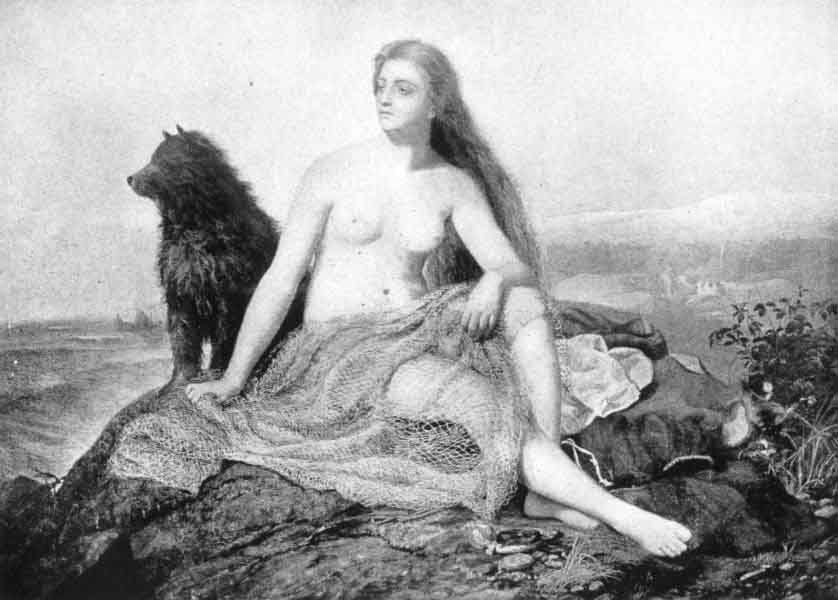
Freyja [Public domain image]

TEUTONIC MYTH

AND LEGEND

by Donald A. Mackenzie

An Introduction to the Eddas & Sagas, Beowulf, The Nibelungenlied, etc.

[1912?]

This is Donald Mackenzie's able retelling of the Northern mythological cycle. He weaves a coherent narrative from the Eddas, the Niebelunglied, the Volsung Saga, Beowulf, the primordial Hamlet myths, and Medieval German tales of chivalry. MacKenzie also wrote Egyptian Myth and Legend and Myths of Crete and Pre-Hellenic Europe.


View items...
Caesar's Commentaries on the Gallic and Civil Wars

Caesar's Commentaries on the Gallic and Civil Wars (16)

Julius Caesar

Caesar's Commentaries on the Gallic and Civil Wars

With the Supplementary Books attributed to Hirtius

Including the Alexandrian, African and Spanish Wars

Translator W. A. Mc.Devitte Translator W. S. Bohn

1st Edition.

Harper & Brothers New York 1869

Harper's New Classical Library

Authorship information:

Suetonius (Suet.12 Caes. Julius.56), in his biography of Julius Caesar states that the Gallic and Civil Wars were written by Caesar, and that the 8th book of the Gallic Wars was written by (Aulus) Hirtius. Suetonius also indicates that either Caesar's friend Oppius, or Hirtius likely wrote about the Alexandrian, African and Spanish wars, but that their authorship was not certain.


View items...

Teutonic Myth and Legend: Chapter 38 The Land of Giants

TEUTONIC MYTH AND LEGEND

by DONALD A. MACKENZIE

An Introduction to the Eddas & Sagas, Beowulf, The Nibelungenlied, etc.

London, Gresham Publications 1912

CHAPTER 38

The Land of Giants

Maidens of Jochgrimm--The Storm Giant Ecke--His Search for Dietrich--Combat in Dark Forest--Giant slain--The Well Nymph--Maiden in Flight --Ecke's Brother Fasold--Overcome by the Prince--The Beast--Arrival at Castle--Giant's Treachery--The Knights who quarrelled--Heime becomes a Robber.

DIETRICH rode along through the forest in thick darkness. He journeyed towards Jochgrimm mountain, where dwelt the beauteous princesses who had heard of his fame and desired greatly to behold him. The prince dreamed not of their treachery, or of the perils that he must needs pass through.

Now there were three young giants who wooed the maidens. They were brothers, and their names were Ecke and Fasold and Ebenrot. Ecke, which signifies "The Terrifier", was but eighteen years old. He had already won fame as a warrior in single combat; but having slain one foeman he could find not another who dared to contend against him. Oft had he heard of Dietrich's valour and great deeds, and he vowed that he would lay him low. Unto Ecke was promise made in the land of giants that if he slew Dietrich he should have for wife Seburg, the fairest of the three princesses in Jochgrimm.

Ecke had wondrous strength. Twice seven days and twice seven nights he could fast and travel onwards, nor ever feel faint; from hill to hill he could leap like a leopard. He required no steed, nor was there one that could carry him.

When the strong giant came to know that Dietrich was to ride forth from Bern, he prepared to go against him. . . . The Princess Seburg clad her lover in bright armour and wished him well. He made swift departure. . . . When he entered the forest the birds fled terrified before him; branches were bowed down and rudely shaken as he passed; trees swayed and groaned, and those that he smote crashed down and were uprooted. . . . So rushed Ecke upon his way until he reached Bern, where he was told that Dietrich had gone towards Jochgrimm by another way.

Without pause the giant followed after the valorous prince. So swift was his pace that he came nigh to him ere night fell. He beheld four knights lying on the ground. But one alone was alive, and he was grievously wounded.

"Seek not the Knight of Bern," the wounded man said; "like to lightning is his sword stroke."

Ecke went onward; raging furiously he went. He feared not Dietrich; his heart's desire was to combat against the arrogant hero. Night fell as he went through the trees.

In the blackness he heard a horseman coming nigh.

Who art thou, he cried, "that rideth through the darkened forest?"

A deep strong voice made answer: "Dietrich of Bern."

"Thou shalt fight with me," Ecke cried, for he was impatient to win renown.

But Dietrich desired not to combat with any foeman in the darkness, and rode on.

Ecke strode beside the Knight of Bern, and made boast of his armour.
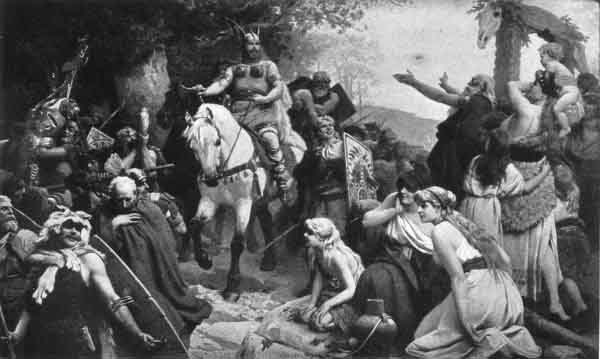
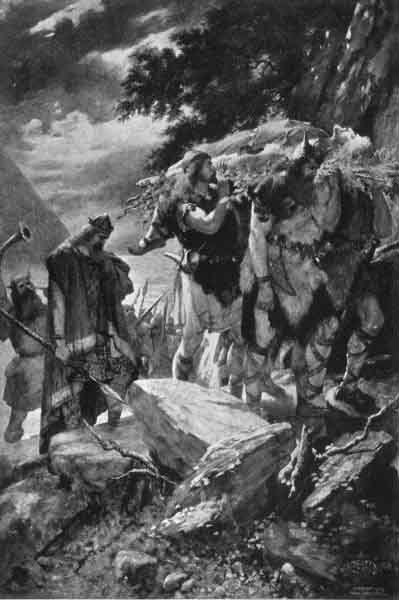
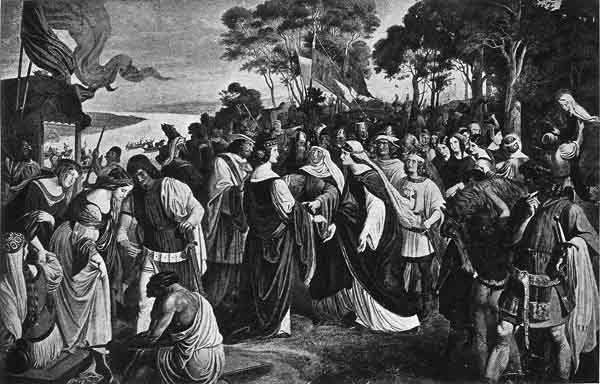
RETURN OF VICTORIOUS TEUTONS<BR> <I>From the painting by P. Thumann. By permission of Franz Hanfstaengl</I> RETURN OF VICTORIOUS TEUTONS
From the painting by P. Thumann. By permission of Franz Hanfstaengl

"By Wieland, the wonder smith, was it fashioned," Ecke said; "nor can thy blade Naglering cleave it. Bright and sharp is mine own sword Ecke-sax. 'Twas forged by him who made Naglering; of gold is the hilt, and it is inlaid with gold. Of fine gold is my girdle also. Much booty will be thine if thou canst overcome me."

But Dietrich could not be tempted to fight for sword nor treasure in the forest blackness.

Ecke was made angry. "Thee shall I proclaim as a coward," he cried, "because thou art afraid. . . ."

"When day breaks," Dietrich said, "I shall combat with thee. Here in the darkness we can behold not one another."

But Ecke, confronting him, refused to wait. "Thou shalt have the Princess Seburg for thy bride if thou art ready now for combat. Fairest is she of all maidens upon earth."

Dietrich leapt from his horse. "By the gods," he cried, "I shall fight thee now, not for thy treasure nor even thy sword, but for Seburg the fair one!"

On stones did they strike their swords. . . . The firesparks flashed bright, and they beheld one another in the blaze and began to fight. Nor was there darkness then, for their swords glowed like flames as they smote together and flashed in the blackness. The clamour of battle roared like thunder through the forest; the heavens heard the clash of their shields. . . . The night was filled with terror; the trees were scorched about them; the grass was trodden under the ground by their feet.

Long they fought, nor did one wound the other. Then Ecke bounded against the prince with all his strength; their shields were interlocked, and Dietrich stumbled and fell. Ecke held him down and said:

"If thou wilt permit me to bind thee, thy life shall I spare. Fain would I deliver thee thus unto Seburg with thine armour and thy steed."

"Death is better than shame," Dietrich made answer.

So they wrestled one with another in the darkness. In vain did Ecke strive to overcome the Knight of Bern, who at length clutched the giant's great throat, and sought to roll over him. Long and terrible was that fierce struggle. Nor would one make peace with the other although they were of equal strength.

In vain did the prince beseech Ecke to swear oaths of fellowship with him.

Dietrich's steed at length broke free. It heard his cries and ran towards him in the night. Falke was its name, and it loved the prince better than life. Now it came to his aid, and, rearing high, the bold steed leapt upon the body of Ecke and broke his back.

Dietrich leapt to his feet, and seizing the giant's great sword he struck fire, and in the sudden blaze he smote off his foeman's head. Then was there silence in the forest.

When dawn broke through the trees Dietrich clad himself in the giant's shining armour; he girded on the mighty sword Ecke-sax, then rode on his way with the head of Ecke dangling from his saddle bow.

He had no great joy in his victory, because he feared that he would be accused of killing Ecke in his sleep. 1

Dietrich rode on until he came to a forest spring and beheld a water nymph lying beside it wrapped in soft slumber. He laid hands on her, and she awoke. Then did the nymph heal the prince's wounds, and he became strong again. She pointed out to him the path which led unto Jochgrimm mountain, and gave warning of the dangers which would beset him. Then did Dietrich mount his steed again and ride towards the land of the giants.

As he went through the forest a beauteous maid came running towards him. Swift were her steps, and her face was pale and terror-stricken, because that she was pursued by the giant Fasold, Ecke's brother, and his fierce hounds. 2

Dietrich gave the maiden his protection, and went against the giant who pursued her. When Fasold beheld the prince clad in Ecke's armour, he cried:

"Art thou my brother Ecke riding hither on a steed?"

Dietrich made answer: "I am not thy brother; him have I slain."

"Thou dog of death," bellowed Fasold, "thou hast murdered Ecke whilst he lay in sleep, else would he never have been overcome."

"I fling thee back thy falsehood," Dietrich answered. "Thy brother challenged me to fight in darkness for the sake of fair Seburg. Had I known he was of such great strength I should ne'er have crossed swords with him."

Wroth was Fasold, and he rushed against Dietrich. Stronger was he than Ecke. In combat he scorned to strike more than one blow; never before was a second required. Fiercely he smote his brother's slayer, and Dietrich fell from his horse and lay in a swoon. The giant then turned away and went towards the castle. He deemed that the prince was slain.

Dietrich lay not long upon the ground. His strength returned to him; he rose up; he leapt upon his horse; he hastened after the giant, for he desired to be avenged.

Now Fasold had vowed never to combat with any foeman who survived his first blow, but Dietrich taunted him, saying: "Thou art afraid to stand against me. A coward is Fasold, else would he combat with his brother's slayer."

The giant turned fiercely, for no longer could he endure the prince's words. Swiftly were their swords drawn, and hot but not brief was the conflict. Thrice was Dietrich wounded, but five times had he wounded with Ecke-sax the giant Fasold, who at length cried out for mercy.

"If thou wilt but spare my life," Fasold said, "thee shall I serve, and ever be thy faithful henchman."

"Had I not slain thy brother," answered Dietrich, "I would have thee gladly for my knight; but I can claim not the service of one whose kin I have wronged. Yet shall I take oaths of fellowship with thee. Let us pledge ourselves now to help one another in time of need, and be like unto brothers before all men."

So they swore oaths of knightly brotherhood, and went together towards Jochgrimm mountain.

A great beast came out against them, and men say that it was like unto an elephant. Fasold would fain have let it pass, but Dietrich dismounted and made fierce attack with Ecke-sax. Yet, although he gave the monster many wounds, he could not slay it. The beast came nigh to treading him underfoot, but once again did. his steed Falke come to his rescue; it broke free; it leapt against and kicked the monster, which turned from the prince a while. Then Dietrich crouched under its stomach and stabbed there with the keen sword Ecke, making nimble escape as the beast fell to die. 3

Then Dietrich and Fasold went on their way. They next beheld a great dragon flying towards them. It was flying very low, and in its jaws it carried a knight, who called loudly for help.

Dietrich struck at the monster, but even Ecke-sax could not pierce it. Whereat the knight said: "By my sword alone can the dragon be slain, but it lies within the monster's mouth."

The Prince of Bern thrust his hand between the dragon's jaws. He pulled forth the sword.

"Wound me not when thou dost strike," the knight cried.

Dietrich smote the monster with the keen-edged sword and slew it, and the captive knight was drawn forth.

"Thy name and lineage?" the prince demanded of him.

"My name is Sintram," answered the knight, "and kinsman am I to Hildebrand at Bern. I was journeying towards Bern, so that I might become a follower of Prince Dietrich. The dragon came upon me while I slept, else would it not have carried me away."

Dietrich's heart was made glad, and he restored unto Sintram his wondrous sword, saying: "I am he whom you seek to serve, even Dietrich, Prince of Bern."

So they went together on their way with Fasold. Then, as they drew nigh unto Jochgrimm mountain, the giant forgot his vows, and sought to take flight. But Dietrich would not have him go free until he reached the castle in which the princesses had their dwelling.

Ere long they reached a great castle. Two giant statues stood on each side of the door, and Fasold led him in. But when the prince came between the statues their arms fell, and had he not made swift escape he would have been slain by their stone clubs.

Dietrich was made wroth. He turned upon Fasold forthwith, and slew him because of his treachery. Then he entered the hall, and the three princesses and their mother, the queen, came towards him, for they deemed he was Ecke.

"'Twas your desire," the prince said, "to behold Dietrich of Bern. He now greets thee thus."

So saying, he flung at their feet the head of the giant Ecke, and then turned from them. . . . He hastened without, and, mounting his steed, rode with Sintram towards Bern.

Heime came forth to meet Dietrich and greeted him with such warmth that Dietrich gave unto him the sword Naglering, which Alberich 4 had forged for the giant Grim. Ecke-sax he did keep for himself.

Witege was ill-pleased because that his fellow knight was thus honoured.

"I forget not," he said unto Heime, "that when I was beset by robbers thy sword remained in its sheath."

"Evil is thy tongue, thou self-sufficient man. Fain would I have it silenced," Heime said.

Both knights drew their swords to combat one against the other. Dietrich was wroth and stepped between them. Then he spake to Heime saying:

"Rash knight, thou shalt now go hence. 'Twas unseemly that thou didst not aid thy fellow when robbers came against him. . . . When by thy deeds thou hast proved thyself a hero, thou mayest return again unto Bern."

"With the sword thou hast given me," Heime said, I shall win more than any man can take away."

He went forth alone. He waged war against the robbers and slew them, and became chief of a robber band. Many a wayfarer fell by his sword, and he was dreaded by valiant knights. He re, turned not unto Dietrich again until he was possessed of much treasure by his evil doings.

Against many giants did the prince combat, but never was he in greater peril than when Laurin, the dwarf, had power over him and his knights and held them all in captivity.

Footnotes

1 This story was originally a storm myth, in which Dietrich was Thunor (Thor), and Ecke a tempest. The three princesses are the giant maids of a Tyrolese folk tale, who brew storms on Jochgrimm mountain. A Highland hag is also a storm-brewer. She is associated with the first week of April which is called "Cailleach". At Cromarty an April hag causes the south-westerly gales and, according to a local saying, still current, "harries the crooks" (empties the pots) of the fisher-folk who can't go to sea.
2 Another nature myth. So do the maidens of the Boyne, Tay, Ness, and other rivers flee before the outraged well demon, who may be a giant, a dragon, or a kelpic, because they had neglected, when drawing water, a ceremonial observance, or had committed a theft. Probably the Severn story, as related by Geoffrey of Monmouth, was originally of similar character. There are also Greek parallels.
3 So was the dragon in Beowulf and the Fafner dragon, which Sigurd stabbed, put to death. The underpart only can be mortally wounded.
4 Alberich was called in French legend Auberon. Spenser introduced him to this country as Oberon. Alberich signifies "elf King".

Teutonic Myth and Legend: Chapter 37 Dietrich of Bern

TEUTONIC MYTH AND LEGEND

by DONALD A. MACKENZIE

An Introduction to the Eddas & Sagas, Beowulf, The Nibelungenlied, etc.

London, Gresham Publications 1912

CHAPTER 37

Dietrich of Bern

Hildebrand's Pupil--Alberich the Dwarf--Grim and Hilde--The Magic Sword--Conflict in the Cavern--Giant and Hag are slain--Great Sigenot--Dietrich taken Prisoner--In the Dragon's Lair--Hildebrand put to Shame--Giant overcome--Heime's Challenge--Wieland's son Witege--Fierce Combat --Dietrich in Peril--Peace Terms.

DIETRICH was the son of great Dietmar, King of Bern, whose brother was the fierce King Ermenrich. He was but seven years old when there came to his father's Court the battle hero, Hildebrand, far famed for valorous deeds. Unto that great warrior was given the care of the young prince, so that he might gain manly wisdom and skill in feats of arms. Fast friends they became ere long, and faithful were they one to another in after years, until death did thrust them apart.

It chanced that when the lad grew strong, and had desire for daring adventure, a giant and a giantess, whose names were Grim and Hilde, ravaged the land with fire, and did slaughter many goodly subjects. Dietmar raised a mighty army and went out against them, but he could discover not the hiding place of the monsters, who ever came forth unawares to work their evil designs.

Now Dietrich had great desire to combat with the giant and giantess, for he was brave as he was strong, and he sought most of all to win a warrior's renown.

With Hildebrand he hunted one fair morning in a deep forest. They came to a green and open space, when suddenly a dwarf started up and ran to escape them. The lad gave speedy chase, and soon he had the little man in his power. His name was Alberich, and he had fame as a cunning robber and a wonder smith. Dietrich desired to slay him, but the dwarf cried out:

"Kill me not, O Prince of Bern, and thou shalt have for thyself the great sword which I forged for Grim and Hilde. It is called Naglering, nor is its equal to be found in the world. I shall also guide thee unto a cavern where much treasure lies hidden."

Dietrich promised to spare the life of the dwarf if his promise were fulfilled, and Alberich said: "Thou must needs combat with Grim, who hath the strength of twelve men, and also with Hilde, who is even more to be feared, ere thou canst possess thyself of the treasure."

Binding vows were then taken by Alberich, who promised to return at eventide with the wondrous sword. As the dwarf promised so did he do. He met Dietrich and Hildebrand close to a great mountain cliff, and delivered up the shining sword, Naglering. Proud was the lad of that wondrous weapon, which brought him, as it befell, great fame in after years.

The dwarf then vanished, and Hildebrand and Dietrich went towards the cliff. Ere long they found the secret door and opened it. The sunlight streamed within, and they beheld, lying beside a fire, gaunt Grim and Hilde, who both at once sprang up angrily and desired vengeful combat. The giant sought for his Naglering, but found it not. Cunningly indeed had the robber dwarf taken it from him.

The giant then seized a burning log and leapt at Dietrich. Fast and ferocious were his blows, and the lad would full surely have been slain but for the sword he wielded.

Hilde sprang at Hildebrand and wrestled with him. Long and fierce was the struggle, because the warrior had great strength, but the giantess held him tightly round the neck, until, gasping for breath, Hildebrand fell to the ground. So was he completely overcome, and the end of his days seemed to be very nigh.

In vain the old warrior called upon Dietrich, who waged desperate conflict with the giant. But at length the lad prevailed. Leaping aside to escape a mighty blow, he smote Grim with Naglering and cut off his head. So perished the ferocious giant, who had laid desolate a great part of the kingdom of Dietmar.

Hildebrand was meanwhile in sore distress. Hilde began to bind him, so that he might be put to death by torture, but Dietrich smote her so great a blow that he clave her body in twain. But she relaxed not thereat her ferocious embrace of the swooning warrior. Such was her power that she united her severed parts before the lad's eyes, and caused herself to be made whole again. So Dietrich smote her the second time right through the middle, and yet again she was joined together as before.

Hildebrand cried faintly: "Leap thou between the Hag's severed body when thou dost strike next, and turn thine eyes from her."

As the warrior bade, so did Dietrich do. He cut Hilde in twain, and immediately separated her body with his own, nor did he look round.

That was the end of Hilde. 1 No longer could she work her evil will. So she cried:

"If Grim had fought with Dietrich as well as I have fought with Hildebrand, we should ne'er have been overcome.

Then life went from her, and Hildebrand was set free. The old warrior embraced the prince, praising his valour and skill, and the glory of battle gleamed in the eyes of Dietrich.

Great was the treasure which was concealed in the cavern. Dietrich took for himself a wondrous shining helmet. It was named Hildegrim, after the giant and the giantess, and it gave more than a mortal's strength to the hero who wore it.

The prince put the helmet on his head. He triumphed in the power it gave him. Then with Hildebrand he returned unto his sire, King Dietmar, who rejoiced greatly because of the valorous deeds of his son, and he made him a full knight before all the people.

There lived among the mountains to the west a great giant whose name was Sigenot, and he vowed to be avenged upon Dietrich because that he slew Grim, his uncle, and Hilde, his aunt, and possessed himself of their treasure, and especially the helmet Hildegrim. One day Dietrich rode forth alone to hunt in the deep forest, and in the midst of it he found Sigenot lying fast asleep. Proud was the lad of his strength, and overconfident withal, and he desired greatly to combat with the giant. So he dismounted and went fearlessly towards him and kicked his body. Sigenot leapt up in anger.

"At last thou art come," he cried. "Long have I waited for thee, Prince of Bern, so that I might take vengeance for the slaying of my kinsman Grim.

The giant seized his great spear, and Dietrich drew his sword Naglering. But unequal was the combat.

The giant smote but a single blow with the spearhaft and felled the prince, whom he speedily bound. Then he bore Dietrich through the forest, and cast him into a dark, underground cavern, which was a dragon's lair. Snakes crept about and hissed in the darkness; the prince had need to combat with them.

Meanwhile Hildebrand went through the forest searching for the prince. He wondered because he could not hear his huntsman's horn, and when he found his horse bound to a tree, he feared greatly that Dietrich had been slain. Great was the grief of Hildebrand. . . .

Suddenly he heard heavy footsteps coming through the trees, and ere long the great Sigenot confronted him.

"Who art thou, and whom dost thou seek?" the giant bellowed.

"Hildebrand is my name," answered the bold warrior, "and I seek for Dietrich, Prince of Bern."

The giant thrust his spear at him, but Hildebrand fought fiercely with his sword. Ere long, despite his valour, the warrior was disarmed, and Sigenot caught him by the beard, and dragged him through the forest, bellowing the while:

"Follow me, Longbeard, follow me; now are Grim and Hilde avenged. Soon shalt thou find thy Prince of Bern."

Now never before had a foeman dared to lay hands upon Hildebrand's beard, and for that reason he was more wroth with than afraid of the giant. As the warrior was being thus ignobly dragged to the cave in which Dietrich lay bound, he saw the sword Naglering lying on the ground. Nimbly he clutched it ere his captor was aware, and, striking fiercely, he wounded the giant, who suddenly relaxed his hold so that the warrior leapt free.

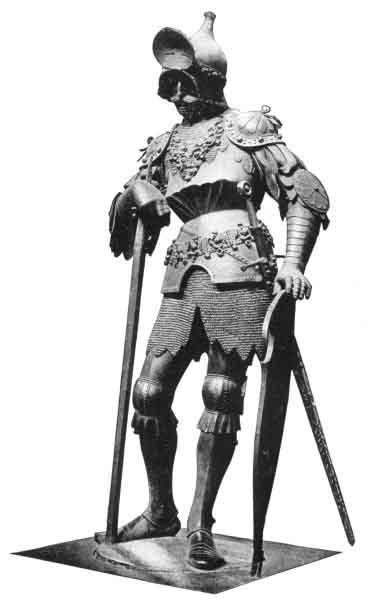
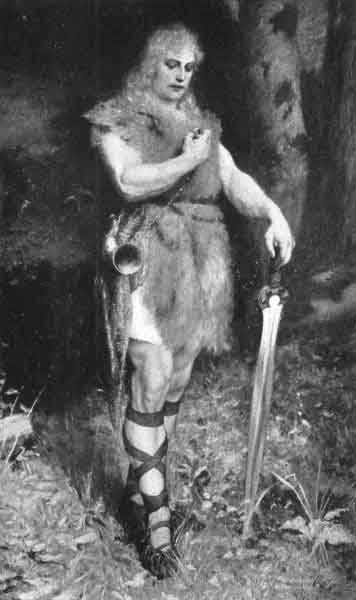
DIETRICH<BR> <I>From the statue in the Church of the Franciscans at Innsbruck</I> DIETRICH
From the statue in the Church of the Franciscans at Innsbruck

Then did fearless Hildebrand smite Sigenot and slay him with a single blow. So perished the kinsman of Grim when he deemed proudly that his vengeance was complete.

Deep was the underground cavern in which Dietrich was kept captive. The prince heard the voice of Hildebrand calling to him, and entreated him to make haste.

"Many vipers still remain alive," he said, "although not a few have I slain and devoured."

Hildebrand cast off his clothing, and each garment did he tear in shreds; then he made a rope which he lowered into the dark, snake-infested cavern, so that the prince might have release from his torture and unceasing conflict.

Dietrich seized the rope; but when Hildebrand began to pull him up, it snapped asunder.

'Twas then that the dwarf Eggerich came nigh, rejoicing because that Sigenot was slain. He speedily procured a rope ladder, and it was lowered to Dietrich, who was thus given escape from the dragon's cave and the hissing snakes that swarmed there.

The prince embraced his rescuer, but Hildebrand did chide him much because that he had ventured forth in the forest alone.

Then they took leave of the dwarf Eggerich, and returned together unto Bern. When the people came to know that the giant Sigenot was slain, they rejoiced greatly, and acclaimed Hildebrand and the fearless son of Dietmar.

Now there was not in all the kingdom a young warrior who was Dietrich's equal. His fame went far and wide, and bold knights came riding to Bern so that they might win his favour with challenge to feats of arms. Those who were worthy and of high birth did the prince choose to be his followers. In time he had thus command of many valorous knights. Among these were Witege and Heime, who had great fierceness and daring, and were so gloomy and cruel of heart that in peace as in war they were dreaded and shunned. Men they smote and women they hated and scorned; many young warriors they slew in conflict. Churls were they both, and how they came to be honoured by Dietrich must now be told.

Heime came first unto Bern. Dwarfish was he in stature, but his heart was full of valour, and he had strength beyond his years. He feared not the prince, despite his mighty fame. Unto him did his sire Studas, who was a breeder of war steeds amidst the mountains, give a swift grey horse, which was named Rispa, and the sword Blutgang.

When he rode boldly into the courtyard of the castle at Bern, Heime challenged Dietrich to single combat. The prince was made angry thereat. Hastily did he put his armour on and the shining helmet Hildegrim; then with his spear in one hand, and in the other his great red shield on which was pictured a golden lion, he charged the bold and low-born stranger. Terrible was the shock. Heime's shield was pierced through, but Dietrich's horse stumbled so that he came nigh to being thrown. Both their spears were broken in twain.

Then did the young warriors, leaping to the ground, cast aside their spearshafts and draw their shining swords. Fiercely did they combat one against the other. But Blutgang rang faintly against Naglering. Heime had skill and valour, but ere long his sword was cloven and shattered so that he was placed at Dietrich's mercy. But the prince was drawn towards him by reason of his prowess, and slew him not. He honoured, in generous mood, the surly stranger, and gave him place among his knight followers.

Ere many days passed another young warrior, seeking adventure, challenged the son of Dietmar to combat. His name was Witege, and he did hie from Denmark. The prince was moved with wrath against him, for he grew weary of the conflicts with each bold stranger who sought to put his skill and valour to test. But in that fierce Dane he met a knight who was more than his equal.

Now Witege was the son of Wieland, the wonder smith, a cunning and far-famed worker in iron. Skilful was the lad with bow and arrows, as was Eigel, his uncle.

He scorned to work at the forge, and desired to seek adventures, so that he might win renown as a warrior. Of the fame of Dietrich he heard one day, and he resolved to challenge him to single combat.

Wieland could not prevail upon him to remain at home, so he fashioned for Witege a suit of shining armour, a great helmet, dragon-mounted, a spear of much strength, and a white shield on which was painted a hammer and tongs. Unto the lad he also gave a wonder sword of great sharpness, named Mimung, which he had aforetime forged by compulsion for a tyrant king.

Witege then set out to journey towards Bern in the land of the Amelungs. On his way he met Hildebrand and Heime, who were also riding to Dietmar's Court with a stranger knight. Witege waited them not, for they sought to rest awhile.

Soon he drew nigh to a strong castle in which twelve robbers had their dwelling. These, when they did behold the young knight coming towards them, spake one to another, saying--"His shining armour shall we take from him, and his right hand shall we cut off, and then send him homeward."

So they sallied forth against Wieland's strong son. Two rode in front and bade the lad surrender; but Witege drew the sword Mimung and slew them right speedily. The others charged against him and waged fierce and unequal conflict.

'Twas then that Hildebrand and Heime and the strange knight came nigh. Hildebrand urged his companions to hasten to Witege's aid, but Heime said: "Help him not; his pride is great; now let his valour be put to proof."

But the old warrior would suffer not that the robbers should slay the youthful hero; so he rode forward and the others followed him. Against the fierce band did they all battle together, save Heime, who looked on, and ere long seven lay dead on the ground, and the others were making swift escape.

Witege gave thanks unto Hildebrand, and together they took vows of knightly fellowship to be ever brotherly and true in after-time.

"Whither goest thou, valorous youth?" asked the elder warrior.

"I ride towards Bern," the son of Wieland made answer, "for it is my desire to meet with Dietrich in single combat."

Hildebrand cared not to hear speech so bold from that valiant young hero. Indeed he feared for Dietrich's safety. So when night fell, and the Dane lay fast asleep, he drew from the lad's scabbard the sword Mimung and placed in it his own.

At morningtide Witege called upon Dietrich to display his valour. As the tale has been told, Dietmar's son waxed wroth, because that the Dane was of lowly birth, being, indeed, but the son of a smith. In vain did Hildebrand warn him of the youth's prowess and skill at arms.

"The time is at hand," Dietrich said, "when peace must prevail in the kingdom. I shall allow no churlish stranger to challenge me to conflict. Heavily shall he pay for his boldness."

"It may be," Hildebrand said, "that thou shalt not prevail against this valorous youth."

"Him shall I have this day hanged outside the gates of Bern," answered the prince.

"Ere thou art able to accomplish that," Hildebrand said, "thou hast a fierce battle to fight. I bid thee success, but not without fear."

Never before did Dietrich meet a doughtier war-man. Strong and rapid were the blows which Witege gave. He smote the prince heavily on the head, but the helmet Hildegrim resisted the edge of Hildebrand's sword, and the Dane cursed his sire Wieland because that his sword was of so little avail.

"Had I but a sword worthy my strength," he cried, "victory would speedily be mine."

Dietrich pressed him hard. With both hands he grasped the sword Naglering, and made daring onslaught with purpose to smite off the head of Wieland's son. But Hildebrand went between the warrior youths and called a truce.

"Spare thou his life," he cried to Dietrich, "and thou shalt have still yet another brave knight amidst thy followers."

"The dog shall die this day," the prince made angry retort; "stand thou aside, so that his life may have end." The old knight was angry. He drew from his scabbard the sword which Wieland fashioned, and gave it unto Witege, saying:

"Thine own sword Mimung I return unto thee. Now defend thyself as befits thy valour."

Glad thereat was the heart of Wieland's son. "Alas," he cried, "that I did curse my sire! Behold, O Dietrich, the sword Mimung; now have I as great desire for battle as a thirsty man hath for drink and a hungry dog for its food."

'Twas then the swords sang loud. Mimung clove armour and shield as they were but cloth. The son of Wieland indeed struck mighty blows, and in time he wounded Dietrich, Indeed, five wounds did he give unto the prince, so that he was forced to call upon Hildebrand to put end to the fray. But the old warrior was wroth with Dietrich, and did heed him not.

King Dietmar then called upon Wieland's son to cease fighting, and promised him great gifts and a noble bride; but Witege waxed in battle fury, and sought for naught else but the death of that arrogant prince. Blow after blow he gave, until at length he split asunder the helmet Hildegrim, so that Dietrich's golden hair appeared.

Hildebrand desired not the prince's death. His wrath was melted when he perceived he was in peril, and he leapt forward and ended the fray. Then besought he Witege, because of the vows they had taken one with another, to swear fellowship with Dietrich and become his knight.

As the old warrior desired him, so did Witege do. He sheathed his sword and took oath of service to the prince, and they became fast friends. Together they went into the castle and drank wine.

But ill-pleased was Dietrich because that he was not the victor as aforetime, and he made resolve to go forth to seek further daring adventure, so that his fame might not be sullied in the land of the Amelungs.

Footnotes

1 When Hercules fought with the nine-headed Hydra, each head, save one, which could not be hurt, grew again as fast as it was cut off. Then his nephew assisted him by searing the wounds with a torch. See Classic Myth and Legend, page 103.

Teutonic Myth and Legend: Chapter 36 The Nibelungen Tragedy

TEUTONIC MYTH AND LEGEND

by DONALD A. MACKENZIE

An Introduction to the Eddas & Sagas, Beowulf, The Nibelungenlied, etc.

London, Gresham Publications 1912

CHAPTER 36

The Nibelungen Tragedy

Kriemhild weds Etzel--Her Desire for Vengeance--The Festival--Invitation to Gunther and his Knights--Hagen's Bravery--The Doom journey--Dietrich and Hildebrand--How the Guests were received--Treachery of the Queen--Scene at Banquet--Its Tragic Ending--Dietrich intervenes--Hall in Flames--Unconquered Heroes--Gunther and Hagen overcome--Gladness ends in Grief.

IT fell that thirteen years after Siegfried's death Queen Helche of the Huns died, and King Etzel 1 , who was a heathen, sought another bride. Rudiger, the rich margrave, surnamed "The Good", was sent as envoy to Worms to win Kriemhild; whereat Gunther was made glad, because Etzel was a mighty monarch, but grim Hagen grew angry, fearing that the widow of Siegfried would stir up enmity against them. Kriemhild ceased not to grieve for him whom she had loved, but her brothers and Queen Ute urged her to be wed to the mighty monarch of the Huns, and at length she gave her consent. Then sent she to Hagen for the Nibelung treasure, which she desired to distribute among the Hun warriors; but he refused to give it up saying: "She shall not give it unto those who are my foemen."

Kriemhild was made wroth thereat. Yet had she a portion of the treasure left, and she gave great gifts to the knights who came with Rudiger.

The widowed bride had lost not her great beauty despite her long and deep sorrow, and when she came to the Court of Etzel, the courtiers vowed that she was even more fair than was Queen Helche. She kissed the king, and when she was wed she was kissed by twelve noble knights, among whom was Bldel, the brother of Etzel, and the great warrior king, Dietrich of Bern, who had taken refuge at Etzel's Court when his uncle, Ermenrich, had by treacherous doings possessed himself of the kingdom of the Amelungs. So it came that Kriemhild had friendship and service from many strong war-men. Great was her power. All the treasure that Hagen had left her she gave to the knights, and at length she said unto herself:

"Now am I made powerful, and can strike against the enemies of Siegfried, for whom my heart still calleth."

As the days went past, and the years, her desire for vengeance grew stronger. There was not a Hun knight who would not do her willing service. Yet none did conceive of her fierce intent.

A son was born to King Etzel, and his name was Ortlieb. Like was he in countenance to fair Kriemhild, and the king loved her more dearly because of her child. So at length when she craved of him a boon he said that he would grant it willingly; and the queen besought him that he should send envoys to Worms and invite, unto a festival at his Court, Gunther and all his knights. As she desired, so was it done. Kriemhild spoke in secret to the envoys and bade them not to leave Hagen behind.

Gunther received the message gladly, nor suspected aught of Kriemhild's evil desire; but Hagen warned the king in counsel with his knights, saying: "We dare not go from here unto the Court of Etzel. Our lives ane in peril, for Kriemhild forgets not who slew her husband Siegfried. . . . Her memory is long."

Thereupon Gunther's brothers taunted Hagen. "Thou knowest thine own guilt," one said; "therefore thou hast need to protect thyself well. 'Twere better thou didst remain at Worms, while those who fear not sojourn among the Huns."

Hagen was made wroth. "No man among you feareth less to venture forth than I do, and with thee shall I go if ye are determined to visit the Court of Etzel."

So it was arranged that they should set out forthwith, and Hagen spake after that of their journey as "the death ride".

Queen Ute had great desire that her sons should tarry in the kingdom. "I have dreamt an evil dream," she said. "Methought that all the birds in fair Burgundy were slain."

"He who is led by dreams," said Hagen, "is without honour and no hero. Let us unto the festival of Kriemhild."

Many women wept when they set forth. With Gunther rode a thousand and sixty knights, and his army did number full nine thousand men. When they reached the Danube River they found it to be high and running swift. Hagen sought for the ferryman, who desired not to take them across unless he were given rich reward. While searching, he saw bathing in a brook certain water fairies. He went stealthily towards them and possessed himself of their vestments. They had need, therefore, to make known to the fierce knight how he and all who were with him would fare upon their journey. One did promise that they would prosper and win great honour, but another said: "Twere better to turn back. . . . Ye are all doomed. Who rideth unto the Court of Etzel rideth to death. Nor shall one return again unto Worms save the priest."

Then Hagen met with the ferryman and slew him for his boldness. He seized the boat, and, returning unto Gunther, he ferried across the knights and all their followers. As he crossed with the last company of men he beheld the priest among them, and remembering the prophecy of the water fairy, he seized him there and flung him overboard. But, although the man could not swim, he was driven over the waves and reached the shore in safety. When Hagen saw that the priest could return unto Burgundy, he knew that the foretelling of the water fairy was true, and said unto himself: "These, our warriors, are all dead men."

When they landed, Hagen splintered the boat in pieces. He was resolute indeed, and made certain that no man should turn back. The Bavarians came against them to avenge the ferryman's death, but they were beaten back, and Gunther and his war-men marched forward until they came unto Bechlaren, where Rudiger the Good gave them generous and hospitable entertainment and many gifts.

Tidings of their approach were borne unto Kriemhild. "The day of reckoning is at hand," she said unto herself. "Fain would I now slay the man who did destroy my happiness. . . . He shall pay dearly because that he hath made me to sorrow."

Aged Hildebrand spake unto Dietrich of Bern of the coming of the Burgundians, and counselled that he should ride forth to greet them. Hagen was a dear war friend to Dietrich aforetime, and there was good will. betwixt them. So the fierce knight of Burgundy gave his friend warm greetings.

Dietrich was made glad, yet did he inwardly grieve, when he beheld the warriors from Worms.

"Know ye not," he said, "that Kriemhild hath ceased not to sorrow for Siegfried? . . . This very day I did hear her lamenting because that he was dead."

Gunther reasoned that Etzel had bidden them thither with right royal welcome, and that Kriemhild had also sent warm greetings, but Hagen knew well that sorrow awaited them.

The Hun king knew not that his queen plotted against his guests, and his welcome was hearty and frank; but Kriemhild was haughty and cold. She kissed but her brother Giselher, who had no part in Siegfried's death. Unto Hagen she spake, saying:

"Hast thou brought hither the hoard of the Nibelungs which thou didst rob from me?"

Hagen answered: "I have touched it not. It is hidden below the Rhine waters. There shall it lie until the Day of Judgment."

"So thou hast brought it not," she said coldly. "Many a day have I grieved for it, and for the noble knight whose possession it was."

"I have brought but my weapons and my armour," said Hagen defiantly.

"I need not gold," Kriemhild sighed; "but I would fain have recompense for murder and robbery."

Then were the Burgundians, at the queen's desire, asked to lay down their arms; but Hagen made refusal for himself and the others, saying that it was the custom of the Burgundians to be fully armed on the first three days of a festival.

It chanced that soon afterwards Kriemhild urged certain of her knights to slay Hagen; but they forbore, fearing as they did his dark brows and quick-flashing eyes.

When night fell the guests were conducted to their dwelling. Grim Hagen and Volker, the minstrel, fearing the treachery of Kriemhild, sought not to take rest.

They clad themselves in their bright armour. Then they took their swords and shields and stood outside the door to guard their companions. After a time Volker took his fiddle, and, sitting upon a stone within the porch, he played merry airs which gladdened the hearts of those who were within, and they forgot their anxieties. Then he gave them soothing music and sweet, so that they were lulled to sleep. Thereafter he took up his shield again and stood beside Hagen at the door to guard the Burgundians against Kriemhild's war-men.

In the midst of the night the fierce Huns made stealthy approach; but when they beheld the knights keeping guard they turned away. Volker desired to challenge them to combat, but Hagen forbade him, and Volker cried out to the followers of Kriemhild: "Cowards, would ye venture hither to slay men in their sleep?" They answered him not. Kriemhild grieved because that her plan had failed, but she ceased not to plot against the guests.

A tournament was held in Etzel's courtyard, and Volker slew a Hun warrior. But for the king, vengeance would have been taken for that cause. "He hath been slain without intent," Etzel said; "let my guests go forth unharmed."

Kriemhild then spake to Dietrich of Bern and old Hildebrand, beseeching their aid to encompass the death of Hagen.

Hildebrand answered: "One man is not sufficient to overcome him." And Dietrich, answering her, said: "Speak not of this again, O Queen, I pray thee. These, thy kinsmen, have never done aught against me. 'Twill bring thee shame if thou dost any hurt to them, because they are now thy guests. It is not for me to avenge the death of Siegfried."

Thereafter did Kriemhild plead with Bldel, King Etzel's brother, making him promise of rich reward, and he promised to achieve her purpose. He went forth to attack Gunther's men with a thousand of his followers. Dankwart was in command when Bldel fell upon them without warning, and fierce was the conflict.

Meanwhile Gunther and Hagen and other knights sat at feast with King Etzel. Kriemhild caused her son Ortlieb to enter and sit nigh to Hagen, and the king said: "Lo! here cometh my only son to be among his kinsmen."

Hagen loved not the lad. "He hath a weak face," he said. "I could never be a guest at his Court."

Suddenly Dankwart rushed into the feasting hall. He alone of all the war-men had escaped the sword of Bldel, whom he slew; his body was red with the blood of foemen. "Why dost thou tarry thus, brother Hagen?" he cried; "our men are slaughtered in their dwelling."

"Guard the door," cried Hagen, and seizing his sword be smote off the head of Prince Ortlieb before his father's eyes. Then he slew the lad's tutor and cut off the right hand of a minstrel who had borne Kriemhild's message unto Worms. Volker drew his blade also and made slaughter. In vain did the three kings, Etzel and Gunther and Dietrich, make endeavour to subdue the fray. Many Hun knights were slain, for the Burgundians were seized with battle fury and sought dire vengeance. They cut their way up and down the hall, and there was none who could stand against them.

Then did Kriemhild plead with Dietrich of Bern, beseeching his aid, what time he watched, standing upon a bench, the doughty deeds of his old war comrade Hagen.

"Save me and King Etzel from this our dire peril," cried the queen.

"I can but try," Dietrich answered. "Not for many years have I beheld such fierce fighting."

Then he uttered forth a great shout, and his voice was like to the blast of a war horn. Gunther heard him, and called upon his men to pause in the fray. "Mayhap," he said, "we have slain knights of Dietrich."

"No harm have ye done me or mine," Dietrich said, "but I ask of thee that I and those with me may have thy permission to go forth in safety."

"Thy wish is granted," answered Gunther.

Then did Dietrich clasp the fainting Queen Kriemhild with one arm and took King Etzel's with the other. Thus did he leave the hall with six hundred of his knights. Rudiger went also with five hundred. Neither sought to take part in the fray.

Thereafter was the conflict waged again with great fury, nor did it pause until not a Hun was left alive in the hall.

The Burgundians rested awhile; then they threw out the bodies of their foemen. Kinsmen of the slain mourned greatly.

King Etzel seized his shield and desired them to combat against the stranger at the head of his men; but Kriemhild warned him that he could not withstand the blows of fierce Hagen. But his knights had to hold him back by force, and, seeing this, Hagen taunted the king.

"The darling of Siegfried and her new husband are faint-hearted," he cried. "Ha, Etzel! Siegfried had thy lady to wife before thee. I slew him. Why, then, shouldst thou be angry with me?"

Kriemhild heard with anger. "Much gold shall I give, and castles and land," said the queen, "unto the knight who shall slay Hagen."

Volker shouted defiantly: "Never before beheld I so many timorous knights. Cowards all! ye have taken of the king's substance and in his hour of trial ye desert him. I cry shame upon ye all."

Many bold warriors rushed against the knights of Burgundy. Stranger knights who were there fought also. The nimble Iring of Denmark struck mighty blows, and in the end he wounded Hagen. Queen Kriemhild praised him when he returned weary from the fray, and prompted him to return again. When he renewed the conflict, however, Hagen slew him.

So fell many brave men, and the long summer day ended and darkness fell. The tumult ceased.

Then the Burgundians besought King Etzel that they should be permitted to leave the hall and fight in battle, but Kriemhild forbade it.

Her brother Giselher spake to the vengeful queen saying: "I deserve not death at thy hands. I was ever faithful unto thee. I came hither because that I did bear thee love and thou didst invite me. Thou must needs now show mercy unto us."

"Can I show mercy who hath never received it?" she answered him. "The vile Hagen slew my child, so those who stand by him must suffer with him. But this I shall promise thee--if Hagen be now delivered up a truce will be granted forthwith."

Gernot answered: "Never shall thy wish be granted. Rather would we die than ransom our lives with a single knight."

"Then must we die indeed like to brave men, Giselher said.

"My brother Hagen is not without friends," cried Dankwart; "ye who have refused quarter shall not receive it. Not at our hands."

In the midst of the night Kriemhild bade her, followers to set fire to the hall. That they did right gladly. The flames raged furiously, and one of them within cried: "Woe is me! we are doomed to die. Rather would I have fallen in battle."

Great was the heat, and the knights were tortured with thirst. Then did Hagen bid one of them to drink the blood of the slain war-men. One who suffered much knelt beside a corpse and drank the blood. The draught made him strong again. "Better is it than wine," he said.

The others did likewise, and were all refreshed so that they were able to endure their sufferings amidst the flames. Burning faggots fell upon them, but they protected themselves with their shields. Terrible was the heat. Never again shall heroes suffer as did these that night.

"Stand close to the walls," Hagen commanded; "your armour shall protect ye; let the blood quench the flaming brands."

When morning broke, the Huns wondered greatly to behold Hagen and Volker again standing on guard at the hall door.

Fierce attack was again made by the Huns, but they were beaten back. Nor did the conflict have pause until the last of Etzel's great knights was slain.

Then did Kriemhild and the king make appeal to Rudiger to aid them, but he desired not to attack the brave Burgundians.

"Shall I slay those whom I did entertain in my own house?" he exclaimed. "I forget not past friendship."

Yet was he constrained to fight, and he mourned his lot with the Burgundians.

"Would that I had a strong shield like thee," Hagen said; "mine own is hewn and battered sore."

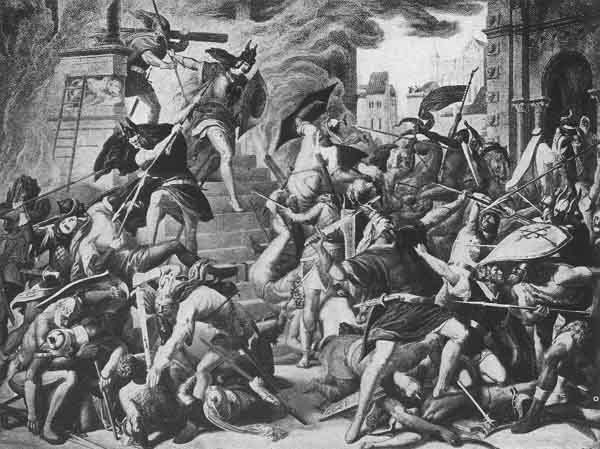
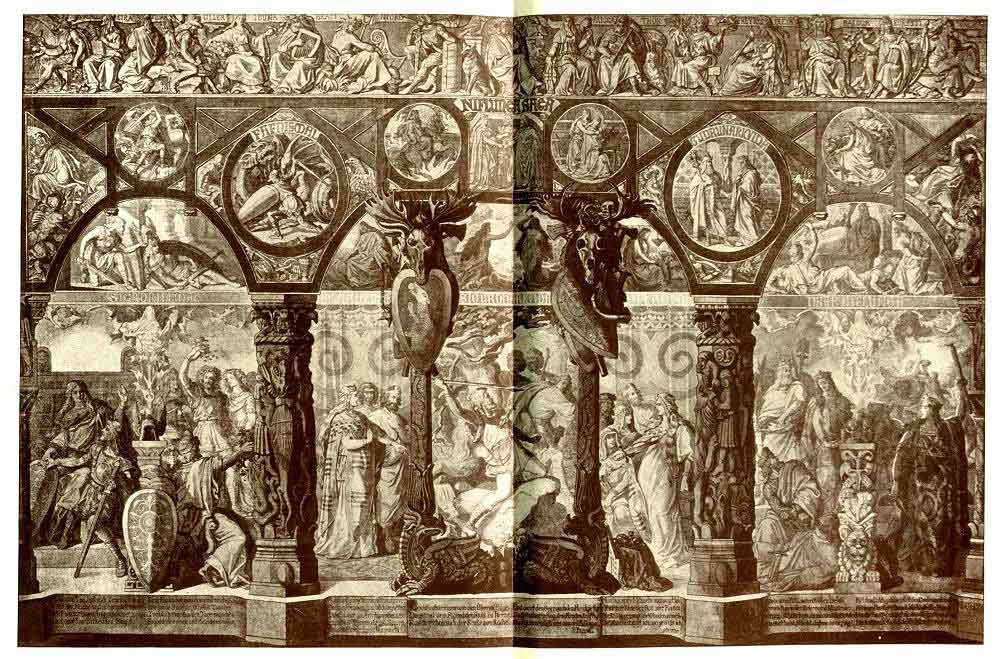
THE FIGHT ON THE STAIRS OF ETZEL'S PALACE<BR> <I>From the painting by Schnorr von Carolsfeld</I> THE FIGHT ON THE STAIRS OF ETZEL'S PALACE
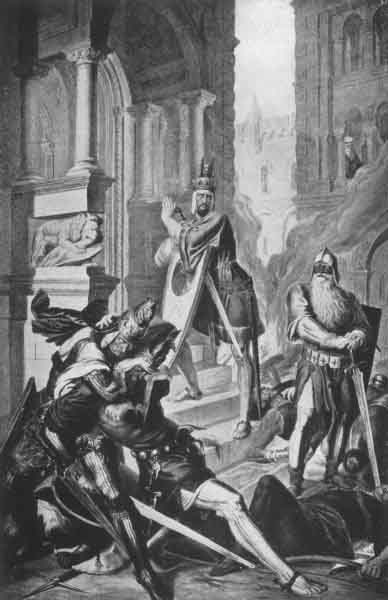
From the painting by Schnorr von Carolsfeld

Rudiger gave Hagen his own shield ere he fought at Etzel's command with those whom he loved. Fierce was the conflict and long, and in the end Gernot and Rudiger slew one another.

Then did Wolfhart, the bold knight of Bern, lead on the followers of Dietrich to avenge the death of Rudiger. One by one they were cut down by Gunther's heroes, save Hildebrand, who slew Volker. But Hagen made vengeful attack and wounded him. The old warrior fled. He hastened unto Dietrich, and cried: "All our men are slain, and of the Burgundians but Gunther and Hagen remain alive."

Dietrich was wroth. He sorrowed for his brave knights. No longer could he withhold from the fray. So he put on his armour and went unto the Hall. He first bade Gunther and Hagen to surrender; but they defied him.

Dietrich drew his sword and fell upon Hagen, whom he speedily wounded.

"Battle-weary art thou," Dietrich cried; "I shall slay thee not."

As he spake thus he caught Hagen in his arms and overpowered him. So was the valiant hero taken captive.

Dietrich led him bound before Queen Kriemhild, and her heart rejoiced. "Now is all my sorrow requited," she said "thee, Dietrich, shall I thank until my life hath end."

The Prince of Bern said: "Slay him not. He may yet serve thee, and thus make good the evil he hath done."

Hagen was cast into a dark dungeon, there to await his doom.

Dietrich then fought against Gunther, who. was more fierce than Hagen had been. Indeed he came nigh to slaying Dietrich. But he was at length borne down, and taken prisoner and bound.

When the King of Burgundy was taken before Kriemhild, she said: "I welcome thee, O Gunther."

He answered her: "If thy welcome were made with love, I would thank ye, but I know well that thou dost mock."

Dietrich pleaded with the queen that Gunther and Hagen should be spared, but his words fell upon ears that heard not.

Kriemhild went unto Hagen and demanded that he should return unto her the treasure he had stolen.

The knight answered her: "Vows I took not to reveal where the hoard is hidden so long as my king liveth."

Then did the queen command that her brother should be slain. With her own white hand she held high by the hair before Hagen the dripping head of Gunther.

"Now all thy brothers are dead," Hagen cried. "Where the treasure is concealed is known but to God and myself alone. . . . Thou devil, thou shalt never possess it!"

So wroth was Kriemhild that she seized a sword and smote off the head of Hagen.

"Alas," cried King Etzel, "the boldest knight who ever fought in battle hath fallen by a woman's hand!"

Old Hildebrand, recking not what would happen him, drew his sword and smote the queen. A loud cry broke from her lips, and ere long Kriemhild died.

So ended the festival of King Etzel, as gladness must ever end in grief.

DEITRICH OVERCOMES HAGEN<BR> <I>From the painting by Schnorr von Carolsfeld</I> DEITRICH OVERCOMES HAGEN
From the painting by Schnorr von Carolsfeld

What befell thereafter I can tell not. Knights and soldiers, wives and maids, were seen weeping, and heard lamenting for their friends.

So ends the Nibelungenlied.

. . . . . .

Minstrels, singing the sorrowful lay of the death of Siegfried, and the fall of the Nibelungs, have told that Queen Brunhild and Queen Ute sat side by side embroidering on tapestry the death of Balder.

Again and again did Brunhild say to the mother of Gunther: "Each time I picture Balder, his face grows like unto that of Siegfried."

Soon tidings were brought to them of the death of Gunther and all his men. Brunhild wept not. She went out into the darkness, nor ever returned again.

When search was made, she was found lying dead in the grave mound of Siegfried, whom she had loved.

Footnotes

1 Attila, "the scourge of God".

Teutonic Myth and Legend: Chapter 35 Betrayal of Siegfried

TEUTONIC MYTH AND LEGEND

by DONALD A. MACKENZIE

An Introduction to the Eddas & Sagas, Beowulf, The Nibelungenlied, etc.

London, Gresham Publications 1912

CHAPTER 35

The Betrayal of Siegfried

The Rival Queens--Their Quarrel--Brunhild plots against Siegfried--Hagen's Vow--The Tragic Hunt--How Siegfried was deceived--The Death Wound--Last Words--A Sad Homecoming--Kriemhild's Sorrow--Scene in Church--Blood Testimony--Gunther pleads for Forgiveness--Treasure taken to Worms--Where Hagen concealed it.

SIEGFRIED and Kriemhild went riding with a gay company towards Worms. There was joy in every heart, but it was fated to end in heavy grief. Prince Gunther journeyed not with them; never again did he behold his sire or his mother.

The aged King Siegmund rode forth with his son; he had desire to meet with Gunther and his knights, but had he known what sorrow was in store for him he would have fared not from the Netherlands.

Gunther gave to all of them right hearty welcome. The queens greeted one another with affection, but from that hour Brunhild could forbear not watching Kriemhild with jealous eyes. . . . When she beheld the twelve hundred knights of Siegfried, she said: "Never was there a subject king who had greater wealth." . . . The queen, however, gave meet entertainment to her guests; but ere long jealousy overcame love; the heart of Brunhild grieved because that Siegfried and his queen were so rich and powerful.

It fell that on a day when the knights tilted in the courtyard Kriemhild lauded her husband's prowess.

"Siegfried," she said, "excelleth every other knight as the moon doth the diminishing stars. For good reason take I pride in him."

"Valiant he may be," answered Brunhild, "yet thy brother Gunther surpasseth him, for he is the greatest of all kings."

"My brother is indeed a noble knight," Kriemhild said, "yet is my husband his equal."

Said Brunhild: "Did not the king surpass me in feats of strength in Isenland, what time Siegfried remained in the ship? He is but my husband's vassal. From his own lips I heard him confess it."

"Were Siegfried but a vassal," Kriemhild retorted, "thinkest thou that my brother would have given me unto him for wife? I pray thee to repeat not what thou hast said."

"That indeed I shall, said Brunhild. "Siegfried is our subject, and his knights await to do us service when called upon."

Angry was Kriemhild. "No service canst thou claim," she said. "My husband is greater than thine. If he were not he would have to pay tribute, and never hath he done so. I pray thee to cease thine annoyance.

"Boast not with empty pride," Brunhild cried angrily; "I am honoured far above thee."

"Know now," retorted Siegfried's queen, "that my husband is no vassal to thine, and is indeed a greater monarch. The kingdom of the Nibelungs he won by his strong right arm, and he hath inherited the Netherlands from his sire. To no man doth he owe allegiance. I am indeed a free and a mighty queen. Dare not to chide me. Thou shalt see when I enter church in thy company that I shall not walk behind."

"If thou art not my subject, then shalt thou go by thyself, nor walk in my train," Brunhild said.

In anger did Kriemhild leave the Queen of Burgundy, and she bade her maidens to put on their richest attire.

Many wondered to behold the queens walking apart. . . . It was doomed that many should sorrow because of that in aftertime.

When they met before the church Kriemhild went forward to enter first, and Brunhild forbade her. "Thou art my vassal," she said; "walk not before me."

"'Twere better that thou shouldst hold thy peace," retorted Kriemhild; "how can a vassal's paramour walk before a queen?"

"What dost thou mean?" Brunhild asked angrily. "Whom dost thou call a paramour?"

"None other than thee," answered Kriemhild. "Did not my husband win thee for thine? Thou didst prefer him thou now callest a vassal, forsooth. . . . Speak not to me any longer. Thou knowest the truth now."

Then Kriemhild entered the church, and Brunhild followed her, weeping sore. There was deadly hate betwixt them, and for that reason many a goodly knight went to his grave.

When the service was over, Brunhild confronted Kriemhild, saying: "Thou didst call me a paramour. I demand thee now to prove thy words."

"'Twere easy to prove them," retorted Kriemhild proudly, showing her rival the ring and the girdle which Siegfried had taken from her.

"A paramour to Siegfried thou wert indeed," she said.

Brunhild bowed her head with shame, weeping bitterly; and when Gunther asked her why she sorrowed she told him what Kriemhild had said.

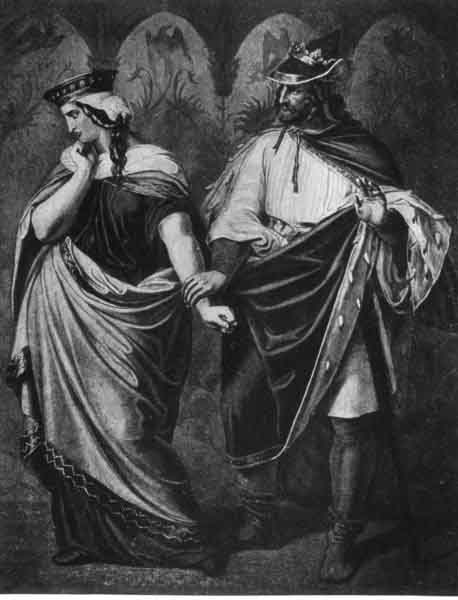
KING GUNTHER AND BRUNHILD<BR> <I>From the painting by Schnorr von Carolsfeld</I> KING GUNTHER AND BRUNHILD
From the painting by Schnorr von Carolsfeld

Then was Siegfried brought before Gunther, and in Brunhild's presence he swore that he had never uttered what Kriemhild had boasted of.

"I grieve that my wife hath made Brunhild to sorrow," he said.

The knights who were there spake one to another. "Would that women might cease their gossip," said one. "Forbid your wives to boast about ye, else there will be strife and shame among us all."

But Brunhild was not comforted. It chanced that Hagen came nigh to her and found her weeping. He asked her why she did grieve so, and when she told him what Kriemhild had said, he waxed wroth because he had sworn allegiance unto Brunhild and served her faithfully, guarding her honour and her life.

"For this insult," he said fiercely, "Siegfried shall pay with his heart's blood. I shall avenge thee, O queen, or die."

Hagen spake to Gunther and the other knights in like manner, and he roused them all to enmity against Siegfried, who reeked not of their secret plotting.

Hagen first contrived that certain knights should visit Worms, making pretence that they came as envoys from King Ludgast declaring war against King Gunther. Siegfried made offer of his service, and Kriemhild was proud thereat, yet did she fear that ill would befall him because that he was reckless and overdaring in battle.

Hagen spake with her treacherously, and she told him that when her husband bathed his body in the dragon's blood a leaf covered, a spot betwixt his shoulders, and that if he were wounded there he would surely die. Brunhild's knight rejoiced in secret, but he promised to defend Siegfried, and counselled Kriemhild, that she should mark the spot by sewing a small red cross upon his clothing, so that he might know where to defend her loved one.

Then Hagen spake to the king, and Gunther arranged that they should go through the forest on a great hunt which would last many days.

Go not forth, Kriemhild pleaded with her husband. "I dreamt that thou wert given chase by two wild boars, and I saw the forest flowers made red with blood."

"Fear not for me, my heart's love," Siegfried said; "I go not a-hunting with foemen, but with thine own kin."

Kriemhild wept bitterly. "Alas! I fear for thy life," she cried. "But yesternight I did dream that thou wert caught betwixt two hills, which fell upon thee, and thou wert lost to my sight. . . . Stay with me here, Siegfried, else I shall sorrow without end."

Siegfried kissed and embraced her with tenderness, and then hastened to join the hunt.

She watched him through her tears as he went from her. Never again did she behold her dear one in life.

There was none like to Siegfried at the hunt. Many wild animals he slew, and he caught a bear alive and bound it, and when he set it free they all gave chase, but it would have escaped but for his valour.

They afterwards sat down to feast together. Food there was in plenty but no wine. Siegfried made complaint thereat, for he was grievously athirst, and he vowed he would never again hunt with them. Little did he dream that a plot was laid to accomplish his death.

Hagen said that there was a clear spring near by, from which they could take refreshment, and he challenged Siegfried to race with him thither for a wager.

Hagen stripped off his clothing, but Siegfried ran in full armour, carrying his shield and spear and his bow and quiver, and yet he reached the spring first. But the hero drank not. He cast off his armour, and laid his weapons on the grass to await the coming of Gunther, the king, so that he might have refreshment before any other.

Dearly did he pay for his courtesy. When the king had taken his fill, and Siegfried stooped down to drink, Hagen drew away stealthily the sword and the bow, and then plunged the spear through the hero's back at the spot where Kriemhild had embroidered the cross. He drew not forth the weapon, but made hurried escape. Never before did he run so swiftly from any man. Siegfried sprang up in anger, the spear sticking fast in his back, and sought for bow or sword to take vengeance on Hagen. But he found his shield only, and flung it after the traitor. It smote him to the ground, and the forest echoed the blow. Had Siegfried but his sword, in that hour Hagen would have been slain.

Snow-white grew the cheeks of that sore-wounded man, the lordly guest of Gunther: he sank to the ground; his strength went from him; death was in his face. Alas! many a fair woman wept tears for him in aftertime.

Among the flowers lay Kriemhild's noble husband, and they were made red with his life blood.

He spake faintly, bitterly reproaching those who had plotted treacherously against him. He called them cowards all. "I have served ye well," he said, "and thus am I repaid. The children yet unborn shall suffer for this foul deed."

Gunther wept. "Weep not for treachery, thou from whom treachery hast come," Siegfried said.

"Now is all danger past," cried Hagen; "I rejoice that he is brought low."

"Boast not, murderous man," Siegfried warned him; "in fair conflict I had naught to fear from thee. . . . Oh, Kriemhild, Kriemhild, my deepest grief is for thee! . . . Would that our son had never been born, because he must bear from his enemies the bitter reproach that his kinsmen are murderers and traitors."

Gunther he reproached for his ingratitude. "I have saved thy life," he said; "I have been the guardian of thine honour. This foul deed is my payment . . . . If thou hast any honour left, protect my wife, thy sister . . . ."

He groaned, for his wound afflicted him sore. Again he spake saying: "In days to come ye shall suffer for this monstrous deed; yourselves have you slain when ye slew me."

He spake no more. Among the blood-steeped flowers he struggled with death. . . .

They laid his corpse upon a golden shield and bore it towards Worms, and in the darkness they left it at the door of Kriemhild's dwelling.

In the morning, when the fair queen was going forth to prayers, she saw the dead body of Siegfried.

"My husband is dead," she cried. "Brunhild hath desired that he should be slain, and by Hagen was he murdered." Heavy was her heart with grief unutterable, nor could she be comforted.

Old King Siegmund embraced his dead son and wept bitterly.

Tenderly was Siegfried's body lifted and borne within; his wounds were washed; in grave robes was he dressed and laid upon a bier.

After three days of mourning the body was borne to the church, and many assembled there to gaze with sorrow upon the dead hero.

Gunther came and said that Siegfried had been slain by robbers. "I sorrow because that he is dead," he told Kriemhild.

"If there was sorrow in thine heart, she answered him, "my husband would not now be laid in death. Would I were dead and he were still alive!"

When Hagen approached the body of Siegfried the spear wound bled afresh. Thus was it proved to all who were there that he was indeed the murderer.

Great was the mourning on the day of Siegfried's funeral. Many wept in the streets. Kriemhild went to the grave, and or ever the coffin was covered over she besought to gaze once again upon the face of her husband. Her desire was granted her, and she lifted up that fair head in her white hands and kissed the death-cold lips of Siegfried. Then fell she in a swoon, nor did she open her eyes again until next morning.

Siegmund departed soon afterwards and journeyed to his own land. But Kriemhild would not return with him, because she desired to be avenged for her husband's death. She was ever mourning, but Brunhild cared not in her pride.

At length Gunther sought her forgiveness, deeming that she had mourned overlong. Kriemhild said: "I shall forgive him with my lips but never with my heart." Yet was she at length constrained to pardon all who had plotted the death of Siegfried, save Hagen, whom she could not suffer to look upon.

Hagen spake to Gunther of the Nibelung treasure, which he could not but think over, and the king contrived that Kriemhild should send for it. So came it to pass that a strong army was sent unto Siegfried's kingdom.

The dwarf Alberich lamented the loss of the Cloak of Obscurity; yet did he deliver up the vast treasure, in the midst of which was a magic rod which would give to the one who possessed it anything that might be wished for. But none knew its virtues.

Thus was all the wealth of the Nibelungs brought unto Kriemhild. She distributed gold to rich and poor, and many adventurous knights paid visit to Worms to share of her bounty. Wages she gave to a great number, so that ere long she had a strong force of war-men at her service.

Hagen was greatly alarmed thereat, and spoke unto the king of Kriemhild's doings. He counselled that the treasure should be taken from her; but Gunther refused to do any harm unto his sister because of the vows he had sworn. Then did Hagen seize the hoard by force, and carried it away. He sank it in the Rhine at Lochheim, with hope to enrich himself in after-time.

So was Kriemhild's immediate hope of vengeance cut off. She took her departure from Worms and went to dwell with her mother at Lorsch. There she embroidered tapestry with pictures of Balder, who had by his brother been slain.

There she tarried for many years, biding the hour of vengeance. Tidings at length came from beyond the Rhine which brought nearer the fulfilment of Siegfried's dying words: "Yourselves have ye slain when ye slew me."

THE DEATH OF SIEGFRIED<BR> <I>From the painting by F. Leeke. By Permission of Franz Hanfstaengl</I> THE DEATH OF SIEGFRIED
From the painting by F. Leeke. By Permission of Franz Hanfstaengl

Teutonic Myth and Legend: Chapter 34 How Brunhild and Kriemhild were won

TEUTONIC MYTH AND LEGEND

by DONALD A. MACKENZIE

An Introduction to the Eddas & Sagas, Beowulf, The Nibelungenlied, etc.

London, Gresham Publications 1912

CHAPTER 34

How Brunhild and Kriemhild were won

Brunhild's Domain--The King and his Vassal--Wooing the Amazon--Her Challenge--Misgivings--Siegfried aids Gunther--Spear and Boulder Contests--Brunhild is won--Fears of Treachery--Siegfried's Secret Mission--Adventure in Nibelung--The Army--Return to Burgundy--Wedding Feast--Brunhild's jealousy--Struggle in Darkness--Invitation to Worms.

FOR the space of twelve days the ship voyaged across the sea, and then drew nigh to a strange shore. Siegfried had beheld it aforetime, and knew that it was Isenland, but Gunther and his knights gazed with wonder on the green lands and the many castles towering upon the headlands.

"He who did cause these strongholds to be built," the king said, "must indeed be a mighty monarch."

"Thou dost now behold the many towers and the fair domain of Queen Brunhild, "said Siegfried. "Yonder is the great castle of Isenland."

The ship was steered into a safe haven, and the prince warned his fellows to have care of their doings in presence of the queen. "Thou shalt say," he counselled them, "that I am but a vassal to King Gunther."

They went ashore and mounted their steeds. Siegfried held the stirrup to the king; the twain were clad in snow-white silken raiment which glittered with bright jewels. Hagen and Dankwart were apparelled in black.

Tidings of their approach were borne unto Queen Brunhild. A courtier spake unto her, saying:

"There cometh hither, O queen, four goodly knights, and one is like unto Siegfried. With him is one of less noble seeming, but he rideth in front, and must therefore be a mighty king indeed. The other two resemble not one another. The first is black-browed and sullen, and fierce are his eyes; his fellow is fair to look upon and is yet of fearless bearing."

A force of knights bade the strangers to deliver up their arms. Unwilling was Hagen to do so, but Siegfried said that such was the custom of the country. Ill at ease were Gunther and Hagen and Dankwart when they beheld the queen and all her maidens coming towards them in midst of five hundred knights with drawn swords.

Brunhild spake to Siegfried only. She bade him welcome to her kingdom.

Then she asked of him: "Why dost thou come hither now with these goodly knights?"

Siegfried made answer: "I thank thee, O Queen, for thy greeting. This noble knight whom I serve is King Gunther. I have followed him because such is his will, else I should not have come hither. He desireth with all his heart to have thee for his bride."

"If such is his desire," Brunhild answered coldly, "the king must needs contend against me in the lists. If he proves to be the stronger, I shall be his bride; but if he fails, then must he and those who are with him be put to death."

Hagen said: "The king shall for certain prevail, because he doth so greatly desire to wed thee."

Brunhild answered him, saying: "Then must he cast the stone and leap to the spot where it falls, as I shall do, and he must also contend with me at spear-throwing. Be not too certain of his success. Consider well my challenge."

Siegfried whispered to Gunther, saying: "Fear not, for I shall give thee mine aid."

Then the king spake boldly unto Brunhild. "For thy dear sake," he said, "I shall risk my life, contending against thee even as thou dost desire."

Brunhild was made angry, and so fierce was she of aspect when her armour was put on, that Hagen and Dankwart feared for the life of the king.

Meanwhile Siegfried had hastened towards the ship. He donned the Cloak of Obscurity, which gave to him the strength of twelve men. Then he returned to the lists unseen by any who were there.

A ring was made, and Brunhild's seven hundred knights stood round it fully armed with naked swords.

Then the great queen came forth. Four men carried her shield, and when Hagen beheld that he cried: "Alas! King Gunther, she is the devil's bride. We shall surely be slain."

Three men carried Brunhild's mighty spear. Gunther began to be afraid, and wished that he were back again in Burgundy.

"Not even the devil could escape her," said he.

Dankwart lamented that their arms were taken from them. "Had Hagen and I but our swords," he said, "Brunhild's war-men would be less arrogant." Hagen spake likewise, and the queen, who heard what was said, bade that their armour and weapons be returned to them.

Then was a boulder carried towards the queen by twelve knights. . . . The men of Burgundy were stricken with fear . . . . . "Would indeed that the devil had her," groaned Hagen.

Brunhild made ready to cast the stone. Gunther watched her with mute amaze. His heart sunk within him. Then it was that Siegfried, wrapped in the Cloak of Obscurity, stole to his side and touched his arm. . . .

The king started. He looked behind him, but saw no man. "Who laid his hand upon my arm?" he asked hoarsely.

"Hush!" whispered Siegfried. "I have come to help thee; so be not afraid."

First Brunhild flung her great spear against Gunther. He would have perished then, but Siegfried warded off the blow, yet not without hurt to himself.

Without delay the prince hurled back the spear, so that the haft struck the queen, for he desired not to slay her. She was felled to the ground. . . . Angrily she arose, but she praised the king for this prowess.

Thereafter Brunhild seized the mighty boulder with both hands, and, having flung it a great distance, she leapt beyond the place where it fell.

Gunther then went towards the boulder with the invisible prince. By the king did it seem to be lifted and thrown, but the mighty deed was accomplished by Siegfried, who cast the stone farther than Brunhild, and leapt farther with Gunther in his arms. 1

Wroth was the queen because that her feats were surpassed, but she spake to her knights, saying:

"Now is Gunther made king over ye all."

Her, face was flushed; her heart thirsted for vengeance.

The warriors of Isenland came towards the King of Burgundy and laid their weapons at his feet. They deemed not that it was Siegfried who had accomplished the mighty deeds and saved Gunther's life.

Meanwhile the prince hastened from the field and returned to the ship, in which he concealed the Cloak of Obscurity. Thereafter he came towards the castle and spake to Gunther, asking him when the trial of feats would begin. So did he deceive Brunhild and her people.

The queen delayed her departure from Isenland, and began to assemble a mighty army. Fearing that she meant ill towards them, Siegfried spake to Gunther and said that he must needs hasten to the kingdom of the Nibelungs and bring back with him a thousand knights, who would be their sure defence. The king was made glad thereat.

Once again did Siegfried assume the Cloak of Obscurity. Then he entered a boat and made it sail swiftly over the waves. Many gazed seaward with wonder, thinking that the boat was driven by wind and tide, for they saw not the prince.

Night had fallen black when Siegfried reached the Nibelung kingdom. He went towards the door of the great mountain in which the treasure hoard was concealed. He knocked loudly, demanding admittance as a weary traveller. In a strange voice he spoke, and the giant porter, who was moved to anger, seizing his shield, opened the door.

"Darest thou with thine evil clamour to awake our people?" the porter growled, and then struck a savage blow. Siegfried parried, but the giant smote again. He came nigh to overcoming the prince, who was greatly alarmed, and yet at heart proud of his strong servant.

For a time they fought hard together, but at length Siegfried threw down the giant and bound him.

Then came against him Alberich, the dwarf, clad in full armour; he fought with a mace which had seven balls on chains. The prince was for a time in great peril, but he overcame the dwarf also, and bound him.

Alberich then cried: "Had I not already vowed to serve another knight, thy slave would I be. Who art thou?"

Said the prince: "My name is Siegfried. Knowest thou me not?"

"Glad am I it is thee and no other," the dwarf said. "Worthy indeed art thou to be King of the Nibelungs."

Then Siegfried unbound the dwarf and the giant, and gave order that a thousand knights be brought forth to do him service. Alberich awakened the heroes who were within, and thirty thousand hastened to obey the ruler. He chose from among them a thousand, and they all sailed forth together in many fair ships towards Isenland, where Brunhild reigned as queen, and Gunther and Hagen and Dankwart awaited their coming.

When three days had passed, Brunhild and her maidens saw, looking from the castle windows, the white sails of many fair ships coming over the sea towards Isenland. The queen was stricken with alarm, fearing a sudden invasion, but Gunther told her that the vessels bore his vassal Siegfried and certain of his own warriors whom he had left behind.

Brunhild went to the beach, and the first she greeted as aforetime was Siegfried. He was clad in gorgeous raiment, and noble was his bearing. . . . Thus was Gunther rescued from peril once again by the Prince of the Netherlands.

The queen then realized she must needs depart from Isenland, and, having chosen her mother's brother to be chief ruler, she sailed towards Burgundy with Gunther and his knights. But she refused to be wed until she had reached the palace at Worms.

A swift and easy voyage was made, and when they were nigh to home Siegfried was sent ahead as envoy to Worms, so that Queen Ute and the Princess Kriemhild might know how the king had prospered.

Giselher beheld first the prince's approach, and he told his mother and fair sister that Siegfried was nigh. . . . Their hearts were filled with dark forebodings, but soon did the prince make them to rejoice with his glad tidings.

Siegfried sat by Kriemhild's side. Her face was rose-red with love, and it was her heart's desire to kiss him. . . .

"Gunther entreats thee to come to the shore, the prince said, "so that thou mayest welcome Brunhild hither."

Kriemhild went gladly with all her maidens, and Giselher led forth a great force of war-men. Brunhild was well pleased because that Gunther was a mighty ruler, and Kriemhild and she kissed one another with love. Together then they all made their way towards the stately palace at Worms.

A great banquet was held, and Gunther and Brunhild were wed. Thereafter in secret did Siegfried speak unto the king, saying:

"Hast thou no memory of thy vow? Thou didst swear that when Brunhild came hither I would be given Kriemhild for wife. . . . Well have I served thee."

Gunther said: "I forswear not my oath. What I can do that shall I do now."

So the king called Kriemhild before him and said: "Thee did I promise unto Siegfried, and if thou wilt have him now my heart's desire will be fulfilled."

BRUNHILD'S ARRIVAL AT WORMS<BR> <I>From the painting by Schnorr von Carolsfeld</I> BRUNHILD'S ARRIVAL AT WORMS
From the painting by Schnorr von Carolsfeld

The princess answered: "Him I shall wed with great joy."

Then were the oaths sworn betwixt them. Proud and happy was the noble prince; maidenly and demure was the beauteous princess.

They all sat down to feast together. Brunhild was at Gunther's side. Her face was pale and cold, and when she beheld Siegfried and Kriemhild together she began to weep bitterly.

The king spake to her and asked: "Why dost thou sorrow? 'Twere more seemly to make merry, for thou art now Queen of Burgundy."

"I weep," Brunhild said, "because that thy sister hath been wedded to thy vassal. . . . Great is my shame thereat."

Gunther told his queen then that Siegfried had lands and castles that were his own. "Great riches hath he," said Gunther, "and therefore am I glad that Kriemhild hath wedded with him."

But Brunhild still sorrowed, and refused to be comforted.

When the feast was over they all returned to their chambers, but Brunhild said she would not be as a wife to the king until he told her all concerning Siegfried and Kriemhild. Gunther was wroth, and answered not, seeking to appease her with caresses, but she laid hands upon him so that he was overpowered. Then, binding the king with her waist girdle, she hung him on the wall.

Next morning Gunther told Siegfried what had happened, and the prince promised once again to be his aid. So, when night fell, he assumed the Cloak of Obscurity and entered Gunther's bedchamber, where he wrestled with the queen. A fierce conflict it was, and Brunhild deemed that her opponent was none other than her husband. In the end Siegfried prevailed, and he took from her the silken waist girdle which she wore, and drew from her finger unawares a ring of fine gold. 2

Thus was Brunhild subdued; after that hour she had but the strength of other women.

Siegfried gave unto Kriemhild the girdle and the ring which had caused many knights to die in the lists at the castle of Isenland.

When the rejoicings came to an end the guests went their ways. Siegfried returned unto his own land, and Siegmund and Sieglind kissed and embraced him and his beauteous bride.

"Henceforward," Siegmund said, "my son shall reign as king." So spake he unto his people, and they rejoiced because that Siegfried was a mighty warrior.

Ten years went past, and a son was born to Kriemhild. He was named Gunther. At the same time Brunhild had a child, and he was called Siegfried.

All went well until Brunhild, who thought of Kriemhild with jealous heart, prevailed upon Gunther to invite Siegfried and his queen to a feast at Worms.

Gary went forth with the king's message, and was received with gladness by Siegfried and Kriemhild, and they bade him tell unto Gunther that they would both attend the feast.

When Gary returned to Worms, Brunhild asked of him: "Is Kriemhild still as fair as she was aforetime?"

The envoy answered her "Yea," and she brooded over it.

Brunhild still regarded Siegfried as a vassal to King Gunther, and she was angry because that he did not make payment of yearly tribute nor visit Worms to do homage, as befitted a subject ruler.

Footnotes

1 The stone-throwing contest is reminiscent of the duels of Scottish bill giants and giantesses, who contend one against the other from height to height. Sometimes a battleaxe and sometimes a stone hammer, but most often a boulder, is thrown. In Wales a mountain giant flings a quoit. In Ross-shire a giantess contends against a giant and wounds him on the forehead. Giantesses are often island dwellers like Brunhild, whose northern origin is not disputed, even by German folklorists. The Queen of Isenland was evidently a Hag heroine of a people among whom Matriarchy lingered as late as it did in the Pictish areas of Scotland. The wooing of Scathach by Cuchulainn is of similar character to the wooing of Brunhild. In the subsequent duel between Cuchulainn and his son, the latter throws his spear blunt end foremost.
2 Evidently her strength was due to the magic girdle. The dwarf Laurin, in Der Kleine Rosingarten, has a girdle which gives him the strength of twelve men. When Dietrich of Bern, wrestling with him, snatches it off, he has the dwarf in his power.

Teutonic Myth and Legend: Chapter 33 The Promise of Kriemhild

TEUTONIC MYTH AND LEGEND

by DONALD A. MACKENZIE

An Introduction to the Eddas & Sagas, Beowulf, The Nibelungenlied, etc.

London, Gresham Publications 1912

CHAPTER 33

The Promise of Kriemhild

The Fair Princess--Her Dream and her Desire--Arrival of her Lover--Hagen's Warning--The Year of Waiting--War declared--Siegfried's Great Deeds--Two Kings taken captive--Lovers meet--A Vision of Beauty--The Worthy Knight--The Kiss and the Vow--Gunther desires Brunhild--Siegfried's Reward.

THE Princess Kriemhild was of great beauty, nor could her equal be found in any land. Many a gallant knight came to death seeking to win her. When her sire, the King of Burgundy died, she was guarded by her three brothers, Gunther and Gernot and Giselher. The queen mother, who was named Ute, had much wealth, and dwelt with her three brave sons and fair daughter in a splendid and stately palace at Worms.

Now it chanced that, ere Siegfried came, Kriemhild dreamt a strange dream, and in the morning she spake regarding it to her mother, saying:

"Methought that I did possess a falcon which was strong and of noble seeming. It was faithful to my will, but there came two fierce eagles and slew it before my eyes. I wept; never did I endure greater sorrow."

The wise old queen said: "I can read thy dream, my child. Thou shalt have a strong and noble husband, but early shall he be taken from thee."

"Dear mother mine," pleaded the princess, "speak not to me of a husband. I desire not the love of any man. My heart's wish is to be ever fair, and to live with thee as I live now until death comes. I seek not the sorrow that love doth surely bring."

"If ever thou shalt have surpassing joy in this life," Ute said, "it shall be given thee by a husband's love. Ah, Kriemhild, thou wouldst indeed be a comely bride! May God send hither a knight who is worthy thee."

Kriemhild blushed. "Speak not again in such wise, mother mine," she said softly. "Full oft is it found by women that their bliss but leads to great sorrow. Neither shall I seek, so that I may avoid all misfortune."

But although the fair princess was long thus minded, the time came when she knew the love of a noble knight, to whom in the end she was wedded. But even as the falcon of her dream was slain, so was her husband. He fell by the hands of her own kinsmen, and so great was her desire for vengeance that many found death ere it was fulfilled.

Siegfried and his knights came riding towards the palace at Worms. Many marvelled greatly to behold them, so noble were they and so richly apparelled. Their raiment flashed with gold, and gold-decked were their bridles. In shining armour they came; high were their helms, and their shields were new and bright. On proudly stepping steeds they rode their stately way, with clink of sword and spear and clang of armour. Siegfried led them on. Nor ever was beheld a fairer knight; on his shield a crown was painted, and he wore the great and matchless blade Balmung, which men gazed upon with wonder.

Tidings were borne to the palace of the prince's approach. King Gunther wondered who he might be, so he bade Hagen to survey him from a window.

Hagen did so and said: "Never have I gazed upon Siegfried, but methinks this noble knight is him and no other. Surely he cometh hither to seek some new enterprise. . . It was this same prince who overcame the Nibelungs and possessed himself of their treasure. For he fought against giants and slew them, and wrested from the dwarf Alberich the Cloak of Obscurity. Never was there a greater hero. He killed the dragon of the forest and bathed himself in its blood, so that no weapon can wound him. Let Siegfried be given welcome, O king. Worthy is he indeed of the friendship of brave men."

The king went forth from the palace. He welcomed the prince. Then he spoke to him saying:

"Why hast thou come hither unto Worms?"

Siegfried made bold answer. "The fame of thy brave knights," he said, "hath gone abroad. I would fain combat with them and with thee for all thy lands and thy strongholds."

But the king spoke words of peace, and sought to have the prince for his ally. In the end his will prevailed, and Siegfried and the knights drank wine together with Gunther.

Thereafter they held games, and Siegfried outshone all others by reason of his strength and skill, for there were none who could throw boulders or shoot arrows like to him. When the knights tilted in the courtyard the eyes of many fair maidens were turned upon the stranger knight.

Fair Kriemhild peered forth from a palace window. She was well content to watch the noble prince. Siegfried beheld her not, but he knew that his loved one was gazing upon him. Yet at heart was he sad, and he wondered how he could win her.

KING GUNTHER WELCOMES SIEGFRIED<BR> <I>From the painting by Schnorr von Carolsfeld</I> KING GUNTHER WELCOMES SIEGFRIED
From the painting by Schnorr von Carolsfeld

Next day the king and all his men went forth to hunt. Siegfried went with them, and Kriemhild fretted alone. Heavy, too, was the heart of the prince.

The weeks went past and the months; the knights hunted oft and vied one with another at sports, but the lovers met not. Nor did Siegfried ever once behold the fair lady he sought for his bride. So was a long year of waiting endured by the twain.

Now it chanced that two kings, who were brothers, desired to war against Gunther and invade his kingdom. Namely were they Ludger of the Saxons, and Ludgast of the Danes. They sent envoys to Worms to make demand of the tribute which was paid aforetime; but Gunther, having taken counsel of Siegfried and his knights, answered them "Nay", and called forth his war-men and made ready for conflict.

Ere long the armies met in battle array. The Danes and Saxons were in number forty thousand, and the strength of the Burgundians was not nigh so great. But great were the deeds of Siegfried, and on the field there was not his equal.

Ere the battle began the prince challenged King Ludgast to single combat, and fiercely did they fight one against the other. Hard were the blows that Siegfried dealt with his sword, Balmung, and in the end the king yielded and was taken prisoner. Ludgast's knights sought to rescue him, but the prince slew thirty, so that but one escaped.

Hagen guarded the royal prisoner, and Gernot rushed into the fray with but a thousand men. Bravely fought the Burgundians. But Siegfried was their strong arm that day. Thrice he drave through the mass of foemen, and the blood of slain men ran behind him like to the Rhine waters. At length he came nigh to Ludger, whom he sought. The Saxon king knew well that his brother of Denmark had been taken captive, and he was wroth thereat. He deemed that Gernot had done the deed. But soon he discovered the truth. Not long did he combat with the heroic prince when he beheld upon his shield a shining crown.

"Cease fighting," the king cried to his men, "for the devil hath sent against me bold Siegfried, the son of Siegmund."

So the Saxon banner was lowered, and King Ludger was Siegfried's prisoner. Five hundred valiant knights were taken captive also, and were led to Worms by Hagen and Gernot.

Now a trusty messenger bore unto Kriemhild secret tidings of the battle, and when she heard of Siegfried's mighty deeds her face reddened like to the rose, and her heart rejoiced not only because he had won great renown, but for reason that he had suffered no hurt in battle.

The two captive kings were brought before Gunther, and they made offer of much gold for life ransom.

Then did Gunther speak nobly. "Thou shalt go free," he said, "but first let there be a peace treaty betwixt us."

Readily did the royal prisoners pledge themselves, and they were honoured as guests. The wounded knights were tended with care, and those who sought not to depart from Worms ere they were healed, remained as friends. The war was ended and there was peace, and Siegfried prepared to return to the Netherlands; but Gunther pleaded with him to tarry yet awhile. That the prince consented to do because of the love he bore for Kriemhild.

A great banquet was held thereafter. From far and near brave knights assembled to rejoice because that victory was given to their arms. All the high-born ladies were bidden as guests, and Queen Ute came with a hundred maidens. Many knights awaited the coming of that fair company, hoping that their eyes would be gladdened by sight of the beauteous princess. Siegfried hoped and waited also.

Then appeared the fairest of the fair. Like to the rose-red dawn beaming amidst murky clouds she came before them all. . . .

Ended was then the trouble of one who had long brooded over her; at last did he behold his heart's desire in all her beauty. Many gems were sparkling on her garments. Her cheeks were rose red and shining with love. . . . None who was there did ever before gaze upon such beauty. As the cloud-girt moon excelleth the stars, so did Kriemhild surpass in splendour all the women who were about her. . . . Gallant knights and gay were stirred with reckless desire to display their prowess before that fair lady.

The chamberlains made clear a path before her, yet did the love-lorn war-men press eagerly to gaze upon Kriemhild.

Siegfried was gladdened and made sorrowful. "How, ah, how can I win thee!" he sighed. "Alas, my hope is vain! I dare not draw nigh to thee. . . . Would I were dead."

His cheeks by turns were red and white. . . . Peerless he stood apart, the great son of Siegmund; noble was his bearing, and as fair was he to look upon as if he were, painted upon parchment by a cunning master. Truly was it said that eye did never behold a lordlier warrior.

The busy chamberlains bade the knights to stand aback, and they gazed with gladness upon the fair ladies, richly robed, who came following Queen Ute.

Then Gernot besought King Gunther that Siegfried be presented unto fair Kriemhild, and the prince was brought before his heart's desire, so that she might greet him. His sadness was swept from him, like dew before sunlight.

Modestly did the maiden greet the brave prince, and her cheeks reddened when he was nigh to her.

"Sir Siegfried, I bid thee welcome," she said; "a valiant and noble knight art thou."

His heart rejoiced thereat; he no longer despaired when he heard her voice, and, bowing low, he kissed her white hand. Then met their eyes, which were filled with secret love. The prince pressed her hand softly, and their hearts did beat together.

Never again had Siegfried such gladness of soul as at that sweet moment, when he turned to walk by her side. . . . All eyes were upon them, and one to the other said that never was there a knight worthier such a prize.

They went before the king, who bade Kriemhild to kiss the noble prince. . . . Nor did Siegfried conceive ere then that life had such joy in store for him.

King Gunther said: "Thus is Siegfried greeted because that many valiant men have fallen by his sword. . . . God grant that he shall never take leave of us."

So was the ceremony ended ere the banquet began. Kriemhild parted a little while from her lover. She went forth in radiant beauty amidst all her fair maidens; there were none like to her--none.

Ere long the lovers met again. The prince waited not for mass; he sought his heart's desire. So they spoke one to another, and she praised him sweetly, thanking God the while for his valour in battle.

SIEGFRIED AND KRIEMHILD<BR> <I>From the painting by Schnorr von Carolsfeld</I> SIEGFRIED AND KRIEMHILD
From the painting by Schnorr von Carolsfeld

Siegfried bowed low and said: "Thee shall I serve all my days, because that I love thee so."

For twelve days did the rejoicings continue, and each day the prince walked beside Kriemhild. . So was royal honour bestowed upon him. The guests made merry; they tilted in the courtyard, they feasted and drank wine together; but at length the time came for them to depart.

One by one they took leave of Ute and Kriemhild, as did also Siegfried, who was plunged thereat in despair.

"Never can I win her," he sighed. . . .

He went forth and called his men; his steed was quickly saddled, and he turned to ride homeward.

But Gunther, hearing of his sudden purpose, sent Giselher to plead with him to remain, saying: "Here thou canst ever see the fair maidens at will."

"Unsaddle the seeds," the prince commanded. "I thought to go forth but Giselher hath prevailed upon me to tarry yet a time."

Because of his love he remained there; nor could he have been happier elsewhere, for he spake to Kriemhild each day. . . . So time passed, but heavy was his heart with love. For love he tarried but to sorrow, and in the end he died for love.

Now it chanced that King Gunther desired greatly to have Brunhild for his bride. He spake with Siegfried thereanent. It was told that Brunhild had vowed to woo not any man who surpassed her not in feats. Great was her strength. First she flung a spear, and her wooer must needs excel her with his. Then cast she a stone, and leapt as far. The knight who failed in either trial was speedily slain. Many sought to woo her, and many died because of their boldness.

Gunther boasted that never was there a woman born whom he could not vanquish. But Siegfried warned him, saying:

"Thou knowest not Brunhild, who hath the strength of four men. Go not unto her if thou dost prize thy life."

"So great is her beauty," the king said, "that I must needs try to win her."

Hagen counselled that he should take Siegfried with him; whereat the king offered the prince reward of honour and service if he would aid him to win Brunhild.

Siegfried said: "If thou shalt give me Kriemhild for wife, thee shall I serve in this thy enterprise. Nor other reward do I seek."

Gunther said: "Thine shall Kriemhild be when I return unto my kingdom with Brunhild for wife."

So they took vows together, and made plans for their journey. The king desired to have an army with him, but the prince prevailed upon him to go forth with only the brothers Hagen and Dankwart and himself. Then Siegfried said that he would take with him the Cloak of Obscurity, which he had won from the dwarf Alberich.

To Kriemhild went Gunther and the prince, and besought her to have fashioned for the four knights raiment both rich and goodly, and the king said they must needs have three changes for four days.

The fair princess set her maids to work, and she herself did cut out each garment. Snow-white silk from Araby and Zazamanc, and silk, green as clover, did the princess bring forth, and silks also from Libya and Morocco. With rare gems was the rich attire adorned, and wrought also with embroideries of gleaming gold. The black-spotted ermine was spared not, and linings were made of bright fishes' skins.

When the king and his three brave knights were all apparelled, each one vowed that their equals were never before beheld.

Kriemhild pleaded with Gunther to go not forth upon his perilous enterprise, but he would not be changed in his intent. The princess wept when farewells were spoken, and to Siegfried she said:

"To thy care do I commend my brother, King Gunther."

Siegfried answered her: "Sorrow not, nor have any fear. If I die not, I shall bring him back again in safety to the Rhineland."

Kriemhild gave him thanks, and was comforted.

Then were their shields of gold and bright weapons and armour carried to the shore. They went aboard--Gunther, the king; Siegfried, Prince of the Netherlands, and the valiant brothers, Hagen and Dankwart.

The white sail was spread; a fair wind filled it, and the ship went down the Rhine.

Many fair maidens watched from windows. Kriemhild wept as the ship fared on.

Teutonic Myth and Legend: Chapter 32 Siegfried and the Nibelungs

TEUTONIC MYTH AND LEGEND

by DONALD A. MACKENZIE

An Introduction to the Eddas & Sagas, Beowulf, The Nibelungenlied, etc.

London, Gresham Publications 1912

CHAPTER 32

Siegfried and the Nibelungs

The Hero's Youth--His Service with Mimer--Wieland overcome--Forging the Sword--The Dragon Regin--The Combat--How Siegfried became invulnerable--Language of Birds--Mimer is slain--Prince journeys to Isenland--Queen Brunhild--Combat with Giants--The Dwarf Alberich--Cloak of Obscurity--The Nibelung Hoard--Quest of Kriemhild.

SIEGFRIED 1 was a great and noble prince whose fame, by reason of his mighty deeds, hath endurance through the Ages. His sire was King Siegmund of the Netherlands and his mother was named Sigelinde. Ere yet he had reached the years that are mellowed by wisdom, Siegfried was of proud and haughty spirit and brooked not restraint. Great was his strength, and if his playfellows obeyed not his will in all things, he smote them harshly, so that they hated as much as they feared him. Wild and wilful was the prince as a lad may be.

Of Siegfried's doings complaint was made unto the king, who resolved to set him to work among strong and skilful men. Accordingly the prince was sent unto Mimer, the wonder smith, who dwelt in a deep forest, so that he might acquire such knowledge of how weapons were made as would serve him well in aftertime.

THE NIBELUNGENLIED<BR> <I>From the fresco by Professor E. Ille</I> THE NIBELUNGENLIED
From the fresco by Professor E. Ille

Mimer gave the lad heavy tasks to perform, and kept him working at anvil and bellows from morn till even. Skilful in time he became, and his strength increased beyond knowledge.

The years went past, and the lad endured the burden of servitude and the blows of his elders with humility. But one day he fell upon Wieland, the strongest and most cunning smith that was in Mimer's service, and dragged him by the locks through the smithy. Mimer was wroth, but Siegfried had discovered the full measure of his might and he commanded haughtily, as befits a prince, that a strong sword should be forged for him. The master smith realized that he must needs obey, however unwilling he might be; so he drew from the furnace a bar of glowing iron, and bade the lad to beat out for himself a worthy blade.

Siegfried swung high the great hammer and struck a blow which shook the smithy. The iron was splintered to pieces, the hammer snapped asunder, and the anvil was driven deep into the ground.

Mimer spake with anger, but Siegfried smote him heavily, and the other assistant he smote also.

Then the lad demanded to be given a sword equal to his strength. Mimer made promise to forge it for him. But in his heart he vowed to be avenged. First he went through the forest to the place where dwelt his brother Regin, who had been, by reason of his evil doings, transformed into a dragon. Mimer roused the monster to anger and bade him lie in wait for Siegfried. Thereafter he returned to the smithy and asked the lad to hasten through the forest unto the dwelling of the charcoal-burner, so that be might procure sufficient good fuel with which to forge the promised sword.

Siegfried seized his club and went forth. He came to a forest swamp which swarmed with venomous snakes and great lind-worms and toads; but he had more loathing than terror. When he reached the charcoal-burner he besought him for fire, so that be might destroy the reptiles.

"Alas, for thee!" the charcoal-burner exclaimed; "for if thou dost return again by the way thou didst come the dragon Regin will come forth to devour thee."

The prince scorned to be afraid, and snatching a fiery brand he returned through the forest and set in flames the trees and shrubbage of the swamp, so that all the loathsome reptiles were destroyed.

Then came forth the great dragon, bellowing loud and spouting venom. The earth trembled as he came. But Siegfried was not afraid. Thrice he smote the monster with his club and thus slew it. 2

Perceiving that the dragon was dead, the prince cut it up, and a deep stream of blood issued forth. He dipped his finger into it, and marvelled to find that the skin had become hard as horn.

Now shall I render myself invulnerable against battle wounds, he said.

So he cast off his clothing and plunged into the hot stream. His whole body was then made horn-hard, save a single spot between his shoulders, to which a gummy leaf had adhered.

Siegfried was well pleased. He clad himself and cooked pieces of the dragon's flesh, so that he might receive a meed of its strength. As he watched the flesh broiling, he tasted a portion to discover if it were ready. When he did that the forest was filled with magic voices, for he could understand the language of birds.

Marvelling greatly, he listened to the birds as they sang:

If Siegfried knew what we know,
What we know this day,
He would seek, O, he would seek
The wonder smith to slay;
For Mimer sent him to the wood
To be the Dragon's prey.

Let Siegfried know what we know,
And ponder o'er our song . . .
The wonder smith would fain, O fain,
Avenge his brother's wrong
Smite to live, or wait his blow
And live not long.

Siegfried heard with understanding, and his heart was hardened against the wonder smith. He cut off the dragon's head, and, hastening unto the smithy, he flung the trophy at Mimer's feet, bidding him to eat thereof. Wieland and his fellow fled, fearing greatly the prince's wrath, but Mimer sought to appease him with flattering words, and at length made offer, for life ransom, of the steed Grane, which was of Sleipner's race.

Siegfried accepted the gift, and then, remembering what the birds had sung, he smote Mimer with his club and slew him.

Then returned the young hero unto his sire, King Siegmund, who reproved him for killing the master smith, but he took pride in the lad because that he had slain the dragon.

Soon afterwards Siegfried was given arms and armour, and became a complete warrior. A banquet was held, and beakers were drained, when, with loud acclamations, the prince was hailed as heir to the kingdom of the Netherlands.

Thereafter Siegmund's strong son went forth to will renown in distant lands, and northward he bent his way towards Isenland. On the shore of the Netherlands a ship awaited him. A great gale blew, and the master mariner feared to go forth. But Siegfried would brook not delay, and crossed the stormy seas without fear, despite the peril he endured.

He landed in safety and journeyed towards the castle of Queen Brunhild. The gates were shut and bolted, but he broke them open. Then did the knights who were on guard rush against him, and they began to fight. But Brunhild came forth and bade that the combat should cease, and she gave the prince right courtly welcome.

Now Brunhild was very fair, and was a battle maiden of wondrous strength and prowess. Many wooed her, but no knight came nigh who was worthy her skill; those who encountered her were slain one by one. Maid attendants she had, too, and they were clad in armour and bravely were they wont to fight for their queen.

Siegfried saw that Brunhild had great beauty, but he had no desire to win her by combat against her knights or by vying with her in feats of strength.

"She whom I shall have for wife," he said, "must be gentle and womanly. I love not the battle maiden."

Yet he departed not without display of prowess, for he seized a boulder and flung it so great a distance that all who saw the feat performed wondered greatly. 3

The prince then went on his way until he came to the land of the Nibelungs. It chanced that the king had died, and his two sons, Nibelung and Schilbung, disputed over the treasure hoard. Unto Siegfried they made offer of a wondrous sword, which had been forged by the dwarfs, if he would make just division of their father's riches. He did as they desired, but they sought to repay him with treachery. For when he was given the sword, which was named Balmung, they said that he had kept back part of the treasure for himself. A quarrel was stirred up, and it waxed fierce. Then the king's sons called forth twelve giants, so that the prince might be overcome and bound, and thereafterwards imprisoned in the treasure cavern of the mountain.

But Siegfried feared not any foe. He fought bravely against the giants.

Then spells were wrought, and a thick mist gathered in the place of conflict; but the sword Balmung was wielded by Siegfried to such good purpose that he prevailed. A thunderstorm raged; 4 the mountains resounded with dread clamour and the earth trembled. Yet did the prince fight on, until he had slain giant after giant and none remained alive.

Thereafter the dwarf Alberich came forth against him, seeking to be avenged. A cunning foeman was he, and not easy to combat against, for he had power to become invisible. He possessed a cloak of obscurity, and when he put it on Siegfried must needs combat with menacing nothingness. Long they fought, and in the end the prince had the dwarf in his power. 5

Although Siegfried put to death the two sons of the king, he spared Alberich, from whom he won the Cloak of Obscurity, which could, when he wore it, render him invisible. For he followed the dwarf as he fled towards the mountain cavern in which the treasure was concealed. Then did the masterful hero possess himself of the hoard, and he made Alberich the keeper of it when he vowed to obey his commands.

The Nibelung people acclaimed Siegfried as their king, but he tarried not long in their midst. He took with him twelve bold war-men, and set sail again for the Netherlands. His fame went speedily abroad, and his deeds were sung of by gleemen in many a hall.

A right valiant and noble prince did Siegfried become; all men honoured him, and by women was he loved. Many a fair maiden sighed because he sought not to win one or another. But he rejoiced in warlike feats and in games, and his heart was moved not with desire for any damsel.

There came a time, however, when gleemen sang of the beauty and grace of the Princess Kriemhild, the daughter of the King of Burgundy. In the wide world there was none fairer, and Siegfried loved her in secret ere yet he beheld her, for he knew that she was his heart's desire, and he resolved that he would woo her right speedily.

He spake to his knights thereanent, and they told both king and queen of Siegfried's bold intent. Siegmund and Sigelinde sought to repress his desire, but the prince would not be restrained.

The king warned his son that the warriors of Burgundy were fierce in war, and among them were Gunther and strong and vengeful Hagen.

"What I shall obtain not by fair request," Siegfried said, "I may win in battle."

SIEGFRIED<BR> <I>From the Painting by F. Leeke. By permission of Franz Hanfstaengl</I>SIEGFRIED
From the Painting by F. Leeke. By permission of Franz Hanfstaengl

His sire made offer of a great army, but the prince said he would go forth as one of twelve knights. He scorned to win Kriemhild by force, and vowed he would woo her by reason of brave deeds.

Then were preparations made for the journey, and the queen caused rich and gorgeous apparel to be fashioned for Siegfried and his men, and when they rode forth they were indeed of noble seeming.

Siegmund and Sigelinde sorrowed greatly when their son kissed them farewell.

"Grieve not," Siegfried said, "for no evil shall come nigh me."

Then rode he away, the noble prince, to share his meed of joy and meet his doom.

Footnotes

1 Siegfried is the hero of the Nibelungenlied, the great Upper German poetic romance (see Introduction). He is identical with the northern Sigurd of the Eddic poems and Volsunga saga. The various versions of the popular tale developed from an older legend. The Nibelungenlied is here introduced by a summary from Thidrek saga, a Norse poem composed about the middle of the thirteenth century, which was based on the Lower German version of the legend and the Dietrich poems. Our introduction gives a consecutive narrative. The Nibelungenlied opens abruptly by introducing Kriemhild, who takes the place of the Norse Gudrun. Siegfried's early exploits are afterwards referred to briefly.
2 The necessity for more than one blow recalls Thor's conflicts with the Midgard serpent in Hymer's boat and at the Ragnarok battle.
3 He resembles the boulder-flinging mountain giants.
4 Thor is suggested here.
5 There is a curious Banffshire story of two mountain fairies who fought for the love of a fairy lady. One was dark and the other was white. The former had power to render himself invisible, but when he did so in the duel a red spot remained. The white fairy saw the red spot floating in the air, and shot an arrow through it. The dark fairy was slain because the red spot was his heart. This story is not of a common type, and is evidently very old. The fairies occupied opposing hills, as if they were the usual Scottish mountain giants. Of course, giants and fairies have much in common.

Teutonic Myth and Legend: Chapter 31 Gudrun's Vengeance

TEUTONIC MYTH AND LEGEND

by DONALD A. MACKENZIE

An Introduction to the Eddas & Sagas, Beowulf, The Nibelungenlied, etc.

London, Gresham Publications 1912

CHAPTER 31

Gudrun's Vengeance

Gudrun's Flight--Grimhild follows her--The Reconciliation--Wooed by King Atle--Doom Dreams--The Fafner Hoard--Coveted by Atle--Invitation to Gudrun's Brothers--Fateful Journey--Treachery--A Fierce Conflict--How Hogne died--Gunnar among Vipers----Queen slays Atle--Becomes Bride of Jonaker--Her Sons--Svanhild is avenged.

WHEN Sigurd and his son were burned with Brynhild on the pyre, Gudrun refused to be comforted, nor could she abide to remain in the Hall of Giuki among the oath-breakers, her brothers, who had brought her husband to his death. So she went forth alone to wander in the forest with desire that wolves should devour her. Five days she journeyed in her sorrow, knowing not whither she went, until she came to the Hall of King Alv. There was she received with pity and tenderness, and she had for companion Thora, daughter of Hakon, King of Denmark. She was well loved, and with Thora she sat and embroidered on fair tapestry the deeds of Sigurd and Sigmund.

Three summers went past and four winters ere Queen Grimhild came to know where Gudrun had her dwelling. She desired that her daughter should return again, because King Atle the Mighty, the brother of Brynhild, sought her for his bride. So Grimhild gave much treasure to her sons, and went forth with them to appease Gudrun with gifts of gold, so that the blood feud might have end. Five hundred war-men rode with Grimhild and Gunnar and Hogne, and they greeted Gudrun and made offer to her of the treasure which they bore with them. Then did Gunnar give to Gudrun a golden goblet filled with the drink of forgetfulness, which Grimhild had brewed, so that she might put past old sorrows and hate. Gudrun drank and her grief faded.

Thereafter Grimhild told her daughter that King Atle desired her for wife, and said that she would be given more treasure when she was wed to him.

"I desire not another husband," Gudrun said; "nor could I live happily with the brother of Brynhild."

"If thou wilt wed Atle," said Grimhild, "thou shalt have sons, and it shall seem to thee that Sigurd and Sigmund are: again in life."

"I seek not nor hope for gladness any more while I live," Gudrun answered.

But her mother pleaded: "Atle is foremost among kings. A nobler husband thou canst not find. May thou never he wed to any man," she added, "if thou shalt spurn this mighty ruler."

"Alas!" sighed Gudrun; "bid me not wed the brother of Brynhild, for he will bring great evil upon our kin, and be the death-bane of Hogne and Gunnar. By my own hand must he fall in the end if I become his bride."

Grimhild wept, nor listened to what Gudrun said. "I shall give thee lands and many war-men," she told her daughter, "if thou wilt take Atle to be thy husband. Thou shalt have joy with him until thy life's end. Besides, by marrying him thou wilt bring great honour unto thy kin."

"Alas! I must then be wed to him," said Gudrun, "although my heart desireth him not. But there is no gladness in store for me, for he will be a bane to my kin."

Grimhild rejoiced because that she at length worked her will, and soon a great company set forth towards the kingdom of Atle the Mighty. They travelled for seven days by land, and then for seven days they voyaged over the sea, and thereafter they travelled by land again for seven days 'ere they came unto the Hall of the King. A great banquet was held, and King Atle and Gudrun were wed. But the bride's heart was sad within her, nor did she ever have joy in the Hall of Brynhild's brother.

One morning when Atle woke from sleep he was greatly troubled because of the dreams he had dreamed. He spoke to Gudrun, saying: "It seemed that thou didst thrust a sword through my breast."

"To dream of iron," the queen said, "is to dream of fire."

"And I dreamt also," continued the king, "that two water-reeds grew up in my hall. By the roots were they pulled up, and they dripped red blood; of them was I asked to partake. . . . Then it seemed that two hungry hawks flew from my wrist, and they went to Hela. Hearts had they steeped in honey, and I ate them. . . . Thereafter I dreamt that two cubs gambolled at my feet; of these did I also partake."

"Thy dreams forebode much ill," Gudrun said; "verily, thy sons are nigh unto life's end. Black grief is at hand."

Weeks passed and then years, and the doom dreams faded from the king's memory. Yet was there more unhappiness between the ill-mated pair.

Then a time came when Atle spoke much of the accursed treasure which Sigurd had found when he slew Fafner. Well he knew that Gunnar and Hogne had kept from Gudrun the greater part, so that they could boast of immense riches. In his heart Atle coveted the hoard, and desired it for himself; so he took counsel with his nobles, and decided to invite Gunnar and Hogne to visit his Hall. A trusted messenger, whose name was Vinge, was sent forth with a company of war-men to make promises to the brothers and induce them to journey to Hunaland. Gudrun knew well that there was evil intent in her husband's heart, so she carved runes of warning upon a gold ring and gave it to Vinge as her gift to Hogne. But Atle's messenger changed the runes so that they seemed to convey a speedy welcome from the queen.

When Vinge reached the Hall of Giuki he made his mission known. The brothers consulted one with another, suspecting treachery and Atle's lust for gold; but Gudrun's ring reassured them, and after they had drunk mead with the messengers, they promised to go forth with them.

But Hogne's wife, Kostbera, made keen scrutiny of Gudrun's ring in her bedchamber, and she saw that the runes had been altered from warning to welcome. To her husband she spoke thereanent. She had also dreamt an ominous dream, in which she saw the Hall overthrown by a rising flood.

But Hogne chided her for thinking ill of Atle. He had given his promise to Vinge to fare forth with him, and scorned to break it.

Gunnar's wife had also dreams of warning. She saw her husband pierced by a sword, while wolves howled about him.

"Little dogs will bark at us," Gunnar said.

"Methought I also saw," his wife continued, "a battle maiden of sad visage entering the hall. She seemed to be a valkyrie."

"A man must die at his appointed hour," Gunnar said; "besides, it is not good to live over long."

Now Gunnar, who was king, for Giuki had departed hence, was well loved by his people, and in the morning they clamoured about him, beseeching that he should not leave them.

But he bade them to feast with him. "We may never again drink mead together," he said, "but no man can escape his fate."

Gunnar's wife spake unto Vinge. "Methinks," she said, "that ill fortune will come to our kind from this journey."

But Vinge swore many oaths, saying that no evil was intended. "May I be hanged," he said, "if a sign of treachery is shown against Gunnar and Hogne in the kingdom of Atle."

There were tears and lamentations when the warrior sons of Giuki went forth never again to return to the kingdom of their sires, although great glory would be theirs by reason of valorous deeds and unflinching courage.

Gunnar's wife embraced her king, and Kostbera embraced Hogne, saying: "May days of gladness be thine."

"Forget not to make merry," Hogne said, "no matter what befalls us on our journey."

When they had voyaged over the sea, there were dumb foretellings of their doom. So swiftly and hard did the oarsmen ply their blades that rowing pins snapped and half the ship's keel was shorn off upon the beach. They leapt ashore and feared not. Gunnar and Hogne went inland towards Atle's stronghold with armour and full war gear and all their men. Two sons of Hogne were with, them, and valorous Orkning, the brother of Kostbera, who had fame for mighty deeds.

They rode together through a dark wood, and when they approached the stronghold of Atle they perceived that the gate was closed against them. A great army was assembling to receive the guests.

Hogne raised his battleaxe and smote the gate asunder, for he must needs enter with dignity becoming his rank.

"Thou hast done wrong," Vinge snarled; "'twere more fitting that thou shouldst wait until I bring the gallows on which ye shall all hang. By smooth words have I induced ye all to come hither; ere long shall ye die together."

"Thy boasts affright me not," answered Hogne; "we shrink not from conflict, if conflict there must be. Yet hast thou wrought us ill, so take thy reward."

As he spake, Hogne swung his battleaxe and slew Vinge with a single blow.

Boldly rode the sons of Giuki until they came to the Hall of Atle. There was a strong army drawn up in line of battle.

King Atle came forth, and spake to the brothers.

"I bid ye welcome," he said, "but unto me must be now given up the great treasure which Sigurd won when he slew Fafner, and is now mine by right of Gudrun."

So fell the treasure curse upon them all in that hour of doom.

Gunnar spake. "Thou shalt never possess our riches," he said, "and if thou dost battle against us, we shall make of thee and thy kin a feast for the eagle and the wolf."

"Long have I desired," said Atle, "to punish ye for the slaying of Sigurd. That indeed was a shameful doing, for his equal was found not among men."

Hogne spake boldly: "Long then hast thou brooded over that matter. A wonder it is that thou didst not sooner set thyself to the task."

Then began the battle, and against one another they cast their spears.

Tidings were borne unto Gudrun of hard fighting, and she hastened forth in great anger. She cast from her the royal robe, and rushing into the midst of the fray embraced her brothers and kissed them.

But in vain did she intervene. The time for peace was past, so she armed herself and fought beside Gunnar and Hogne against the war-men of Atle.

Bravely fought the brothers. The king's three brothers were slain, and Atle cried:

"Now am I the last of my kin, and by thee was Brynhild slain."

"Thou shalt have thy faring in time," answered Hogne; "the gods have decreed thy punishment."

Fiercer grew the conflict, for Atle rallied his war-men and urged them to battle. But he was driven back into his Hall, which soon streamed with blood. Great were the deeds of the valorous Giukings.

But at length Gunnar and Hogne were pressed hard and overpowered. Then were they bound in fetters.

Atle was wroth when he perceived that so many of his war-men were cut down, and he scowled upon Hogne.

"He hath cut down a host of my heroes," he said; "so let his heart be cut out."

"Do thy will," answered Hogne, "for I fear not. So grievously am I wounded that I may as well die."

But the king delayed taking vengeance. He desired first to know where the Fafner treasure was concealed, so he had the brothers cast into separate dungeons.

Gunnar was first brought before him. "Thy life shall be spared," Atle said, "if thou wilt reveal where the treasure lies hidden."

Gunnar answered him. "Ere I speak," he said, "Hogne's heart must be brought unto me."

Then did Atle seek to practise deceit with much cunning. He had a thrall seized, so that his heart might be held up before Gunnar. The man screamed with anguish ere yet the knife touched him, for he desired not to miss constant fare and good, nor leave his well-loved swine.

The coward heart was cut out, and it trembled before Gunnar.

"That is not the valorous heart of my brother," he said, "but the heart of a thrall."

So Hogne had to be slain. He laughed when his enemies fell upon him, and they marvelled at his valour.

Then was, the hero's heart plucked forth, and when Gunnar saw it he said:

"That indeed is the heart of great Hogne. See how it still beats without fear. I wavered while my brother was yet alive, but now can I die well satisfied, Atle, for thou shalt never know where the treasure lies hid. Yet thou, O King, shall escape not thy doom, and the Rhine river shall keep the secret of the gold."

Atle was wroth; his brow darkened and his eyes burned fire.

"Take hence the prisoner," he growled, and as he bade his men so did they do. 1

Gunnar was bound and thrust into a loathsome dungeon which swarmed with vipers. But Gudrun sent unto him a harp, and he played upon it with his toes, making such sweet music that all the vipers were charmed into a magic sleep save one, which gnawed his breast until it reached his heart to suck his life's blood. Great torture did Gunnar suffer ere he died.

Men have told that the viper which killed the hero was the mother of Atle, who was a sorceress.

The king boasted before Gudrun, because that he had triumphed over her brothers.

"Gunnar and Hogne are indeed no more," the queen said, "and unto me is given a heritage of vengeance."

Atle liked not her speech, so he said: "Let peace be made between us. Thee shall I give much treasure as atonement for the loss of thy kin."

Gudrun would accept not of blood payment, but she desired that a funeral feast be held for Gunnar and Hogne.

The king gave ready consent, and then was the dread work of vengeance begun. Gudrun slew her two sons. Of their skulls she made drinking cups, and she had their hearts cooked in honey for the king. In his wine she mixed their blood.

When the feast was over, Atle desired that his sons should be brought before him.

"Thou hast given me dark sorrow," Gudrun said, "by slaying my brothers. Now hast thou thy reward. Thou didst eat the hearts of thy sons, and their blood hast thou drunken in thy wine from these their skull cups.

"Vengeful woman," cried Atle, "a great cruelty thou hast done by slaying thine own children."

"There shall be still greater cruelty yet," she answered him.

"Thou shalt be burned alive for this," Atle cried fiercely.

"Thine own death thou dost foretell," she said, "as well as mine."

Now a son of Hogne was left alive. He was a Niblung. 2 With him did Gudrun conspire. When Atle had drunken deep, and slumbered, his wife went with Hogne's son to his bedchamber, and she thrust a sword through him.

Atle woke up and cried: "Who hath given me my deathwound?"

Gudrun made known herself, and said she had taken vengeance for her kin.

Atle pleaded that he would have stately burial, and the queen promised him a great pyre. When he died she set fire to the hall, and all that were within it were burned. In the darkness the war-men sprang one upon the other, and many fell fighting ere the end came.

Gudrun made escape, but she desired not to live any more. She hastened towards the shore and cast herself into the waves, so that her days might have end.

There are those who tell that she died thus, but others say that the waves bore her over the sea and cast her upon the beach nigh to the stronghold of King Jonaker.

A strong warrior was he. When he saw the queen's beauty he desired to have her for bride, and when she was nourished and comforted the twain were married and they dwelt happily together.

Gudrun had three sons, and they were named Hamder, Sorle, and Erp. It is told that when they became full warriors she sent them forth against King Jormunrek to avenge the death of Svanhild. But Erp, it was deemed, was unwilling to go forth, so his brothers slew him.

Then Hamder and Sorle set forth. Their mother charmed their bodies against steel, and when they reached Jormunrek, Hamder cut off his hands and Sorle smote off his feet.

"If Erp were here," one said to the other, "he would have taken the king's head."

Many strong and well-skilled warriors fought against the sons of Gudrun, but without avail, for they could not wound them.

Then in the midst of the fray appeared a wise old man who had but one eye. He was Odin, but they knew it not. He counselled that the warriors should cast stones against the twain, who were protected by spells. As he advised, so was it done. Many stones were flung at Hamder and Sorle, and they were speedily slain.

So endeth the northern tale of the Volsungs and the Giukings.

Footnotes

1 A similar legend regarding a secret is current in the Highlands. Neil Munro gives a spirited version in his picturesque tale "The Secret of the Heather Ale" in The Lost Pibroch.
2 The Giukings were originally the Nibelungs (Hniflungs) who possessed the hoard guarded by Andvari (Alberich). That is why Hogne's son is called a "Niblung". The reference is a survival from one of the older versions of the legend. In the next chapter the Nibelungs are dwarfs (elves) and the Giukings are the Burgundians. How myth and history commingled in endless variations is illustrated by the Dietrich stories. Similarly, myths which had a common and remote origin, and developed separately in various districts, were also fused by wandering minstrels.

Teutonic Myth and Legend: Chapter 30 The Last of the Volsungs

TEUTONIC MYTH AND LEGEND

by DONALD A. MACKENZIE

An Introduction to the Eddas & Sagas, Beowulf, The Nibelungenlied, etc.

London, Gresham Publications 1912

CHAPTER 30

The Last of the Volsungs

Brynhild's Daughter--Escape to Norway--Her Protector murdered--Why she was called Krake--The Princess Thora--Her Dragon--like Serpents--How Ragnar won his Bride--The Northern Cinderella--Wooed by the Viking--The Slave becomes a Queen--Story of Svanhild--Wife of Jormunrek (Ermenrich)--Bikki (Sibech) the Accuser--Fate of Gudrun's Daughter.

Now when Brynhild died, Heimer feared that Giuki's vengeful sons would slay Aslog because that she was the last of the Volsungs, and might rear up a son who would come against them. So he prepared to take flight. He made a harp, in which he concealed Brynhild's child with certain of her treasures, and voyaged to Norway, where he made pretence to be a minstrel. He went to a house in Spangerejd and dwelt in it. He revealed not there the secret of the child's concealment. But one day the housewife perceived that there was treasure in the harp, for the door of Aslog's harp-chamber was not closed, and a portion of rich cloth protruded from it. Then was Heimer murdered in his sleep, and Aslog was taken forth with the treasure that was hers.

The child grew up in the strange household, and her foster-parents were not only poor but cruel and harsh; the high-born girl was made a slave, and was set to work at menial tasks. As the years passed by her beauty shone forth, and her captors, fearing that blame would fall upon them for doing evil, kept her clad in rags, and smeared her face with soot and tar, so that no eye might gaze upon her with wonder. Then was she nicknamed Krake, which signifies "the crow".

Thus did Aslog abide with harsh and strange folk until the coming of the great viking Ragnar Lodbrog, who had fame not only on the high seas for deeds of valour, but also because he had slain the venomous serpents which were the bane of King Heroth's kingdom.

It chanced that the king had gone hunting in the woods, where he found two young snakes; these he bore home with him to his daughter Thora, by whom they were fed until they grew so large that she dreaded to approach them. Each then began to devour an ox daily; and they both became so powerful that they laid waste the countryside, and killed men and beasts with their venomous breath.

King Heroth feared to contend against the serpents, but he offered his daughter in marriage to the man who would slay them. Now Thora was fair to behold, and many heroes went forth to fight the monsters; but they suffered death one after another, and the affliction grew greater, so that all people were in constant fear and peril.

The day came when Ragnar heard of Thora, whom he desired for wife, being set up as a reward for serpent-slaying, and he resolved to win her by mighty deeds. So he bade that a mantle and breeches of wool be fashioned for him, and when they were ready he gave King Heroth to know that he would make attack on the serpents.

It was the season of winter, and he dipped his woollen attire in a stream and it was soon frozen hard. Clad thus, he was protected against the venom, so he girt on his sword and took a spear in his right hand and a shield in his left and went forth to fight, so that Thora might be his bride.

A great serpent came against him, but he feared not, and prepared to combat with it. Then another great serpent hastened to the aid of the first, and he was soon in dire peril. They spouted venom upon Ragnar, but his frost-bound clothing protected him; and they smote him with their tails, but he stood firm. Terrible was the conflict which was waged, and the king and all who were with him were filled with alarm, and sought high and narrow hiding places, fearing that Ragnar would be overcome.

The serpents were enraged, and they made ferocious attack with monstrous jaws agape, but Ragnar raised his shield against them each time they sought to bite. He was indeed sore pressed and greatly wearied; but at length he cast his spear at them and it went through their hearts, so that they were both slain.

A great shout was raised by those who were in hiding, and the king came forth to honour Ragnar. He laughed to see the strange attire of the hero, and nicknamed him "Lodbrog", which signifies "shaggy-breeches".

Then was a great banquet given. Ragnar was attired ill splendour, and he was given Thora for wife. But when she had borne him two sons she died, although young and fair, and her husband mourned for her.

Ragnar then plundered on the high seas and raided Scotland and Pictland. He set a new king over the Orkneys, and went against Norway.

It chanced that he came one day to Spangerejd, and there he sent men ashore to procure bread. When they returned with the food he was made angry because that it was burned. The men told him that they had gone to a house in which there was a beautiful maiden: they could refrain not from gazing upon her, and so the bread was burned.

Now Ragnar bethought him to have such a maiden for his bride, so that he might forget his grief for Thora. He sent to her a message bidding her to come unto him. Desiring to put her wisdom to test, he told his messengers to ask her to come not on foot nor yet driving; not attired and yet not naked; not feasting and yet not fasting; not with anyone and yet not alone.

Aslog, who was named Krake in her poor dwelling, came towards the great sea king neither driving nor on foot but riding upon a goat with her feet trailing upon the ground; she came without attire, but yet not naked, because her hair was so long and bountiful that it covered her body, and she drew a net about her; she came not feasting nor yet fasting, because she held an onion to her lips and tasted of it; she was not alone, because her dog walked by her side. 1

Ragnar, who was now a great king, took beauteous Aslog, the daughter of Sigurd and Brynhild, for his bride, and their sons were named Ingvar and Ubbe. 2

After Sigurd's death Gudrun had a daughter who was named Svanhild. She was given for wife to Jormunrek, 3 King of the Gauts. Like to a sunbeam was she in the hall of Giuki, and there was great sorrow when she went forth with her bondmaids. Much treasure was she given, but the curse of Andvari's gold followed her. It fell that she was falsely accused by Bikki of unfaithfulness with a prince, and so greatly enraged did the king become that he ordered that she should be put to death by being trampled under the hoofs of horses.

Then was Svanhild bound and left lying on a plain; but although the horses ran over her they injured her not, some say because of her surpassing beauty, and others because of the brightness of her Volsung eyes.

The king deemed that his fair bride was innocent, because she had escaped injury, but Bikki, her accuser, poisoned the king's ear, and persuaded him to command that Svanhild should be laid upon the ground with her face downward. Then were the horses driven over her again, and she was trodden deep down into the earth by the multitudinous hoofs. So perished Svanhild, daughter of Gudrun, while Aslog, daughter of Brynhild, reigned as Ragnar's queen in a northern land. In Norway, s royal line alone doth the blood of the Volsungs flow.

The young prince, who was Jormunrek's son, was condemned to death by his sire and was hanged. 4

KRAKE<BR> <I>From the painting by M. E. Winge</I> KRAKE
From the painting by M. E. Winge

Footnotes

1 So did Grainne come to Diarmid in the Highland Fian tale. Grimm also gives a version of the story with numerous references to similar tales in other languages than Gaelic and German. In Saxo (Book 9) there is a more sordid account of Ragnar's wooing of "a certain young woman" who became the mother of Ubbe. Like Odin, when he wooed Rhine, Ragnar made use of female attire. Our version is from Ragnar's saga. The Volsunga saga drops Aslog at the point where she became Krake.
2 Here we meet history. By one authority Ingvar and Ubbe are said to be the northmen who murdered King Eadmund of England. Others identify them as the avenging sons who carved an eagle on the back of King Ella in Yorkshire, because he had driven their half-brother Ivar from the throne. Krake is a northern Cinderella, sung of in Norway and Denmark. She was a link between Odin and the Norse kings, who prided themselves in their descent from the Asa-god.
3 Ermenrich (Hermanric) of the Ostrogoths.
4 Saxo gives an account of a sham execution, but in the Dietrich story he is actually put to death. Bikki is Sibech.

Teutonic Myth and Legend: Chapter 29 Brynhild and Gudrun

TEUTONIC MYTH AND LEGEND

by DONALD A. MACKENZIE

An Introduction to the Eddas & Sagas, Beowulf, The Nibelungenlied, etc.

London, Gresham Publications 1912

CHAPTER 29

Brynhild and Gudrun

Brynhild's Magic Sleep--Awakened by Sigurd--Lovers pledge their Troth--The Draught of Forgetfulness --Gudrun wins Sigurd--Gunnar's Wooing--How Brynhild was deceived--Quarrel with Gudrun--Sigurd is murdered--Gudrun's Sorrow--Brynhild dies on Sigurd's Pyre--Ride to Hela.

WHEN Sigurd came nigh to Hindarfell, in the land of the Franks, he beheld a blaze of light on the hill. Then he perceived that a stately castle was girt round with magic fire. Its roof was of shining gold. A banner on the highest tower floated in the wind.

He rode towards the castle. He went through the flames on the back of Grane. He dismounted and went within. There he beheld a beauteous battle maiden wrapped in magic sleep; golden was her hair, and she was clad in armour. . . . He went towards her and took off her gleaming helm, and her locks fell free. Yet her eyes opened not, so strong was the sleep spell that was upon her. . . . He drew his magic sword and cut through her armour so that it fell to pieces, whereat the maiden awoke. . . . Her wondrous eyes glowed upon him; her pale cheeks reddened and her lips opened.

"How long hast thou lain asleep?" asked Sigurd.

"Who art thou," the maiden sighed, "that hast shorn my armour asunder, and hath power to break the runes of sleep? . . . Art thou indeed Sigurd, the son of great Sigmund? Hast thou come at last with the helmet of darkness and the sword which slew Fafner?"

Sigurd answered. "I am even Sigurd, the son of Sigmund, and my sword hath shorn thine armour asunder."

"None but a Volsung could have done the deed," cried Brynhild, for indeed it was she--the beauteous valkyrie whom Odin had punished by laying her in a magic sleep because that she had caused to fall in battle those whom he favoured.

"A Volsung am I," Sigurd answered, "and I have come to thee because thou art so fair and full of wisdom. Fain would I learn of thee."

Then Brynhild smiled. She threw back her golden hair, and gazed forth upon the world once more. She saw the bright sun and the fresh green ways, and like a dawn-awakened bird she raised her voice in song.

Long was my sleep, long was my sleep,
Darkling 't was lone and dreamless and deep
Long as the evils that mankind endure,
As long and as sure;
Helpless in sunshine and starshine I've lain,
Wrapped by the runes that bind like a chain
Helpless ye found me:
Odin had bound me
Bound me in sleep where I lay. . . .
Hail to the day!
Hail to the sons of the light!
All hail to the night!
Hail and O hear, beholding us twain,
And give what we hope now to gain. . . .
Hail ye gods and ye goddesses dear,
And Earth, the mother of all!
Give us of wisdom and tenderness here,
Hands that shall heal and hearts without fear
Till death shall at length on us call. . . .

Then Brynhild told Sigurd how Odin had touched her with the sleep thorn, and said that never again would she be a chooser of the slain, but would lie in slumber until a lover came.

"But I vowed a vow," she said, "that I would never wed a man who knew what it was to be afraid."

Sigurd said: "Fain would I hear of thy wisdom, for which thou art famed."

"With gratitude can I speak to thee," said Brynhild, "but let us first drink mead together. May thou profit by what I shall teach thee, and may thou in after time remember what I now speak unto thee."

She filled a golden goblet and gave to Sigurd to drink.

"The mead," she said, "is mixed with renown and songs merry and sad, and with wise thoughts and tender heart thoughts and valorous speech. . . . Thou shalt grave war runes on thy blade, and twice shall Tyr be named. Runes of ocean shalt thou carve on stern and rudder and oar; thou shalt have peaceful sea-ways. . . . Runes thou shalt learn to ward off blood vengeance and doom. . . . Runes thou shalt learn to call fairy help when a son cometh, and runes for wound healing which thou shalt carve on trees whose branches are bending towards the east. . . . I shall teach thee runes of high-heartedness and valour--the runes of the gods, the runes of the elves, and the runes of the wise Vans. . . . I shall give thee runes that shall aid thee in all things until life ends. . . . Now thou shalt choose what thou dost desire to be and to have.

Sigurd spake: "I was born to be without fear. I shall forget thee never, and in my heart shall I treasure what thou givest unto me."

Then Brynhild gave runes to Sigurd, and she counselled him to give friendship for friendship, and to have forbearance so that he might win fame among men.

"Take close account of what is evil," she said; "from a maiden's love and a man's own wife wrong may come. Give little heed to those who speak more harshly of others than they deem they do; take not advice from men of poor judgment. Ever be watchful of danger wherever thou farest; let not a woman enchant thee in the feasting hall. Heed not the unwise speech of a man who hath drunken deep. Keep the oaths thou dost swear. Trust not him whose kin thou hast slain. . . . I can read not of thy future right well, nor perceive clearly what shall befall thee, but may evil come not from thy wife's kindred."

Sigurd said: "None other but thee shall I have for my bride."

Brynhild made answer: "If it were given me to make choice among all the sons of men, thee alone would I desire to be mine."

Sigurd gave to the gold-haired maiden the magic ring which was in Fafner's hoard.

Then did they swear binding oaths together, vowing that they would ever be faithful one to another until life's last loop was spun.

Thereafter went Sigurd on his way, for he must needs travel unto the hall of King Giuki. Loving Brynhild, he went, but it was doomed that he should break his binding vows, and spurn the golden-haired maiden whom he had rescued from magic sleep. It was indeed fated that he should drink the draught of forgetfulness, so that new love might enter his heart, for he must needs suffer because of the treachery of another.

A warrior of noble seeming was Sigurd, and wondering eyes beheld him as he drew nigh to the dwelling of Giuki. Great was his height, and he had the shoulder-breadth of two men. Young was he, and very fair.

His eyes were blue, and of such brightness that men quailed before him; his nose was high-ridged, and bent like to an eagle's beak; broad was his face from cheek bone to cheek bone. His hair was copper-brown, and hung over his shoulder gleaming in sunshine, and his beard was short and fair. All beholders gazed with mute wonder upon his great sword Gram.

He was withal fearless and high-hearted, one who loved his friends and was unafraid of any foe. Ever ready was he to give aid to kinsmen and allies. Such eloquence of speech was his that men were drawn towards him.

Those who played games round Giuki's hall ceased when Sigurd came nigh. King Giuki greeted him with welcome to his dwelling, and the treasure chests were taken from Grane's back and borne within.

The king had for wife the crafty Grimhild, who was a sorceress, and they had a beauteous daughter who was named Gudrun. Their three sons were Gunnar, Hogne, and Guttorm.

Now, when Grimhild beheld Sigurd, she was taken with desire that he should have her daughter for his bride, and ill-pleased was she when she found that his heart was filled with love for Brynhild.

It chanced that the two maidens dreamed dreams. Brynhild had a vision of Gudrun coming towards her, and on the day that followed Gudrun indeed came in a gold-decked chariot with all her maidens, for Gudrun had also dreamt a dream and desired that the wise Brynhild should solve it.

Brynhild, who was King Budle's daughter, dwelt betimes at her castle, and betimes at the Hall of Heimar, who had for wife her sister Bkhild. Her brother was King Atle the Mighty.

It was at Heimar's hall that Giuki's daughter found the fair battle maiden on that fateful day.

Gudrun told Brynhild of her dream. "It seemed," she said, "that we were together in a forest and saw a noble stag. Copper-coloured was its hair, and we both desired to possess it. But no one save myself alone could reach the stag, and I possessed it, and was made glad. Then thou didst come, Brynhild, and thou didst slay my stag, and I wept bitterly. Thereafter thou didst give me a young wolf which was red with the blood of my kin."

"Alas!" Brynhild sighed; "I can read thy dream. Thou shalt marry Sigurd, whom I desire for my lover. A magic drink he shall receive, and he shall turn from me. Then shall there be a feud, and he shall be slain, and thou shalt thereafter marry my brother King Atle the Mighty, whom thou shalt slay in the end."

Gudrun wept. "Terrible indeed it is," she said, "to have knowledge of these things."

So she left Brynhild and returned with her maidens to the hall of King Giuki, her sire.

Three years passed, and Sigurd remained with the king who had given him welcome. With Gunnar and Hogne he took oaths of fellowship, and they hunted together and made merry.

Ever did Queen Grimhild desire that Sigurd should take Gudrun for his bride, and at length she brewed a magic drink which would make him forget the battle maiden whom he had chosen for his bride.

A night came when they sat together in the feasting hall, and the queen rose and filled the drinking horn with the magic drink and gave it unto Sigurd, saying:

"It hath pleasured us to have thee abiding with us here. Thou shalt receive from us all thou dost desire. Drink thou from this horn the mead which I have prepared for thee."

Sigurd drank as she desired, and he forgot Brynhild and the binding vows he had sworn with her. The love he had for her passed away, and he saw that Gudrun was very fair.

Then the queen said: "King Giuki shall be to thee a sire, and his sons are thy brethren."

To the king in secret Grimhild spake, as she embraced him: "Give thou our daughter for wife unto Sigurd. Great is his wealth, and it would be well that he should ever be with us."

Giuki disdained to offer his daughter even unto Sigurd, but the queen constrained her son Gunnar to counsel the young hero to have the beauteous maid for his bride.

So it fell that Sigurd and Gudrun were wed in the Hall, and they dwelt happily together. They had a son, and his name was Sigmund.

Queen Grimhild next desired that her son Gunnar should have Brynhild for wife, and she said: "Go thou and woo the battle maiden, and Sigurd shall go with thee."

"That will I do right willingly," Gunnar made answer, "for I would fain have golden-haired Brynhild for my bride."

Then he rode forth towards the hall of Heimar, and with him went Sigurd. Grimhild had wrought a spell so that Brynhild would know not her former lover.

Gunnar besought of Heimar that he should have the battle maiden for wife, but Heimar said: "Brynhild shall only wed him whom she herself doth choose. To her thou must go. She dwelleth in a castle beyond, which is girt about with magic fire, and thou must needs ride through the flames to win nigh unto her."

Then Gunnar rode towards the dwelling of Brynhild, and Sigurd went with him. But when they came nigh to the fire-girt castle Gunnar's steed would go no farther, for it feared the flames.

Sigurd said: "To thee shall I give Grane, on whom to ride through the fire."

So he dismounted; but when Gunnar sat upon the back of Grane, the steed refused to move forward. None save Sigurd could go unto Brynhild; none could ride through the flames save Sigmund's noble son.

Then took Sigurd the semblance of Gunnar, and Gunnar the semblance of Sigurd, as Queen Grimhild had given each of them power to do, and Sigurd leapt upon Grane's back and rode through the magic fire.

Brynhild saw Sigurd coming towards her and said: "Who art thou who hast come through the magic fire?"

Sigurd answered: "My name is Gunnar, son of Giuki. Thee shall I have for my bride, because that thou didst vow to marry him who would reach thee through the flames."

"Thee shall I wed, Brynhild said, "if thou shalt promise to slay those who also desire to have me for wife."

"That shall I promise thee," answered Sigurd, and the battle maiden was well pleased.

Three nights he abode with Brynhild in the castle, and ere he left her she gave to him the ring that was once Andvari's, and had been taken by Sigurd from the hoard of Fafner--the ring of doom which was a bane to them both.

Through the flames once more went Sigmund's great son. With Gunnar he again changed shapes, and together they returned unto the hall of Giuki.

In time fair Brynhild left her fire-girt castle and went unto the dwelling of Heimar, to whom she told how fate had served her.

"Fain was I," she said, "that it had happened as aforetime--that Sigurd had come through the flames towards me instead of Gunnar."

"As it hath chanced," said Heimar, "so must it be."

Now Brynhild had a daughter, whose name was Aslog. A Volsung was she by birth, for her sire was Sigurd, and it was fated that she would be the last of her race. The battle maiden gave the child to Heimar, so that she might be nourished and fostered and kept free from harm.

When Brynhild did that she went with King Budle, her father, to the hall of Giuki. There was a feast of splendour held, and Gunnar and the battle maiden were wed. They drank mead together and made merry.

But if joy came to the heart of Brynhild, it speedily vanished when she beheld Sigurd with another bride. In secret she bewailed her fate, because that her first love who had awakened her from magic sleep had been taken from her by treachery and sorcery. Nor could such sorrow have long endurance. The treasure curse was upon them all; the shadow of doom was already darkening their days.

Ere long the pent-up grief storm broke forth in lamentation and feud; ere long there was shedding of blood and the heart call of vengeance.

It chanced that Brynhild and Gudrun bathed together in the river, and the battle maiden perceived that Andvari's doom ring was worn by Sigurd's bride. They fell to quarrelling one with another. Thereafter Brynhild went home; pale was her face and anger burned in her eyes: her heart was in torment.

On the morn that followed Gudrun besought Brynhild to sorrow not.

"Thy heart is evil," the battle maiden said; "it giveth thee joy to see me grieve. But thou shalt escape not thy due, for no longer can I endure to see thee with Sigurd."

"Thou hast Gunnar, my brother," said Gudrun; "a worthier lord is he than thou dost deserve. Well mayest thou take joy in him."

"Happy would I indeed be with one more noble," Brynhild answered.

Then Gudrun taunted her, and told how Sigurd had gone through the flames in the guise of Gunnar so that she might be beguiled.

There was no joy in the heart of Brynhild thereafter. Her days and nights she spent in lamentations, so that she was heard by all. Nor would she speak unto anyone, not even her husband; for when she wailed not, she lay like to one who was dead; alone in her chamber she lay; her face was white as winter's snow, and ice-hard and cold.

At length Gunnar besought Sigurd to go unto her, for to none had she spoken for many days, nor had she eaten or drunken aught.

But Sigurd feared that he could quench not the flames of her grief, and knew well that she fostered ill against him with dire intent. Yet was he constrained to speak to her. So Sigurd entered her chamber.

"Arise, O Brynhild," he cried, "for lo! the sun is bright; grieve no more, and make merry in our midst."

Brynhild opened her eyes, as aforetime she had done when Sigurd awakened her from magic sleep.

So," she spake, "thou art so bold as to come hither thou who hast among all the others been most treacherous unto me."

"Speak not thus," said Sigurd for what reason dost thou sorrow so deeply?"

"Because the sword is not red with thy heart's blood," Brynhild answered.

Then was Sigurd moved to grief also. To Brynhild he spake tenderly and low. "Thee did I love better than mine own life, he said; "but alas! I was given to drink of the mead of forgetfulness, so that a spell was cast over me and I knew thee not. Yet did I sorrow when I came to know that thou, my heart's desire, wert wife to another. . . . Now be my doom fulfilled, for I desire not to live any more."

"Too late! . . . too late!" cried Brynhild. "It is too late to speak of thy sorrow. Now will greater scorn be turned against me than heretofore. . . . Women shall mock; none shall pity me."

Then Sigurd said he would put away Gudrun and nave her for wife, but Brynhild would hearken not.

"All things have changed," said the woman of sorrow, "and I would fain die. . . . I have been deceived. I desire thee not, and I desire no other."

In sore grief did Sigurd leave her; his head was bowed, his eyes were dimmed, and never again was there joy in his heart.

"I would fain die," Brynhild wailed. "I have been deceived. . . . Sigurd hath deceived me and death is his due. . . . I will not have him live with her who taunts me with scorn. Even now he telleth her of what hath passed, and she mocketh me."

When Gunnar entered Brynhild's chamber she spake:

"Thou shalt live not another night if thou dost not slay Sigurd.

Nor aught else would she say unto him.

That was indeed a grievous speech to the ears of Gunnar--to be asked to slay one with whom he had taken binding vows. Yet did he love Brynhild more than Sigurd. So he went unto his brother Hogne and told him what had come to pass.

"If Sigurd is slain," Hogne said, "a noble warrior indeed shall be cut off, and doom and shame may be our dower."

So together they went unto Guttorm, who was young and had not sworn oaths with Sigurd, and he consented to do the will of Brynhild.

In the morning Guttorm entered the bedchamber where Sigurd and Gudrun lay fast asleep. He drew his sword. He thrust it through Sigurd's body and gave him his deathwound. Then he turned to make hasty escape.

Sigurd woke in his agony, and, seizing his sword Gram, he flung it at Guttorm and slew him.

Then Gudrun, who lay with her arms about her loved one, awoke to her sorrow; her body was wet with the blood that streamed from Sigurd's deathwound. Bitterly she moaned and wept.

"Grieve not too much," her husband sighed: "as the norns have decreed, so has it come to pass; my doom was hidden from me, and it has now fallen. . . . The hand of Brynhild is in this foul deed: she who loves me above all other men desireth that I should die. . . . Ah! had I not been stricken while I slept, many great men would have fallen ere I could be overcome . . . ."

Then Sigurd died. . . . Even while he spake he was taken from Gudrun, and she gave forth a loud and bitter cry that was heard throughout the Hall.

Brynhild laughed. . . .

Said Gunnar: "Thou dost not laugh for joy, O monstrous woman, for thy cheeks have grown grim and death-white. . . . How wouldst thou feel now if thine own brother Atle were slain before thine eyes?"

"Vain is thy threat against Atle," Brynhild answered; "there shall yet be much bloodshed, but thou thyself must fall ere he shall die."

Gudrun cried: "Sigurd is dead; my kinsmen have slain him."

Nor other moan she made.

Brynhild sighed in secret: "One I loved, and no other, and he is laid in death."

All through the moonless night that followed the death day, Gudrun sat beside her husband's body. Her tears were dried; her cheeks were pale; she smote not her hands nor uttered any cry. Many sought to comfort her, but her heart was cold.

At length her sister came and drew the white sheet from off Sigurd's body, and said:

"Gudrun, turn thine eyes upon him thou lovest. Kiss his lips. Take him in thine arms as if he were still alive."

Gudrun looked in Sigurd's face. . . . His eyes were glazed in death; his lips were cold; pale were his cheeks, and his hair was red with blood.

She lay down beside Sigurd; she kissed his lips and wept.

Then spake her sister: "Never knew I of love like to the love that Gudrun beareth for Sigurd."

Gudrun said: "Like to a sword-lily among grass blades was Sigurd among the sons of Giuki, my brothers.

I whom he raised up am now but a leaf cast to the winds. . . . Never more by day or by night shall I hear his voice most sweet. . . . Upon me have my brothers wrought this sorrow; my brothers have made me grieve with bitterness. Their oaths are broken, and they are brought to shame, and their kingdom shall be laid waste. Never shall they have joy in the treasure which they desire; it shall be their bane and drag them down to death."

Brynhild came and saw Sigurd's body. She stood apart and spake not, but her eyes burned with grief fire.

Then went she unto Gunnar and cursed him and all his kin, because that the vows of friendship were broken and he and they had conspired against Sigurd and her heart's desire.

"Together we plighted our troth," she cried, "and to the grave shall I follow him."

Gunnar desired not that Brynhild should die, but Hogne said: "She hath ever been a bane to us. 'Twere better that she died now."

Ere yet Brynhild sought death, she caused to be slain Sigmund, the son of Gudrun. But Gudrun could find not greater deeps of sorrow than she had already reached.

A great pyre was built, and on it-were laid the bodies of Sigurd and his son. When it was set ablaze, Brynhild rode towards it upon her white steed, and cried:

"Gudrun would have died with Sigurd had she a soul like to mine."

Then she leapt amidst the flames, and was burned with him she loved so well.

So Brynhild passed from the world of men, an she rode the darksome ways towards Hela to search for Sigurd.

At Hela bridge the giant maid, who keeps watch, stood before her and said:

"Thou shalt pass not by this way. O gold-haired maiden, thy hands are red with the blood of heroes. . . . On Giuki's hall thou hast brought sorrow and scaith."

"Blame me not Brynhild answered; "my life was robbed of love; my vows were despised; by treachery was this evil done upon me, and I was mocked at and put to shame. . . . Sigurd was betrayed, and I was betrayed by Sigurd, whom I love, and now seek in death."

Then golden-haired Brynhild sang, swan-like and sweet, her death song on Hela bridge.

Ah! but for battle never ending
Are mortals made alive,
Ah! but to live o'er long to sorrow
To sorrow and to strive;
Yet Sigurd and I shall live in Hela,
As fain we'd lived before
Our fame shall echo through the Ages
Ever and evermore.

Spurring her white steed she cried: "Sink down, O giant maid!" and rode on to Hela's glittering plains.

BRYNHILD<BR> From the statue by Bissen<BR> Photograph by Vilhelm Tryde BRYNHILD
From the statue by Bissen
Photograph by Vilhelm Tryde

"Gudrun's Sorrow" 1

Home they brought her warrior dead:
She nor swooned, nor utter'd cry;
All her maidens, watching, said,
"She must weep or she will die."

Then they praised him, soft and low,
Call'd him worthy to be loved,
Truest friend and noblest foe;
Yet she neither spoke nor moved.

Stole a maiden from her place,
Lightly to the warrior stept,
Took the face-cloth from the face;
Yet she neither moved nor wept.

Rose a nurse of ninety years
Sat his child upon her knee
Like summer tempest came her tears
"Sweet my child, I live for thee.

Tennyson.

Footnotes

1 Although the Volsunga saga version of Sigurd's death is followed, a fragment of song pictures the tragedy in a grove from which the warrior's body was carried to Gudrun. Clerk Saunders was slain in bed also, and this ballad suggests the existence of an early version of the Volsung story ere the Helgi lays were introduced. Tennyson's beautiful poem appears to have been suggested by a version of the Gudrun story.

Subscribe to this RSS feed

Log in or create an account